December 1841. Sophie Knorring’s Diary.
← Read November 1841 | Continue to read →
Begun around May 1, 1841, at her parents’ estate of Paslep, completed around March 1, 1842, in St. Petersburg *. The discoverer of this document and the author of the detailed commentary on the text is the historian Sergei Gavrilov
All parts of the diary by month: May 1841 | June, August 1841 | September 1841 | October 1841 | November 1841 | December 1841 | January 1842 | February 1842
December 1841
* Hover over the bold text to view the commentary. On mobile devices, press and hold your finger on the highlighted text while reading the commentary, then release.
1st, Monday.
In the morning I wrote home, read. Aunt Louisa went to pay visits; I expected Tamburini, but again I had to skip [my lesson]; we chatted for half an hour, and he departed again. We went for a walk and met Grand Duke Michael on Liteyny Prospect (in der Liteina) on foot, and he passed so close to us that we nearly collided; he greeted us very amiably. In the evening we were alone.
2nd, Tuesday.
In the morning Aunt Louisa told me that I could have the carriage to go to Aunt Annette’s; it was her birthday and wedding anniversary; immediately after breakfast I did my hair (coiffeirte ich mich) and dressed. And rode with Aunt and Helene to Grandmamma’s, who was very glad that I had come. I went with Aunt Minna [illegible]… Grandmamma wished Louisa to [illegible] tomorrow afternoon… we went to Aunt Jette’s with the intention of dining there; Aunt Minna went to Annette’s to deliver presents, and instead of returning, Victor sent word to me that I must by all means come to her for dinner; I was very sorry [to leave], as the children were very glad that I had come and wept tears when I departed. For dinner we were alone: Minna, myself, Aunt Annette, Ivan And[reyevich], and Robert Daler. After the meal I spoke much with Robert, and only at 9 o’clock did the invited guests arrive, drank tea, then Robert sat at the clavier, and I launched myself (lancirte mich) into a waltz with Ivan And. Then we danced several contredanses and chatted in the intervals. I amused myself very well, but left only at the beginning of the second hour [after 1 AM]; Aunt Louisa’s carriage had already come for me.
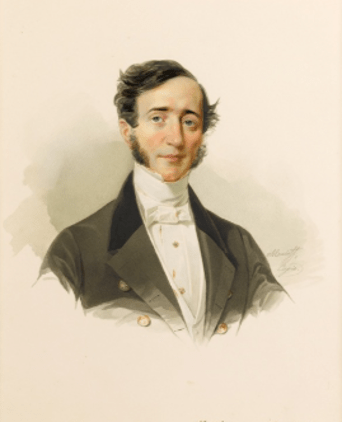
I made the acquaintance there of Mr. Behling, with whom I had a long and pleasant conversation about music. It was so funny to me when he approached me – a man I did not know at all, and yet of whom I had already spoken so much; I could not restrain a smile. Caroline also rode back with me; when we arrived home, I found Aunt Louisa had already returned from the Cankrins’ ball (Cankrinschen Ball). I wore my new dress of mousseline de laine for the first time. I was very glad that the evening (Soirée) took place and that I was able to go, as it seemed to give them much pleasure; I brought her a beautiful collar as a gift.
3rd, Wednesday.
Rose a little late; the weather is still the same; truly, it seems as if it [such weather] will not end at all this year. Overcast all the time, a thaw, [but] today the bridge still stands. The Neva is free of ice. In the evening we were alone; Tamburini gave me a lesson.
4th, Thursday.
In the morning I wrote home very diligently. At 9 o’clock, after breakfast, Tamburini arrived, but again I could not take my lesson: the cup [of patience] overflowed (das Maas war voll), and I shed tears; the separation from my dear family, etc., all this overcame [washed over] me, and moreover it is so impolite to skip [the lesson] – I found it unpleasant. We went for a walk; the weather was quite fine, it seemed to be freezing slightly. Grandmamma and Aunt Minna dined here; the fur coats from Paslep arrived. In the evening they went to the ball at the Vorontsovs’ (zu Voronzofs); Louisa looked quite advantageous. Grandmamma stayed with us for another half hour, and then they departed, and we immediately retired to our rooms. I finished my letter to Helene and went to bed at 1 o’clock [in the morning]. I had not yet fallen asleep when the others returned home.
5th, Friday.
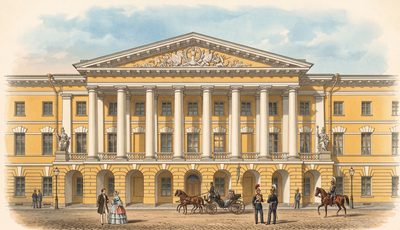
Sent my mail in the morning. From 10 to 12 o’clock the Chevalier Guard Regiment (die Chevalier Garde) conducted exercises, and beautiful music played; the weather was better, as it had frozen a little. After breakfast we went for a walk with Aunt Louisa along the embankment (am Quai), where it was completely dry. The Neva is still free of ice. After a very pleasant walk, where we were quite invigorated, we [returned] completely tired, it had already grown quite dark; I was sitting in my room and changing my dress when suddenly a tall woman entered, who mistook me for Helene and asked for Aunt Louisa; by her muff I realized that standing before me was the General’s wife Klüpfel; I announced her to Aunt Louisa, and she conversed with her in the meantime. She stayed with us for dinner; I must say that she did not seem as striking [outstanding] to me as I had thought. She was so kind as to prepare a syrup of beetroot and sugar for me. At 8 o’clock she departed, and immediately after that General Grünewaldt entered and stayed quite late after tea; the young ladies (Demoiselles) spent the evening at Behling’s.
← Read November, 1841 | To be continued →
Begun around May 1, 1841, at her parents’ estate of Paslep, completed around March 1, 1842, in St. Petersburg *. The discoverer of this document and the author of the detailed commentary on the text is the historian Sergei Gavrilov
December 1841
* Hover over the bold text to view the commentary. On mobile devices, press and hold your finger on the highlighted text while reading the commentary, then release.
6th, Saturday.
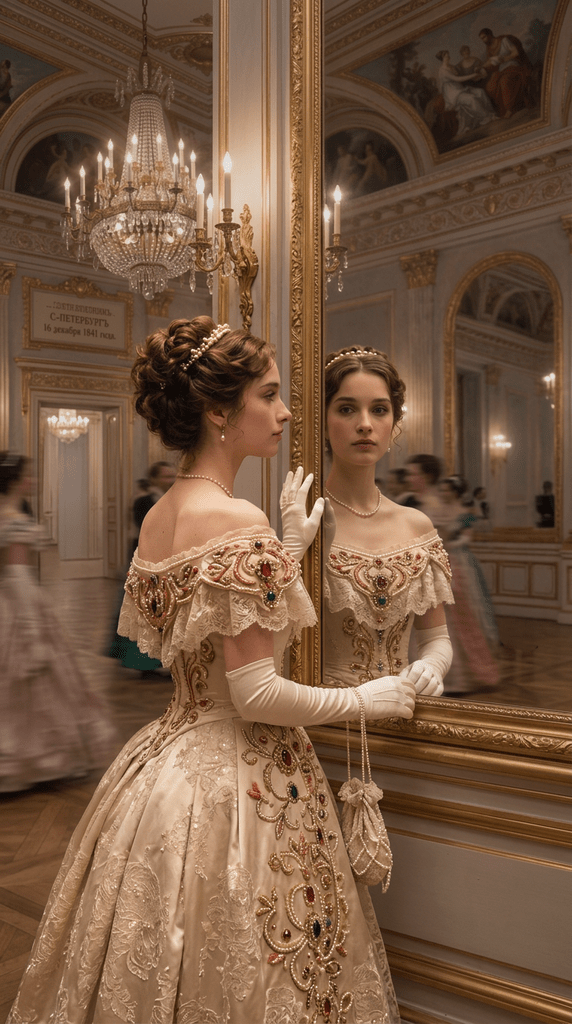
I rose early to complete my toilette before Aunt Louisa needed the maid. For I was to set off for the Palace (Palais) to see the festivity; Aunt Minna came for us in her carriage, and at 11 o’clock we arrived at the gallery, in a rather empty hall, which, however, soon filled with ladies whose magnificent outfits dazzled me (éblouit – Fr.); military men and high officials squeezed through the crowd to take their places. One could hear the heralds presenting [illegible]… pacing back and forth, until at last silence fell, and [there appeared] pages, ladies-in-waiting, and kamer-junkers, and behind them – the Emperor and Empress, the Heir to the Throne with his spouse, and Elena Pavlovna, Maria, Alexandra, Olga Nikolaevna, Maria Mikhailovna, and the Princess of Oldenburg. Then everyone proceeded into the church. And we too had the happiness of being present for the entire Mass; from our windows we could not see the ladies of the high family, but the Emperor and Grand Dukes – very well. From there we went to the gallery again to watch the entire procession on its way back. The ladies remaining in the hall all made a deep curtsy (révérence – Fr.). And then we departed; Aunt Louisa and Louisa remained there for the grand ball (bal massé – Fr.). All this brought me immense pleasure, as one can hardly [imagine] all this pomp, magnificence, and endless wealth without seeing it with one’s own eyes. Louisa in her attire was the loveliest of all, with her pearls (perles), corals (arbousiers), and cabochons (cabochons). The ladies there were absolutely covered in diamonds. Completely tired, I arrived at Grandmamma’s; an hour later, Aunt Louisa came for me in a droshky. Helene and Fr. Rüdiger went for a walk; I remained [at home], as it was very windy and 7 1/2 degrees of frost [Reaumur], [although] the air was magnificent. For dinner we had Robert, who stayed the whole evening until half past eleven. At the table I received letters from everyone in Paslep, which I read from beginning to end immediately after the meal. I was very, very glad of this. Tamburini had promised to come in the evening… but did not come. Also from Hamburg very joyful news: Pyotr And[reyevich] himself writes to Grandpapa, and the physician Balau to Uncle Pontus, that things are going surprisingly well. Thus the Lord has again put to shame [reduced to nothing] our faint-heartedness and disbelief, and shown that for Him nothing is impossible.
Sunday, 7th.
In the morning I wrote a letter to Mama. Then Aunt Louisa read us a beautiful sermon, after she had already read the Gospel at the coffee table when everyone was gathered. After breakfast we went for a walk; the weather was magnificent: it was freezing, the sun was shining. The Fontanka was covered with ice, the bridge removed, and the ice was running strongly down the Neva. When we returned, I sang a little; Louisa accompanied me. Louisa had a very bad stomach, and it was unclear whether she would go to the court ball (zum Ball bei Hof) in the evening. For dinner we had Grandmamma, Aunt Minna, and Woldemar Knorring. After the meal we made music. Since Louisa had not put on her ball gown at all, it was decided [for her] to remain at home, which I regretted very much, as I had so much looked forward to seeing her once at such a grand ball. With difficulty Uncle Pontus obtained only two tickets. And so around 8 o’clock I departed from here with Aunt Minna. We drove up to the Commandant’s [entrance of the Winter Palace] (Comendansky) and went to the gallery, where there were already quite a few people. The hall was in the greatest disorder. The chandeliers and all the candles were being lit. Servants were running back and forth, the parquet was still being polished, until finally everything was put in order. The lighting was dazzling. At all the doors stood noble Palace Grenadiers (Pallast-Grenadiere) and Moors (Mohren). The first gentlemen to come out were the grandees Count Chernyshev and Prince Volkonsky. From all the doors people entered, and in barely half an hour the parquet was filled; they walked and talked, the military in particular were very numerous. Finally, a bell rang, beautiful music by Lyadov (Liadof) sounded, and the Imperial family entered; the ladies all stood to the right of the door. And soon the polonaise began, which lasted quite a long time, for they passed by us at least 8 times.
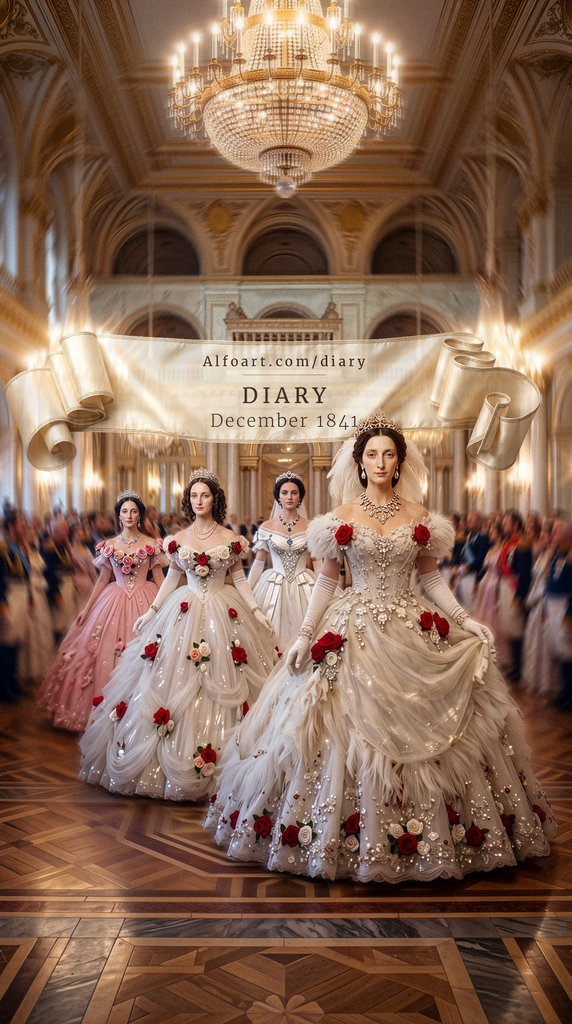
But as we stood at the other end of the gallery, very far from the Imperial family, Aunt Minna was so kind as to procure me a beautiful place right opposite the Imperial family, where they stopped most often during the dance. And the outfits (toiletten) were as follows: The Empress – [in] white satin (weiß atlas) with a wide marabou trimming (marabous), falling on both sides and decorated with red roses and strewn with the most magnificent solitaires, as well as the entire waist, and in every flower cup [on the dress] – a solitaire. On her head a diadem with diamonds, on one side hung two marabou [feathers], on her neck a necklace of diamonds of incredible size; in short, it is hard to see a richer and more tastefully chosen outfit. The Tsesarevna – in white, decorated with white roses. In the flowers – diamonds, on her head also a diadem of diamonds, the waist is strewn with diamonds. Roses are woven into her hair, and solitaires sparkle in the flowers. Maria Nikolaevna – all in white, the dress trimmed with white ribbon, a diadem of diamonds, the waist and dress in front strewn with diamonds. On her neck a necklace of diamonds with one large blue stone, the gloves [sleeve trimmings?] also trimmed in blue. Olga N[ikolaevna]: a pink [dress], on her head a diamond diadem, on the side a pair of pink roses. On her neck a necklace of diamonds, on the dress roses with diamonds. Alexandrine: dressed in pink, curls, and a garland in the shape of a diadem made of roses with leaves; on her neck a necklace, which hung down quite long, of diamonds, and on the flowers on the dress also diamonds. Elena Pav[lovna]: a white [dress]… in the shape of an apron, pink, at the top around the waist, as well as the entire waist in front, is completely strewn with diamonds; a similar necklace of diamonds and dark stones, as well as bracelets (bracelets). Entirely on one side, a wreath of pink and white roses, and 2 pink marabous hung down, on the front of the dress also pink marabous. Both of her daughters [dressed] very simply: one in white, the other in pink, very sweet, but not beautiful. The Empress danced only the polonaise, the Tsesarevna only one française, Elena Pav[lovna] did not dance either, the rest [danced] quite a lot. Maria possesses an extraordinary bearing [dignity], her features are very regular, a superb neck, such as I have never seen, and Imperial posture. Olga is a blonde and of incomparable beauty; Alexandrine– a brunette, very lively and graceful (gracieuse); the Tsesarevna has less bearing, but a superb figure, beautiful dark eyes, not a [very] beautiful nose, but overall [looks] quite pleasant. After we had [watched] 5 contredanses and waltzes, in which the high family took no part, we departed. I paid little attention to the rest of the public; the outfits were generally beautiful; 2 contredanses were danced simultaneously, and the Grand Duchesses danced vis-à-vis. The Heir to the Throne did not dance at all, [and the Duke of] Leuchtenberg turned out to be an astonishingly handsome man. When we returned home, Aunt Louisa was still awake. I was very tired and lay down immediately, but forgot to blow out the candle; I did it only in the night when I woke up, which gave me a terrible fright.

Monday, 8th.
The weather is very fine. On this day a grand dinner party (dîner) was to take place here, and I had a great desire to rid myself of this meal; everything here was foreign to me, and I am so shy (geniert). Aunt Louisa guessed my wish. She presented me with a box for “The Jewess” (zur Jüdin); only at 4 o’clock was it decided that we would get the box and could leave. In a great hurry I dressed together with Fräulein Rüdiger, and thus the three of us went to Grandmamma’s for dinner, where Mr. Behling, who was very amiable, also dined. We went there without gloves and bought them for ourselves at Becke’s (bei Becke). After the meal we went to the theater. The Bolshoi Theatre (Das große Theater) was completely occupied, not a single empty seat. The music is very beautiful, the scenery is superb (superbe), [but] overall very noisy (lärmend). Mr. Versing, who has a beautiful bass, sang very well; he played the Cardinal; Breiting, of whom I had heard so much and who has made much noise here, possesses a tenor, but shouts so terribly that one’s ears ring; he is very large and fat, and therefore has a great deal of strength for shouting. The female voices I found poor: Demoiselle Neureuther and Madame Mathies, who also shouts terribly. [But] overall everything pleased me very much. Madame M. plays Sarah, and Neureuther the Emperor’s niece. A very interesting opera; Andrianova (Andrianoff) performed a pas de deux. She dances with very great grace (grace) and confidence; Mademoiselle Schelfacht also dances, a girl of 16, very pretty, a charming little face and supreme grace. In the fourth act Mr. Versing and Mr. Breiting sang a duet, very, very beautifully; we left before the end [of the performance], as in the 5th act there was still to be a lot of shouting and [grisly] spectacles, as Mr. Behling told us, who was with us. We rode to Grandmamma’s, drank tea there, and returned home only after 12 o’clock. Aunt Louisa was already lying in bed. Louisa came to us in her nightgown, and we chatted a little; she told of her dinner party, and thus we went to sleep. This time I did not forget to blow out my candle, but I was very tired.
Tuesday, 9th.
In the morning I finished my letter to Mama and sent it off, then wrote a long letter to Elvira. After breakfast I practiced a little; at 4 o’clock Aunt Louisa and I walked a little. After the meal I sat down next to Fräulein Rüdiger, who was embroidering her handkerchief; we spoke of this and that. Finally the social talk (conversation) became serious, and we spoke of death; it is striking [terrible] how often I now have the opportunity to speak on this subject. She said that the main thing is a clear conscience; I cannot convey how such statements surprise me. When one is oneself so deeply convinced of the truth of what one believes, one wishes to impart this conviction to everyone; ah, and it is such a blissful feeling to realize that the Lord has already allowed us to know the truth. Such is the case with me; at least, I experienced an inner joy when I saw that I have a more correct understanding in this regard; we spoke further, but it seemed that she did not entirely wish to believe what I was telling her. Only the Lord Himself is capable of this, and may He deign to open her eyes. In the evening we were alone; I waited for Tamburini all day, but in vain.
Wednesday, 10th.
In the morning my considerable occupations: read and wrote; it snowed all day, so there was no question of a walk. As Tamburini again did not come in the morning, I wrote him a note, but just as I was about to send it (around 2 o’clock), he arrived, and after a long break I took a full lesson. When I entered the study after the lesson, Aunt had Madame Diekoff with her – a very sweet little woman; although she is 40 years old, she looks 25. When it grew dark, we all walked through the rooms. In the evening we were alone, and it too passed very pleasantly.
Sophie plunges headlong into the most dazzling place in the Russian Empire – the Winter Palace! First, she watches the solemn procession of the imperial family, and the next day she attends a luxurious court ball. The diary turns into a veritable 19th-century fashion magazine: with delight and incredible detail, Sophie describes the outfits of the Empress and the Grand Duchesses, literally strewn with solitaires, marabou feathers, and garlands of roses. Sophie visits the Bolshoi Kamenny Theatre to see the fashionable opera “The Jewess.” Her theatrical reviews are magnificent: she admires the grace of the ballerinas but mercilessly criticizes the visiting German tenor, who “shouts so terribly that one’s ears ring.” And how touching, against the backdrop of all this palace pomp and theatrical passion, sound the simple anxieties of a young girl: the long-awaited news of her uncle’s miraculous healing, the resumption of lessons with the elusive Tamburini, and the nocturnal panic over a forgotten, unextinguished candle!
11th, Thursday.
.jpg)
Snow fell and it froze; in short, it finally became a little better, which had been sighed for so long. In the morning I wrote a letter to Emilia; after breakfast Aunt Helene and I took a very pleasant walk, first along the Grand Embankment (am großen quai), and then along Liteyny Prospect (in der Liteina). On the embankment we met the Empress with the beautiful Olga Nikolaevna. For dinner we had Grandmamma and Aunt Minna; they stayed until 12 o’clock. At half past 7 Tamburini arrived, and I took my singing lesson; never before had I laughed so much during a lesson as on this day: he was in such a good mood and so amiable, he stayed for more than an hour and a half. I amused myself very much with him this evening. I was singing Bordogni’s 4th exercise (Bordogni), and at first I simply could not catch the beat. For tea General Prittwitz arrived, who spoke a lot of empty words [boasted] (schwadronirt) rather a lot.
Friday, 12th.
In the morning I finished my letter to Mama and sent it to the post. After breakfast, Aunt and I went for a walk; Louisa also came with us, but soon turned back, as she had a terrible cough and it was windy. We, however, took a very pleasant walk; when Aunt had escorted me home, she went to Princess Vyazemskaya, whom, however, she did not find at home. Meanwhile Mademoiselle Berg was here; I was introduced to her and had to sing for her; I cannot say that she pleased me. In the evening we were entirely alone; Fr. Rüdiger had not been here for the second day; she had gone to her sister’s to be together with her brother these [days]. Behling came in the evening to give a clavier lesson. Fr. Rüdiger returned home in the evening very [illegible].
Saturday, 13th.
I rose early in the morning, as Tamburini was to come either in the morning at 9 o’clock or at 1 o’clock, but he did not come; after coffee I practiced. Aunt Louisa wished to take me with her to Vasilyevsky Island (Wasily-Ostrof), but I deemed it better to stay and wait for my lesson. Shortly before Aunt L. left, Eulalie Kriloff arrived, who stayed quite a long time; she also told me that Hermann Maydell had died. After breakfast she left, and only at 2 o’clock did Tamburini arrive.
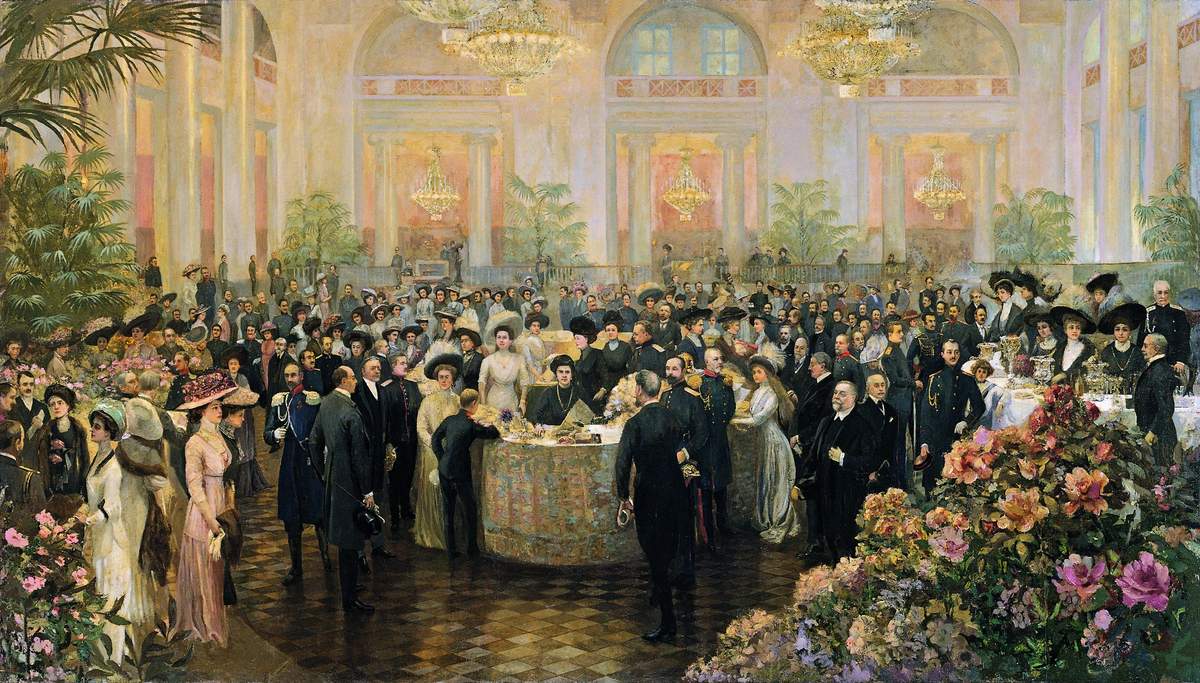
I had tired myself out so much (fatiguirt) during the morning [while practicing] that I could not withstand the entire lesson. After the lesson I spoke a little with Charles and then rode with Louisa in a closed carriage to the shops [Gostiny Dvor] to buy myself some gros de Naples (gros de Napel) for the lining of a bodice, as the Assembly of Nobles’ Ball (adlige Ball) is to take place on Tuesday, and Aunt Louisa wishes me to go there; she presented me with a very beautiful dress of crepe. I also bought everything for needlework at the Cosmetic Shop, for Emma Knorring’s lottery. For tea, Stenger arrived; after he left, we all still paced the rooms [back and forth] for quite a long time. Aunt Louisa spoke much of court life (Hofleben) and her attitude toward it; due to the mourning, they skipped today’s ball at the Procurator’s wife Weymarn’s. I was in a particularly serious mood today; ah, this day awakened painful memories in me. Ah, what a heavy day this day was for us a year ago, yes, to this day the heaviest in our lives; what days full of fear and pain those were for us all, and yet a faint hope still flickered in our souls, until finally everything ended, and we were left only with the pale dead body of our dear sister. But the mercy of the Lord was great, infinitely great; He miraculously helped us to bear even this deep, deep pain.
Sunday, 14th.
At the coffee table, Aunt Louisa, as usual, read the Gospel, then we went to the pastor [to church]. Moritz, in his manner, read a quite beautiful sermon, but for me there were too many beautiful phrases [and] too little for the heart; [however] the beautiful singing and the organ edified me greatly. On this day I was particularly moved; I prayed constantly for my dear, dear Mama: what a heavy day this was for Mama; I missed her very much, for the Lord alone is able to comfort and strengthen!! – Robert, who had just arrived from Pella (Pella), was also in church. After breakfast I sat in my room, worked, and secretly shed tears, as I experienced deep sorrow and pain. Before the meal we went for another walk; for dinner we only had Robert, who immediately after the meal departed again for Pella. This was the first Sunday that Grandmamma did not dine here; she was at Ivan And[reyevich]’s, who was unwell. The evening, although we were alone, passed quickly and pleasantly, with work and chatter. However, A[unt] L[ouisa] felt quite unwell and went to bed early; both cousins were also at home. The weather is very fine; it froze a little, but there is almost no snow left at all, almost nothing but wheels are to be seen (Räder).
Sophie’s capital life continues to gain momentum, and her chance encounters on the St. Petersburg streets become ever more impressive: during a walk along the embankment, she and her aunt run into the Empress herself and the beautiful Grand Duchess Olga Nikolaevna! The young woman actively prepares for the upcoming brilliant Assembly of Nobles’ Ball, traveling in a closed carriage to the Gostiny Dvor for fashionable “gros de Naples” silk fabric for a new dress. Her vocal lessons with the world-famous Antonio Tamburini bring increasing joy: the maestro stays for an hour and a half, and they laugh heartily over Sophie’s inability to catch the beat of the complex Italian vocal exercises. However, behind the outward glitter of the salons, the visits of boastful generals, and the discussions of court life lies a deep, hidden pain, a heavy and tragic date for the family, forcing Sophie to secretly shed bitter tears in her room and mentally transport herself to her grieving mother at their home estate.
Monday, 15th.
The weather is quite fine. After coffee, I practiced, then the usual occupations. Fr. Rüdiger was still quite unwell and lay in bed all day. After breakfast, Aunt Louisa, Helene, and I went for a walk; Louisa stayed at home because of her cough. We walked the entire Liteyna (die Liteina) to the Perspective (Perspective), where we gawked a little [window-shopped?], as we bought… [illegible]… [and] went back the same way; it was a walk lasting more than 3/4 of an hour. For dinner Madame Meybaum was here; the evening passed quite pleasantly. Before tea, a doctor and Mr. [illegible] came to see Fr. Rüdiger; Madame Meybaum left only after 11 o’clock.
Tuesday, 16th.
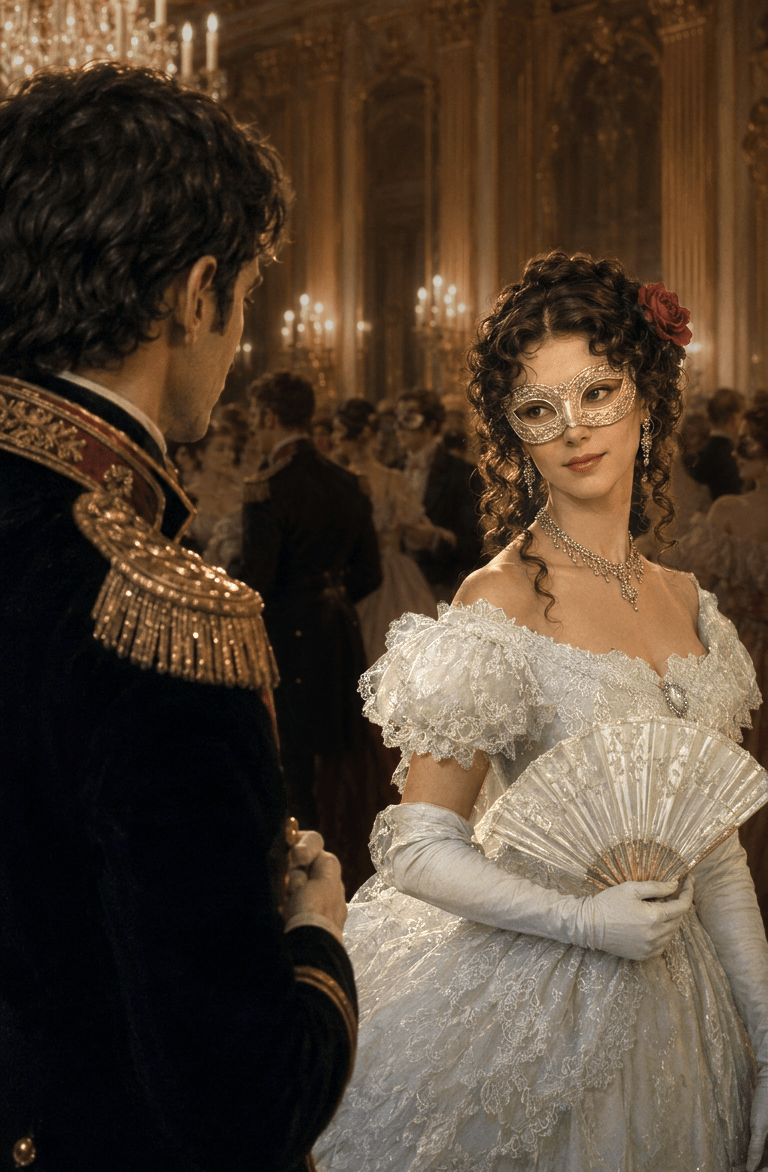
The weather is quite fine. In the morning I wrote a letter to Mama and tried on my ball gown; I lacked white ribbon and shoes, so even before breakfast I rode to the shops [Gostiny Dvor] and to Grandmamma’s; from there Minna set off [marched] with me on foot to Millionnaya Street (in die Milona), where I bought myself a pair of very good shoes, then to the straw-hat maker, [bought] cord… for the dress. Due to a mix-up (durch eine confusion), Aunt Minna [sent/received] my letter, which I had written to her on Sunday evening, only on Monday evening; it also contained a letter to Tamburini, which is why he did not come on Monday. At half past two I returned home, had a little breakfast, and, after I had… [changed?], freshened myself up a little for dinner; after the meal I paced the room with Louisa [until] half past 3. She told me much about C. [Carl?] in particular; Uncle Pontus was also here [and] said it was time to dress. My outfit (toilette) was as follows: white crepe over white silk, and the neckline trimmed around the neck and sleeves with wide genuine lace; a beautiful parure (parure). Very beautiful long curls and a single red moss rose (Moosrose) on one side. The outfit looked so good, and [someone?] regretted that I had dressed [?]…
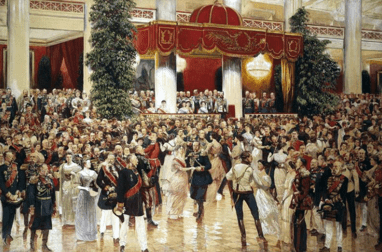
At 8 o’clock we drove to the famous Assembly of Nobles’ Ball (adligen Ball); Louisa had to stay behind due to her cough. A beautiful wide staircase leads upstairs; on the landing, a huge mirror, before the door a porter (Schweizer); one enters a rather large quadrangular room, on three sides, between the mirrors and doors, stood candelabras.
To the right, a door led to the buffet (bouffet), which was already lit and completely… From there we entered another small room, then into the hall. A magnificent room, around the hall on both sides galleries; along them long benches upholstered in red cloth, in three rows, one higher than the other. All this produced a highly imposing (imposanten) impression. The hall was still almost empty when we… …entered, but it filled up very quickly. At half past 8 the music began playing, and the Imperial family began with a polonaise, then danced 3 françaises (française). Aunt Louisa stood up, and we moved closer to the dancers.
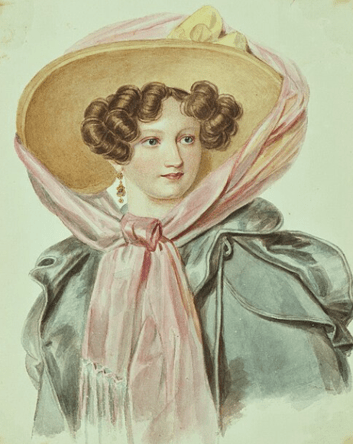
#/media/%D0%A4%D0%B0%D0%B9%D0%BB:Olga_Nikolaevna_of_Russia_by_C.Robertson_(1841,_Hermitage).jpg)
During the first quadrille I stood next to Grand Duchess Olga, who can rightfully be called the most beautiful [or: a swan]; opposite her danced Maria Alexandr[ovna], and next to her – Alexandrine. During the second française the Emperor and Grand Duke stood next to us; after the third française a waltz struck up, but no one from the Imperial family waltzed.
The place where the Imperial family was located was a sort of box; behind were also seats decorated with flowers; the Empress sat there and watched with a smile as the Grand Duchesses danced. In general, she was in a very good mood and very welcoming. She was in white embroidered with gold; both Grand Duchesses [Olga and Alexandra] – in pink; the Duchess of Leuchtenberg [Maria Nikolaevna] – in white with dark velvet and diamonds in her hair.
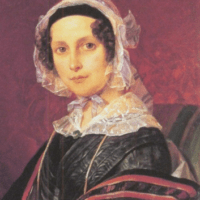
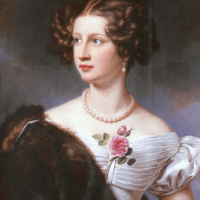
The Tsesarevna [Maria Alexandrovna] – in pale blue, with a similarly dark hairstyle (coiffure). I was generally pleased to see ladies from high society, such as, for example, Madame Sukhozanet (Souchasonets), Mary Golitsyna (Merry Golizin), Mademoiselle Mezentsov (Mesenzof), Madame Krüdener (Mme Krüdner), who is indeed very beautiful, Madame Zakharzhevskaya (the surname is written in Russian letters – S.G.) Madame Vorontsova and very many of these ladies, unfortunately, to my great regret, were not there. Alexandrine I saw from afar. Among the ladies of high society (haute société) there were few [acquaintances?], and those who were there did not distinguish themselves by their beauty. Madame Salavoy [?] [was considered] so beautiful, [but] we found her not in the least beautiful, very plump and moreover somewhat large; Sophie Rehbinder was quite pretty. I was also very glad to see the beautiful General’s wife Albrecht. Madame Uglinskaya was also there with her daughter; but I find the Madame so ugly and so vulgar (ordinaire) that I do not understand how one can court her so heavily (die cour machen), and what so attracts the gentlemen to her; and this fat woman danced quite a lot.
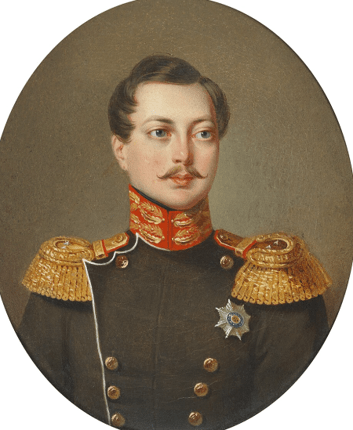
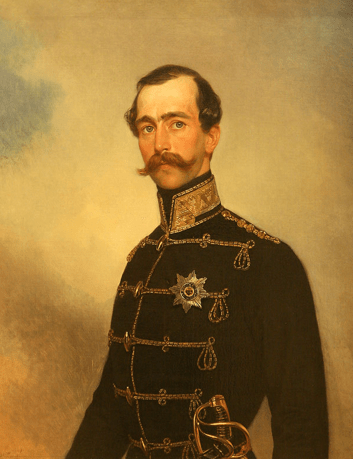
The Heir to the Throne [Alexander Nikolaevich] and the Duke of Leuchtenberg stood before us for a long time; the former I saw so closely and so long for the first time. He truly has a very pleasant, welcoming face; he is rather plump and pale, I like him very much; the Duke is incomparably more handsome; both were dressed as hussars. I examined everything very attentively, and it entertained me greatly; I walked with Aunt Louisa until 12 o’clock, then Uncle wished to leave, and I was ready, as I was very tired.
As we were leaving, we passed very close to the Emperor, the Grand Duke, and the others. The Emperor was speaking with Mr. [illegible], the Austrian ambassador; on the stairs we met Mr. Perier, the envoy of France, a very handsome man, who greeted me, which I was very glad of, as I thought he had departed long ago.
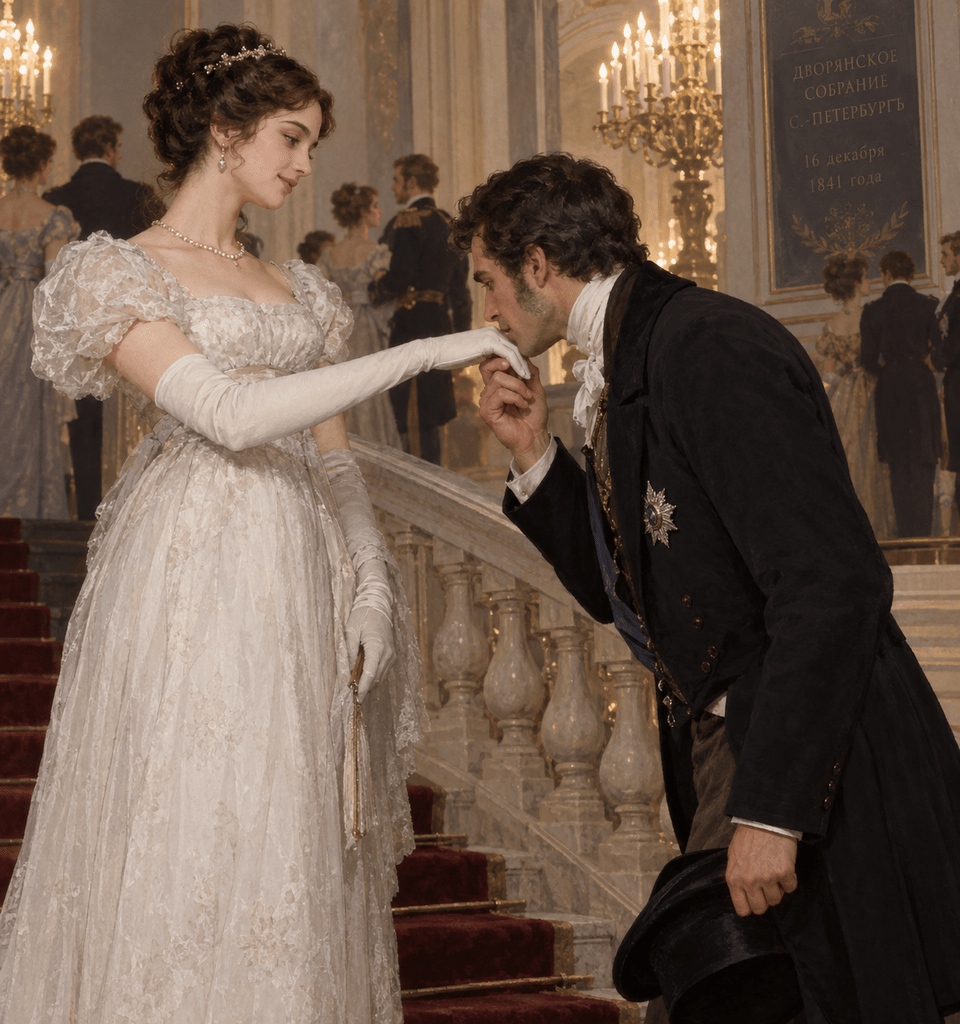
17th, Wednesday.
Spent the morning as usual; after the dinner meal I walked a little, in the evening we were alone.
18th, Thursday.
In the morning I wrote very diligently to Mama and Helene. Before breakfast I took a singing lesson, [which] out of old habit, turned into a very pleasant social chat (conversation) with Tamburini; I gave him 100 rubles for [the lessons], which I borrowed from Aunt Louisa. After breakfast Aunt Louisa [rode] to the shops [Gostiny Dvor], while I went with Helene for a walk, and we had the joy of meeting the beautiful Olga Niko[laevna]. Fräulein Rüdiger suffered greatly this day: her throat almost completely closed up, and a gargling liquid had to be syringed into her throat, which I took upon myself; in the evening the abscess burst, and she felt much better. For dinner Grandmamma and Aunt Minna were here. In the evening we worked diligently.
19th, Friday.
In the morning I dispatched my letters. Fräulein Rüdiger felt better, and she left her bed. Even before breakfast, Aunt Louisa went to the shops again, and we went for a walk. For dinner here, after the meal, General Grünewaldt arrived, very amiable as is his custom, but how long… [when] Mr. Behling had his clavier lesson, General’s wife Richter arrived with her whole family, consisting of 2 sons and 1 daughter; Natalie, while not at all beautiful, has a quite pleasant face and manners. Grünewaldt soon withdrew, and Konstantin… I have never met such a nasty young man; nothing amuses him, [illegible]…we worked diligently, then made music. Natalie played quite sweetly, Carl and …[illegible] danced a galop; we were very tired and laughed much. Following this, I… [illegible] Mr. Behling stayed for the whole evening. We conversed about such interesting things; he spoke to me in particular about his singing, and especially praised the loveliness of my voice; they stayed here until 12 o’clock.
20th, Saturday.
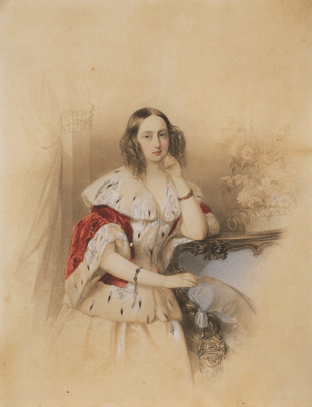
Spent the morning as usual; after breakfast I went with Helene for a walk. Aunt Louisa was still ill, and we had… [illegible] Then we walked along the Embankment (am Quai), and I again had the joy of seeing Grand Duchess Olga. She truly is my ideal of beauty… In the evening we were alone. I waited for Tamburini, who, however, unfortunately did not come.
Sophie’s capital life definitively turns into a dazzling fairy tale, where during an ordinary walk one can easily encounter the Empress and the beautiful Grand Duchess Olga Nikolaevna. Preparation for the main event of the season – the famous Assembly of Nobles’ Ball, requires hasty trips in a closed carriage for expensive “gros de Naples” silk and luxurious lace. The climax is the ball itself: Sophie finds herself at the very epicenter of splendor, standing in the hall literally a step away from the dancing monarchs, the Heir to the Throne, and the foremost beauties of the empire. Even the strict Maestro Tamburini yields to the general animation: their vocal lesson turns into an hour-and-a-half fit of laughter because the pupil simply cannot catch the beat of a complex Italian vocal exercise. However, the main intrigue lies elsewhere: amidst this dizzying glitter, waltzes, and palace pomp hides a deeply personal tragedy, carefully concealed from prying eyes, forcing the brilliant debutante to secretly shed bitter tears in her room.
21st, Sunday.
I was in a great hurry with my [embroidered] coaster (Untersetzer) for Emma Knorring’s lottery and worked on it all morning; Aunt Louisa read us a sermon. For dinner we had Grandmamma; in the evening [we were] alone.
22nd, Monday.
Waited all day for Tamburini, who, however, unfortunately did not come; in the evening [we were] alone.
23rd, Tuesday.
The weather is very unwelcoming, as it was very windy; I sent my letter to Mama. After breakfast I rode with Aunt Louisa to the shops for some things; I went to buy myself a pair of boots. For a short time we dropped in, when it was already completely dark, on Grandmamma, who was very busy finishing her little gifts for Aunt Jette’s children. We returned home late; we were still trying on most of the [things]; my toilette (toilette) was not even completely finished when I came out for the meal; in the evening we had General Prittwitz.
24th, Wednesday.
The air was still infinitely [illegible] and unpleasant. Even before breakfast we rode out with Helene and Aunt Louisa to buy the very last things. A terrifying multitude of carriages crossed the Perspective (Perspective) in all haste, driving and walking intermingled, which made a very special impression on me. First we stopped at [illegible] to buy something for the Christmas tree (Weihnachtsbaum); from there I popped in to Grandmamma’s for a minute, then we drove to the English Shop, and at the Russian shops [in the Gostiny Dvor] Aunt Louisa got out very often, while we remained sitting in the carriage for half an hour at a time: surprises were probably being bought for us (Ueberraschungen). Aunt Louisa bought [pastries?] to treat us (regaliren); we were very merry and laughed a great deal; we reached home rather late. For dinner we had Woldemar Knor[ring]; after the meal we decorated the Christmas tree (Weihnachtsbaum) for Masha’s children; both grandparents [Grandpapa and Grandmamma] were also here, then we were sent into the study, and half an hour later, when we came out [from there], everyone found beautiful presents before them. I received a beautiful brown silk dress from Uncle Pontus, and a psalter, a collar, and a purse [portemonnaie] from Aunt Louisa. Very beautiful gifts. General Grünewaldt dropped by for a minute; [also present were] General Klüpfel, Stenger, Robert; it was a very pleasant evening. Late in the evening I wrote a few lines to Mama: this is the first Christmas Eve (Weihnachtsabend) that I spend without my dear parents; in my thoughts I was very much in Paslep – next to my dear [family].
25th, Thursday. [Christmas]
Rose very early in the morning, drank coffee alone with Helene, and rode to Nielsen at the church, where he read an absolutely magnificent sermon. The text was about [how the Lord] had to save us, and how He, by the will of the Father, decided [to send] His only begotten Son into this corrupted world. I have never heard a more beautiful sermon from Nielsen. The church was very full; I spoke there with Lenchen Furm[ann?]. Soon after we returned home, Louisa arrived from the Palace (Palais) and after breakfast told us a great deal about it. Robert breakfasted with us. I received a letter from Tamburini in which he informs me of the sad news that he has lost his little son; I took this news very much to heart; we also spoke of the vision that Julia Steinbach had a year ago. For dinner, Grandmamma and Aunt Minna were here, as well as Nikolai and Robert. After the meal, Aunt Jette arrived with her two daughters, and soon after that General Diekhoff with his wife. I was very amused this evening, watching Helene and Nikolai together.
On these pages, the genuine Christmas bustle of 1841 St. Petersburg bursts into the diary! Sophie describes the incredible pre-holiday traffic jams on Nevsky Prospect (the Perspective), where high-society carriages and pedestrians mingled in a pre-New Year fever. We witness touching holiday traditions of the time: secret shopping (Auntie constantly disappears into the shops of the Gostiny Dvor for “surprises” while the girls wait in ignorance in the carriage), the communal decorating of the Christmas tree, and a cozy Christmas Eve at home.
But behind the glittering facade and expensive gifts lies a quiet sadness – this is the first Christmas that Sophie celebrates far from her parents. And as always, capital life is closely intertwined with drama. In the morning, cousin Louisa returns with fresh impressions straight from the Imperial Palace, while the world-famous Maestro Tamburini, instead of a lesson, sends a letter with news so tragic that it breaks Sophie’s heart right in the midst of the holiday. However, the tears of youth dry quickly; by evening, our heroine is watching with undisguised pleasure the amusing romantic flirtation among her guests!
26th, Friday.
Helene and Louisa went to church to Bese (Bese), while I preferred to read aloud a beautiful sermon by Hofacker to Fräulein Rüdiger; after breakfast I did my hair (coiffeirte ich mich) and changed my dress to come here to Grandmamma’s; Louisa brought me. It seemed dear Grandpapa and Grandmamma were very glad. There were quite a few [guests] for dinner there: Aunt Jette and Ovander, Madame Ovander with her daughter, Madame Bacheracht and Georg, Madame Amburger, Annette and Ivan Andreyevich, Mr. Krüger, and several other elderly people; I amused myself very much. After the meal the ladies did needlework; later Aunt Louisa arrived with the young ladies (Demoiselles), we made a little music, Emilia B[acheracht] played very sweetly; after 11 o’clock we departed.
27th, Saturday.
The weather is quite fine, but I did not take advantage of it, as I was a little hoarse; on this day we were entirely in our own circle, it was a very pleasant evening.
28th, Sunday.
In the morning we went to Moritz [to church], Helene and I walked to the front and sat down; it was the last Sunday in the old year. Moritz spoke of this a great deal, in beautiful, touching words, which, however, did not fill my heart, and I returned home completely empty. The others, however, were in great raptures over the sermon. On this day I felt very unwell; I had a bad cold. For dinner we were alone; Grandpapa and Grandmamma were at Ivan And[reyevich]’s. After the meal General Grünewaldt arrived, who, however, left before tea, as the old General’s wife Klüpfel (Klupfeld) arrived here with her charming daughter Loulou (Loulou), and they stayed until 12 o’clock. The conversation was quite lively, and although the old woman is already 83 years old, she is still very vigorous (rüstig) and takes quite a lively part in almost everything.
29th, Monday.
On this day I felt very unwell. At 11 o’clock, as I sat at the grand piano (am Flügel) warming up my voice, Tamburini entered; it was very hard for me to take a lesson from him, he was still very shaken [by grief]; I [too] was too moved to be able to sing, and therefore the next lesson is to take place on Wednesday. When I entered the study, I found young Richter (Richter), who had also come up [to us] and stayed; he came to bring Aunt Louisa the sad news that his aunt Dmitriyeva (Demetrieff) had died.
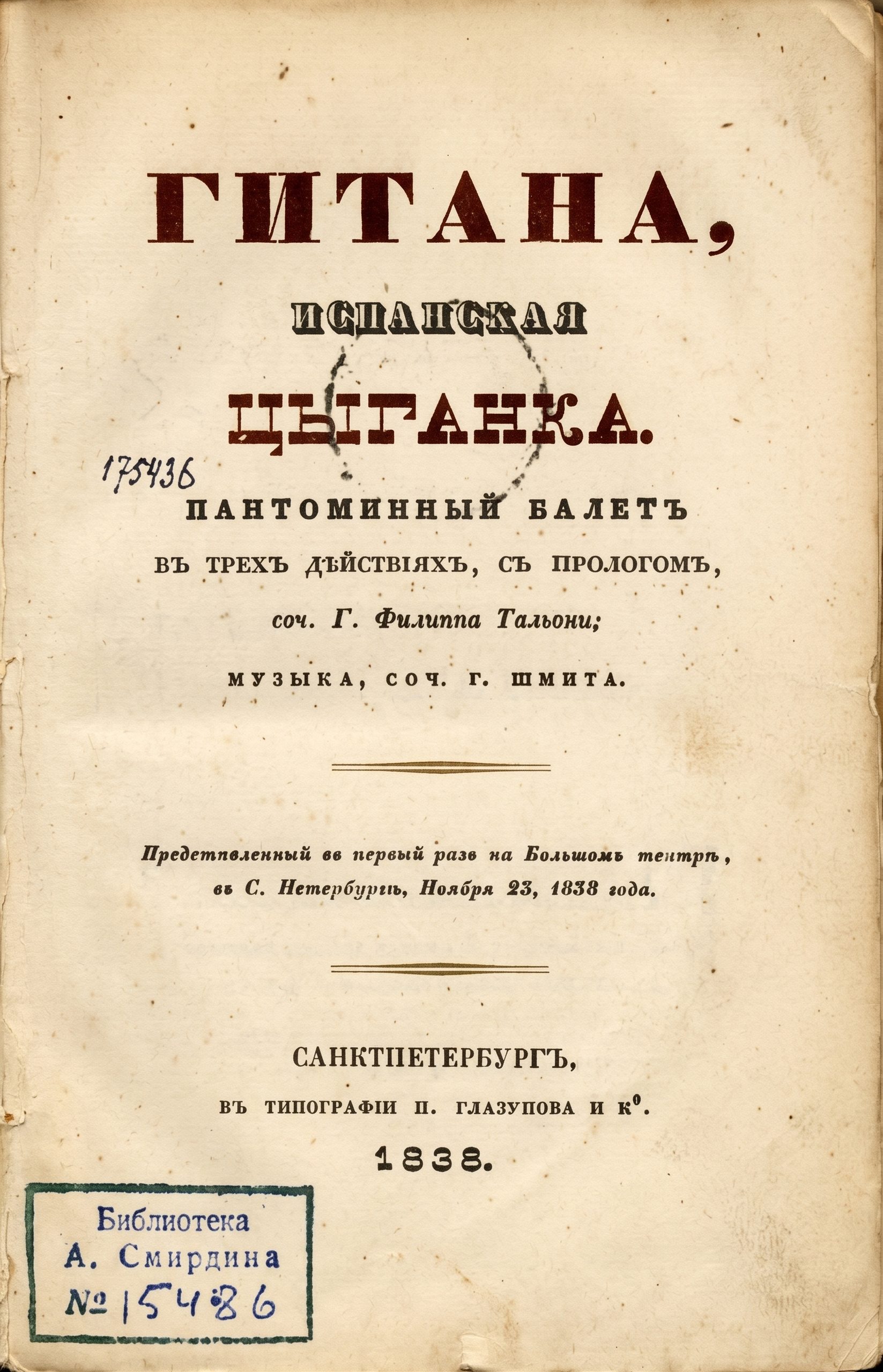
Everyone went for a walk; I stayed home. In the evening we were to [go] to the ballet to see “La Gitana” (die Gitana); as a box had been taken for my sake, I had to go, albeit reluctantly, since I was very unwell and had a cold, and a terrible runny nose besides. We did our hair (coiffirten uns) for the theater, as usual, before the meal; Louisa was already [ready], as she had changed [dressed?] in advance. At half past 4 an invitation unexpectedly arrived for that same evening to the Grand Duke’s (Großfürsten), which I was very glad of; however, Uncle Pontus seemed to find it quite unpleasant that the young ladies (Demoiselles) were not invited. A great commotion (confusion) arose, outfits (Toiletten) were [prepared], a [note] was written to Grandmamma, and she was so kind as to ride with us. The three of us rode together; at Grandmamma’s Helene moved into Grandmamma’s carriage (Aunt Minna was at Aunt Jette’s).
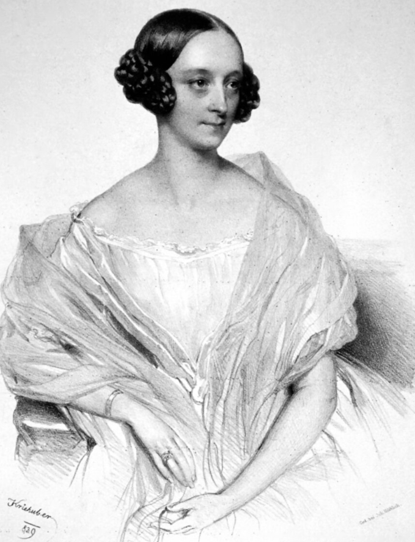
The Bolshoi Theatre was full; scarcely had we arrived when [the performance] began, and I must say that I have never seen such a lovely ballet! Taglioni (die Taglioni) is pure, charming grace; [and] a most lovely child appears in the first act; the 2nd act depicts a fair where Taglioni [in the role of] the Gitana dances; the 3rd act depicts a gypsy cave, the 4th – when she returns to her parental home; I was absolutely in raptures. But I was very glad when we reached home; I was almost broken and went to bed, as I could barely stand on my feet, so ill did I feel.
30th, Tuesday.
In the morning I finished my [embroidered] coaster and had quite a bad cold; my runny nose tormented me greatly. After breakfast Countess Toll was here with her daughter, and Landrat Grünewaldt; in the evening General Prittwitz was here.
31st, Wednesday. [New Year’s Eve]
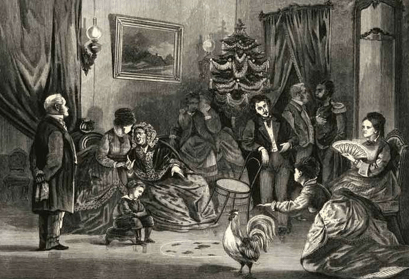
As this was the last day of the old year, old Grandpapa and Grandmamma were here, the Ovanders with Annette, and also Stenger. After the meal, the gentlemen sat down to a game (Partie), and the ladies to their needlework; Stenger smoked, out of old habit. However, this joyful game was soon interrupted by mummers [in masks], soldiers (maskirten Soldaten), who entered, sang, and acted out some comedy; this amused us greatly and made everyone laugh. After this we indulged in all sorts of amusements, which are only permitted on New Year’s Eve (Silvester Abend): for instance, we sent a servant out into the street with rings, and he was to ask passers-by their names; thus I received the name Peter, Louisa – Theodor, Helene – Gabriel, and D. Simeon. Then a hen [rooster] was brought in, we 4 young ladies (Demoiselles) sat in a circle, and without hesitating for a second, the rooster immediately came over to me and pecked my treat (Gabe). At half past 10, after we had all mutually bid each other a final farewell in the old year, everyone departed. Then we went into the study – we young ladies and Aunt Louisa. First she read to us from the Hymnbook (Gesang Buch), then from the “Treasury” (Schatze), and read the “Our Father”; we were all very moved, and I felt a vivid longing for my family. And so again a year, and a whole year has passed, with all its events and influences, external and internal. And the mercy of the Lord was great, very great: He preserved for me my parents, sisters, and all our dear [ones]; He did not lay heavy sorrow upon us, He guided us so lovingly, protected and guarded us from all evil and all misfortune, ah, and what have I done for Him in return for all this? Ah, my heart is still the same – fickle and wicked, indifferent and cold, unable even to [turn] properly to Him, my faithful and dear Savior; not once did I take Communion, sins accumulate day by day, and, as if in a dream, I pass from one day to the next. The Lord led me in a most peculiar manner this year; such strange and painful things I experienced. For a moment I believed that my lot [destiny] for my whole life was already decided, but suddenly the Lord overturned everything; it was not to be; [in a] moment everything collapsed (gieng anders nieder), that which I thought I had built dissolved. In any case, [I am grateful] for God’s guidance. For at first, when everyone was against Kursell (Cursell), I liked him. This lasted almost the whole winter and part of the summer; in August I refused him (gab ich ihm den Korb); barely eight days had passed after this when he fell gravely ill (schwer krank), and since then I have not seen him. Overall it was a surprising year, and I wish to record the main events. On December 30, 1840, was the funeral of dear sister. Margaretha and her father were with us. We saw in the New Year alone; Helene was unwell for several weeks. The time until summer we spent very quietly and solitarily; only occasionally did someone visit us; we went out for a whole evening only once, and that was the most painful affair with Reisenfeld. On St. John’s Day (Zu Johanis) we went for 3 weeks to Revel [Tallinn]. Then a few days by water to Killo [?], … we remained in Paslep (Paschlep), and we from there… Then came that extremely unpleasant time with Kursell; then followed the trip to St. Petersburg, Mama left, and I stayed with Aunt Louisa to take singing lessons. I am writing these lines in St. Petersburg, where I concluded the old year and began the new. May the Lord help me to pass graciously through this year as well.
St. Petersburg evenings are suddenly replaced by boisterous Yuletide amusements: on New Year’s Eve, singing mummers burst into the aristocratic salon, and the noble young ladies divine their future husbands by setting a real live rooster right in the middle of the room. High-society life continues to spring surprises: before a trip to the Bolshoi Theatre for a ballet with the legendary Marie Taglioni, the family has to hastily change their plans due to a sudden evening invitation to the Grand Duke’s. But behind the dazzling facade of the capital, genuine drama always lurks. Vocal lessons with Maestro Tamburini are interrupted by shared tears – the famous Italian is heartbroken over the tragic loss of his young son, and the impressionable Sophie sincerely shares his pain. The climax, however, arrives on New Year’s Eve. Summing up the departing year, the young woman finally musters the courage to entrust to her diary the truth about how her summer romance with Otto von Kursell actually ended. And here a real shock awaits us: the finale of this betrothal turned out to be far darker than described in the sanitized fair copy, and the life of the rejected suitor, it turns out, literally hung by a thread!
All article commentary
1. Chatting with the Maestro: Antonio Tamburini outdoes himself. Arriving to give a singing lesson and once again finding Sophie hoarse and nursing a cold, he doesn’t even try to pretend to be upset. He simply chats with her for half an hour about life and calmly leaves to go about his business.
1.2 Encounter on Liteyny Prospect: The entry from December 1st is pure delight! Sophie is walking in der Liteina (along Liteyny Prospect) and literally comes face-to-face with Grand Duke Michael Pavlovich (the younger brother of the reigning Emperor Nicholas I). He was known for his habit of strolling through St. Petersburg on foot without a grand retinue and was noted for his affability. The fact that he politely bowed to the young ladies he nearly knocked over is a perfect illustration of the capital’s mores at the time.
2. Hairstyle and Visits: The word coiffeirte (from the French coiffer – to arrange or style hair) reveals the young lady’s morning routine. Sophie is carefully preparing for a double celebration at Aunt Annette’s (a birthday and a wedding anniversary), which entails an elaborate hairstyle and an elegant day dress.
3. Mr. Behling: Heinrich August Behling (1793 – 1854) was a St. Petersburg pianist and organist, educator, choral conductor, and founder (1818) of the Singakademie choral society – the oldest German singing society in Russia. From 1824 to 1850, he taught piano at the Orphan Institute of the Imperial Foundling Home; in the 1830s and 1840s, he served as a music teacher to the Grand Duchesses, daughters of Nicholas I. He served as music director of the Petrikirche (from 1828?), and taught choral singing at the Petrischule (from April 1827). He held the post of organist at the Petrikirche from 1840 until his death.
4. Andrei Andreyevich (Heinrich August) Behling (1793 – 1854). Source – internet. The Cancrin Ball (Cankrinschen Ball): Aunt Louisa returns from a ball hosted by Count Georg Cancrin (Egor Frantsevich Kankrin) – the all-powerful Minister of Finance of the Russian Empire (from 1823 to 1844). His balls were famous throughout St. Petersburg, and to be invited meant belonging to the very apex of the elite. In M. Korf’s memoirs, however, there is an amusing anecdote that the only representative of St. Petersburg high society who did not attend the Cancrin balls was Tsar Nicholas I: “When the Emperor was asked if he would be at the ball, he replied: ‘Good heavens, don’t you know that the Countess cannot stand me; she would likely throw me out of the house.'” The Countess was the sister of a Decembrist, for whose fate she had written petitions, but the Tsar had not granted them.
5. Overcast all the time, a thaw – Sophie’s diary also serves as a weather log for the winter of 1841. From it, one can gather that the weather on December 16, 1841, was warm and unsettled, as sometimes happens even today.
6. Emotional Breakdown (“das Maas war voll”): The German idiom “the cup overflowed” perfectly describes Sophie’s psychological state on December 4th. Homesickness (missing her parents in Estonian Paslep), the St. Petersburg slush, and accumulated fatigue lead to tears right before the arrival of the global star Tamburini. Sophie is ashamed that she is “impolitely” canceling the lesson, but her nerves take their toll.
6.2 The Vorontsov Ball (zu Voronzofs): Another stunning society event! Louisa, looking her best, goes to a ball at the Counts Vorontsov’s. This refers to the ball hosted by Count Vorontsov-Dashkov in his palace on the English Embankment in St. Petersburg. Count Ivan Illarionovich Vorontsov-Dashkov (1790–1854) was a member of the State Council, Chief Master of Ceremonies at the court of Nicholas I, and a wealthy man. “The balls he gave were second only to the court balls. On the evening of a celebration, the Vorontsov-Dashkov palace-house presented a magnificent spectacle: on every step of the luxurious staircase stood two livery footmen; below, in white caftans, the Dashkov livery; on the upper half of the staircase, in red caftans, the Vorontsov livery. By ten o’clock everyone arrived and settled into the first two halls. When news arrived that the Tsar and Tsarina had left the palace, the Vorontsov-Dashkovs’ majordomo, the Italian Ricci, in a black velvet tailcoat, short velvet pantaloons, stockings, and shoes, with a sword at his side and a tricorne under his arm, nimbly descended the stairs and took his place at the entrance accompanied by two butlers; the Count positioned himself on the first step of the staircase, the Countess waited on the first landing,” etc. (Memoirs of Count V. Sollogub as retold by V. Veresaev source )
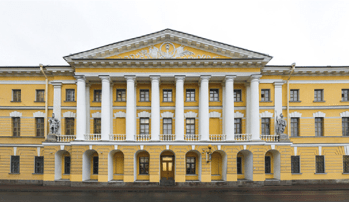
7. The Chevalier Guards (die Chevalier Garde): The entry from December 5th is pure St. Petersburg romance! Right under the windows of their house (or in the square nearby), the elite Chevalier Guard Regiment, the heavy guard cavalry, is conducting drill exercises. Such exercises were always accompanied by the playing of the regimental military band (“beautiful music played”), and ladies often admired them from their windows or during walks. Sophie lived with Uncle Pontus, who had an apartment in the officer’s quarters of the Chevalier Guard Regiment on Zakharyevskaya Street.
8. Am Quai (On the Embankment): The ladies walk “am Quai” (in the French manner – along the embankment). The closest to the Chevalier Guard quarters was the Voskresenskaya Embankment, followed by the Frantsuzskaya (French) and Dvortsovaya (Palace) Embankments, the favorite promenade spots of the capital’s aristocracy.
9. General’s Wife Klüpfel – “daughter of the Great British subject Greenwood, Anna Vasilievna,” wife of General Vladislav Klüpfel (1796 – 1885), who was at the time a Major General and commander of His Majesty’s Life Guards Cuirassier Regiment, and later inspector of all military educational institutions in the empire, which did not prevent him from also taking the post of director of the Russian-American Company.
10. Prepared a syrup of beetroot and sugar – a quirky touch to the image of the Englishwoman: the General’s wife Klüpfel cozily brews a homemade beetroot cough syrup for Sophie.
11. The Festivity – Saint Nicholas Day at the Winter Palace: The entry of December 6th is an invaluable historical document. On his name day, Emperor Nicholas I hosted a grandiose reception at the Winter Palace. From the balconies/galleries, Sophie observes the Grand Imperial Procession (the march of the royal family to the Grand Church of the Winter Palace).
12. The Romanov Family: Sophie lists the entire pinnacle of the Russian Empire walking in the procession: Nicholas I himself, his wife Alexandra Feodorovna, the heir Alexander Nikolaevich (the future Alexander II), the Grand Duchesses (Olga, Maria, and Alexandra Nikolaevna), as well as Grand Duchess Elena Pavlovna, her daughter Grand Duchess Maria Mikhailovna, Duchess Therese of Oldenburg, and others. To see this in person was the dream of every noble!
13. Bal massé: Sophie’s aunts remain at the palace for the bal massé – a crowded court ball and masquerade to which thousands of guests (officials, officers, and nobility) were traditionally invited. Sophie, as an unmarried girl who had not yet been formally presented at court, goes home to rest.
14. Jewelry Fashion: Sophie describes her cousin Louisa’s outfit using French jewelry terms: perles (pearls), cabochons (cabochons – gemstones cut with a smooth, unfaceted surface), and arbousiers (arbousiers – literally “strawberry tree berries,” a term frequently used in 1840s jewelry making for round coral beads).
15. Weather by Réaumur: Sophie writes: “7 1/2 Grad Kälte” (7.5 degrees of cold). In the Russian Empire and Germany at the time, the Réaumur scale was universally used. 7.5°R is approximately -9.4 °C (15 °F). A thoroughly frosty and windy St. Petersburg day!
16. Ice on the Rivers: And again, the St. Petersburg winter: the ice has already set on the Fontanka, but on the Neva “Eis geht mit Macht” (the ice is running strongly), so the pontoon bridge has been dismantled again. The city is once again sliced in two by the icy river, but inside the palace, a dazzling life boils.
17. The Commandant’s Entrance: Sophie writes that they drove up to the “Comendansky”. The Commandant’s Entrance of the Winter Palace was indeed used for the entry of guests who did not hold the highest court ranks, as well as for spectators invited to the galleries.
18. Preparing for the Imperial Ball: The description of how, in the final minutes before the ball begins, servants run about the hall lighting thousands of candles in the chandeliers and polishing the parquet on the fly is a phenomenal insider’s look at the daily workings of the Winter Palace. Sophie, standing in the choir gallery (the spectators’ gallery), sees the entire “kitchen” of the celebration’s preparation before the hall is illuminated with “dazzling” light.
19. Moors and Palace Grenadiers: “an allen Thüren standen die nobeln Pallast-Grenadiere, u. Mohren”. This is 100% historically accurate! Veterans of the Company of Palace Grenadiers (in their famous bearskin hats) and court Moors (hailing from Africa or the Middle East) in luxurious oriental turbans and baggy trousers traditionally stood as guards of honor at the doors of the ceremonial halls of the Winter Palace.
20. Chernyshev and Volkonsky: The first to enter the hall are true titans of the era of Nicholas I: Count Alexander Ivanovich Chernyshev (Minister of War) and His Serene Highness Prince Pyotr Mikhailovich Volkonsky (Minister of the Imperial Court). It was they who managed this entire enormous state and court mechanism.
21. Music by Lyadov: The mention of the composer/conductor Liadof most likely refers to Konstantin Nikolaevich Lyadov (father of the famous composer Anatoly Lyadov), who in those years was one of the leading Kapellmeisters of ball and theatrical music in St. Petersburg.
22. The Dress of Empress Alexandra Feodorovna: Sophie describes the outfit of the wife of Nicholas I with the precision of a fashion magazine of the time. Weiß atlas (white satin) trimmed with marabous feathers (marabou – downy feathers of the African stork, incredibly popular in 1840s ball fashion) and red roses.
23. Sophie’s Fashion Vocabulary: The young lady is brilliantly versed in ball fashion and jewelry. She uses terms like: “Solitairs” (solitaires – large, flawless single diamonds), “marabous” (feathers of the African marabou stork, which cost a fortune at the time), “bracelets”. The ladies’ dresses are decorated with artificial flowers (roses), into the cups (Blumenkelch) of which real diamonds are sewn so that they sparkle in the light of thousands of candles like dewdrops!
24. The Tsesarevna (Die Thronfolgerin): This refers to Maria Alexandrovna (wife of the future Emperor Alexander II). Sophie gives her a rather honest assessment: her bearing is not as imperial, her nose is not the most beautiful, but she has a superb figure (ein superben Wuchs) and wonderful dark eyes.
25. The Daughters of Nicholas I: Sophie describes the three famous daughters of the Emperor in detail.
26. Maria Nikolaevna (Marie Nicolaevna): Sophie is enchanted by her regular facial features, her regal bearing (Kaiserlichen Anstand), and her “superb neck.” On this evening, she is wearing white with blue accents (a blue stone on her neck and trimming on her gloves).
27. Olga Nikolaevna (Olga N.): Sophie calls her “a blonde of incomparable beauty” (von einer unvergleichlichen Schönheit). Olga, dressed in pink, was indeed considered one of the most beautiful princesses in Europe of her time.
28. Alexandra Nikolaevna (Alexandrine): The youngest, the family favorite (who, tragically, would die of consumption just a few years later, in 1844). Sophie describes her as a brunette with curls, very lively and graceful.
29. Grand Duchess Elena Pavlovna: The Emperor’s sister-in-law (widow of Michael Pavlovich) appears in a luxurious outfit with an “apron” and diamonds. But Sophie judges her daughters rather strictly: “dressed simply, sweet, but not beautiful.”
30. Dance Etiquette: Empress Alexandra Feodorovna, whose health was already fragile in those years, dances only the mandatory opening polonaise. The young people, however, dance a great deal, with two contredanses happening simultaneously at opposite ends of the gigantic hall, and the Grand Duchesses dancing opposite each other (vis à vis).
31. Duke of Leuchtenberg: Maximilian Joseph Eugène Auguste Napoléon de Beauharnais, Duke of Leuchtenberg (1817, Munich – 1852, St. Petersburg) – a Bavarian, later Russian military and statesman of French descent, 3rd Duke of Leuchtenberg (from 1835); husband of Maria Nikolaevna (1839), grandson of the French Empress Joséphine, President of the Imperial Academy of Arts (from 1843), head of the Mining Institute (from 1844).
32. The Opera “The Jewess” (La Juive): Sophie escapes a boring dinner party to go to the Bolshoi Kamenny Theatre (the main imperial theater before the construction of the Mariinsky) for Fromental Halévy’s opera “The Jewess” (La Juive). This is the “grand opéra” genre – featuring massive choruses, heavy stage sets, and powerful brass instruments. Refined Sophie, accustomed to Italian bel canto, was shocked that it was “overall very noisy” (lärmend).
33. Mr. Versing – Wilhelm Versing (1811, Munich – 1879, Odessa) – a German operatic singer (bass-baritone) and theatrical actor. The role of Cardinal Brogni in “The Jewess” is considered one of his major artistic successes.
34. The Tenor Breiting: This is brilliant theatrical criticism! Sophie listens to the German tenor Hermann Breiting (who performed the lead role of Eléazar) and the bass Wilhelm Versing (Cardinal de Brogni). And while she liked the bass, the tenor, according to her words, “shouts so terribly that one’s ears ring.” And then follows a stunning conclusion: “he is very large and fat, and therefore has a great deal of strength for shouting.”
35. The Ballerina Andrianova: In the divertissement of the opera, Elena Andrianova herself danced – the legendary prima ballerina of the Russian romantic ballet, a favorite of the St. Petersburg public, and the first performer of the role of Giselle in Russia. The fact that Sophie saw her pas de deux live is a fantastic detail!
36. Mademoiselle Schelfacht (Schelfacht) (correctly – Schlefokht or Shleyfokht, real surname Ilyina; 1822 – 1846) – a Russian ballerina of the Imperial Theatres of the Russian Empire.
37. Escape before the fifth act: The famous finale of the opera “The Jewess” consists of the main heroine Rachel (whom Sophie calls Sarah) being thrown into a cauldron of boiling oil or water. Their escort, Mr. Behling, honestly warns the ladies that there will be too much shouting and gruesome scenes (“viel geschrien u. zu sehen seyn”). The impressionable young ladies decide to spare their nerves and safely escape to Grandmamma’s to drink tea, never watching the finale!
38. Fire Safety: Sophie mentions a candle twice. The first time, she was so tired after the Winter Palace that she fell asleep with a candle burning and woke up in the night terrified of her carelessness (fires were the greatest fear of the time). The next day she proudly notes: “This time I did not forget to blow out my candle.”
39. The Debate on Death and the Salvation of the Soul: The entry of December 9th reveals Sophie’s deeply religious, Pietist character. Her interlocutor (Fräulein Rüdiger) believes that for the salvation of the soul, a “clear conscience” (good deeds) is simply enough. Sophie, however, is genuinely indignant at such a position: as a true Lutheran of the Awakening era, she believes that salvation is granted only through true, deep faith and the revelation of the Lord.
40. Madame Diekoff – Catharina Antoinette, née von Weiss (1801 Vilna – 1888 Baden-Baden), married to Pyotr Dyakov, Governor-General of the Smolensk, Vitebsk, and Mogilev governorates, grandson of Senate Chief Procurator Alexei Dyakov. Through her husband she was a niece to Count Stenbock, whose house in Revel is now occupied by the Estonian government, as well as to the poets Derzhavin and Kapnist, and the architect Lvov. The entry about Madame Diekoff is a charming salon sketch. A lady who is 40 but looks 25 is an object of admiration and, of course, quiet discussion behind her back.
41. Encounter on the Embankment: Sophie continues to add to her “collection” of encounters with the imperial family. Strolling along the Neva embankment (Großer Quai – Palace or English Embankment), she meets the wife of Nicholas I, Empress Alexandra Feodorovna, and her daughter, Grand Duchess Olga Nikolaevna, whose beauty Sophie had admired at the ball. The nobility’s walks along the embankment were the main capital promenade of the time.
42. Bordogni’s Exercises (Bordogni): A fantastic detail for music historians! Sophie writes that Tamburini assigned her to sing “Bordogni’s 4th exercise.” Giovanni Marco Bordogni (1789–1856) was a famous Italian operatic tenor and an outstanding vocal teacher. His collections of vocalises (Vocalises) remain the gold standard for vocal training worldwide to this day!
43. The Comedic Maestro Tamburini: The Italian baritone clearly enjoys his visits to this hospitable house. He fails to arrive in the morning, forcing Sophie to write him a note, shows up around two in the afternoon, and the next day arrives in the evening and puts on a real show during the lesson. Sophie confesses that she “had never laughed so much,” and the lesson stretched to an hour and a half instead of the allotted time.
44. The General who “schwadronirts”: General Prittwitz drops in for tea. Sophie uses the brilliant German verb “schwadronieren” – to chatter loudly, to talk nonsense, to boast (a word etymologically linked to a cavalry squadron/schwadron, hence the association with loud officers’ tall tales).
45. Mademoiselle Berg – possibly Julia Berg (1820 -?), daughter of Admiral Moritz Berg, Commander-in-Chief of the Black Sea Fleet, and the future wife of General Konstantin Kaufmann, who led the conquest of Central Asia, the first Governor-General of Turkestan, and commander of the troops of the Turkestan Military District.
46. Familiar Names: Real historical surnames flash through the diary. Eulalie Kriloff, wife of a university professor, née Knorring, Sophie’s cousin, brings news of the death of Colonel Hermann Maydell (1800 – 1841), son of their aunt – a representative of an old Baltic baronial family (von Maydell), which once again underscores Sophie’s close ties with the Estonian diaspora in St. Petersburg.
47. Exhausted by Tamburini: Sophie warmed up her voice so diligently in the morning while waiting for Maestro Tamburini (who promised to be there either at 9 AM or 1 PM, but only arrived at 2 PM) that by the time of the lesson she was completely exhausted (so sehr fatiguirt) and could not sing for the allotted hour. A prima donna as a teacher is a heavy trial for a punctual German young lady!
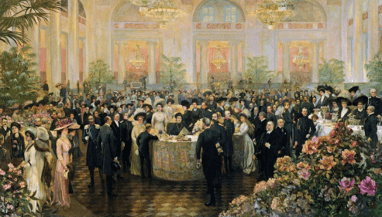
48. The Assembly of Nobles’ Ball. Despite mournful thoughts, society life takes its course. On Tuesday, the Adlige Ball is to take place – the famous ball at the Assembly of Nobles (now the building of the St. Petersburg Philharmonia).
49. Aunt gives Sophie a crepe dress, but a sturdy framework is needed to sew the bodice (waist). The girls go to the Gostiny Dvor to buy gros de Napel (gros de Naples) – a dense, ribbed silk fabric that perfectly held the shape of corsages.
50. Court Gossip: A charming vignette of daily life: in the evening, the women pace the rooms nervously or thoughtfully (giengen in den Zimmern herum), and Aunt Louisa launches into a discussion of Hofleben – court life. Having access to the Emperor and the Grand Dukes, the aunt evidently shared the behind-the-scenes intrigues of the Winter Palace with her niece.
51. Procurator’s Wife Weymarn – Olga, née Shemiot (1801-1879), granddaughter of Abram Gannibal, wife of Alexander Weymarn, Chief Procurator of the 1st Department of the Governing Senate.
52. Mourning (Anniversary of her sister’s death): These lines are the key to all of Sophie’s melancholy described in the first notebooks of the diary. She is mourning her sister Kitty. Exactly a year ago, on December 13th, after agonizing days of fear and fading hope, her sister passed away. Sophie’s faith (and her Pietist submission to God) was the only thing that helped her survive this tragedy.
53. Grieving for her sister: The entry from December 14th is pierced with pain. It is the first day after the anniversary of her sister Kitty’s death. Sophie writes: “What a heavy day this was for Mama,” realizing that her mother in the Estonian estate of Paslep is currently enduring the same agonizing memories in solitude.
54. Pella: Sophie mentions Robert, who arrives from Pella and immediately leaves again. Pella is a historical area and manor near St. Petersburg (in the vicinity of modern Otradnoye), which housed a post station and the remains of an unfinished palace built by Catherine the Great.
55. Winter Wheels instead of Sleighs: The phrase “man sieht fast nur Räder” (almost nothing but wheels are to be seen) is a brilliant meteorological detail. In mid-December, a light frost hit St. Petersburg, but almost no snow remained. Because of this, townspeople could not use sleighs and were forced to ride in wheeled carriages, which was very bumpy and loud on the frozen, snowless pavement.
56. A Walk along Liteyny and Nevsky: On Monday, the ladies take a classic St. Petersburg promenade: they walk all the way down Liteyny Prospect (die Liteina hinunter) to the intersection with Nevsky Prospect, which Sophie calls by the old French fashion – Perspective. There they “gawked” (stared at the luxurious shop windows) and walked back.
57. Fashion and Shopping on Millionnaya: Preparing for the grandiose Assembly of Nobles’ Ball, Sophie tries on her dress and discovers she lacks shoes and ribbons. Together with her cousin, she walks to Millionnaya Street (die Milona). In the 1840s, Millionnaya Street (running directly from the Winter Palace) was one of the most fashionable shopping districts in the capital, housing the best shoemakers and millinery salons.
58. “Confusion” with the Mail: A classic 19th-century communication problem. Sophie cancels or reschedules a lesson with Tamburini by slipping a note for the maestro inside a letter meant for her Aunt Minna. But Aunt Minna, by mistake (due to a “confusion”), only opens or forwards this letter a day later. As a result, Tamburini does not receive the warning and fails to show up for the lesson.
59. Sophie’s Fashionable Outfit: The young lady describes her toilette in detail: white crepe over white silk, genuine lace (ächte Spitze), a set of jewelry (parure), long curls in the 1840s fashion, and an asymmetrical detail – a single red moss rose pinned into her hair on one side.
60. A beautiful parure(from the Fr. parure – adornment, set of jewels) – a set of jewelry matched by the quality and type of stones, by material, or by unity of design. As a rule, it consists of a matching necklace, earrings, brooch, bracelet, and often a diadem. Originally, the number of points on such a diadem could indicate the title of its owner (countess, baroness, or duchess).
61. The Assembly of Nobles’ Ball (Adlige Ball): Sophie and her aunt arrive at the building of the Assembly of Nobles (built by architect Paul Jacot in 1839). Her description of the interiors – the wide grand staircase, the mirrors, the enfilade of antechambers, and the Grand White Column Hall with galleries and benches upholstered in red cloth (rothem Tuch) – possesses absolute historical accuracy!
62. Began with a polonaise, then danced 3 françaises (française): Sophie records in her diary the typical order of dances at a noble ball. The most interesting dance here is the French quadrille. The quadrille at a Russian noble ball was not a single dance in the modern sense, but a figure dance, where several couples performed pre-arranged movements to music. Usually, 4 couples participated, standing in a square. The gentleman and lady could: take a few steps towards each other; bow; pass towards another couple; separate and return to their place; move in a circle; perform chassé (gliding steps); execute promenades – the couple moving together; change partners or interact with other couples; conclude the figure by returning to their starting place. At the same time, it was not necessary to hold hands the entire time. In the quadrille, there were many moments when partners moved alongside or passed by each other. From Sophie’s words, it is unclear whether she participated in the quadrille or simply observed while standing nearby.
63. Proximity to the Emperor: At the balls of the Assembly of Nobles, etiquette was slightly more relaxed than at the Winter Palace. Sophie writes that during the dances, she stood in the crowd of spectators literally shoulder-to-shoulder with the Tsar’s daughter, Olga Nikolaevna, and during the next dance, Emperor Nicholas I himself and the Grand Duke stood next to her!
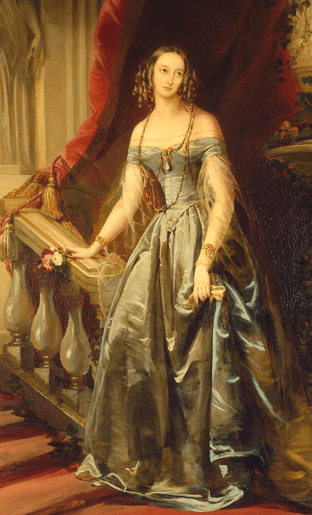
64. During the first quadrille I stood next to Grand Duchess Olga – Olga Nikolaevna (1822, St. Petersburg – 1892, Friedrichshafen) – the second daughter of Emperor Nicholas I; from 1846, the wife of Charles I, King of Württemberg.
65. The List of the Empire’s Foremost Beauties: The final lines of the diary entry are fantastic. Sophie lists the famous social lionesses who have gone down in the history of Russian literature.
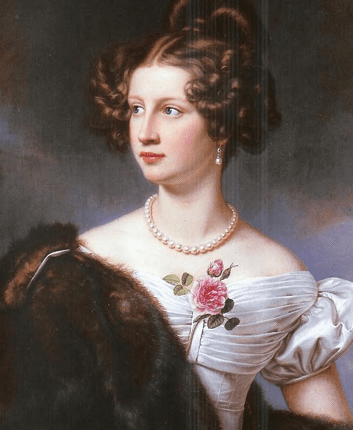
66. Madame Krüdener (Mme Krüdner), née Countess Lerchenfeld (Ger. Amalie Stargard in Regensburg, Gräfin von Lerchenfeld), a cousin of Empress Alexandra Feodorovna, one of the social lionesses of St. Petersburg and the greatest beauties of the 19th century, the muse of Fyodor Tyutchev (to whom the poem “I met you…” is dedicated). Sophie unerringly picks her out in the crowd: “who is indeed very beautiful.”
67. Madame Zakharzhevskaya: née Countess Elena Pavlovna Tiesenhausen (09.10.1804 – 09.13.1889), wife of Lieutenant General Grigory Donets-Zakharzhevsky (1792 – 1845), commandant of St. Petersburg, and sister-in-law to the Chief of Gendarmes Benckendorff. At this time, she held the position of Mistress of the Robes (Hofmeisterin) at the court of Grand Duchess Maria Nikolaevna. According to Countess Dolly Ficquelmont, also née Tiesenhausen, her cousin “Lily” was an exquisite and very beautiful lady, with a dazzling complexion, and her gentle, noble character evoked the admiration and love of those around her. Countess Elena Pavlovna Tiesenhausen (09.10.1804 – 09.13.1889)
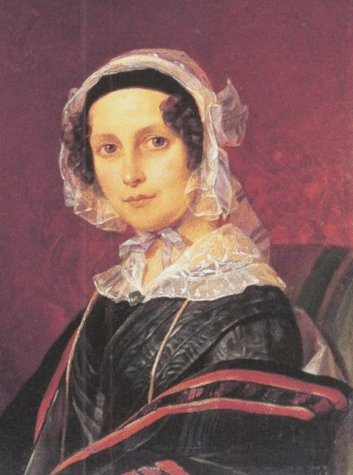
69. Along with them, Sophie singles out her unmarried peers: Mademoiselle Mezentsov (Mesenzof) – evidently Natalia (1820 – 1895), through her mother a great-granddaughter of Suvorov, named in honor of her grandmother Natalia Suvorova; in 1841, a lady-in-waiting. She was the older sister of Nikolai Mezentsov, Chief of Gendarmes (1827 – 1878), later a Lieutenant General, Chief of Gendarmes, and head of the Third Section, who was assassinated by the terrorist Kravchinsky.
70. Mary Golitsyna – who exactly Sophie means is unclear. Possibly Maria Pavlovna Golitsyna (1826 – 1881), great-granddaughter of Field Marshal Rumyantsev, but she was only 16 years old in December 1841 (however, she did marry Vladimir Skaryatin (1812 – 1870), who died in a hunting accident, shortly after in 1843).
71. The Appearance of the Tsesarevich: Her description of the Heir to the Throne (the future Emperor Alexander II the Liberator) is striking in its candor. She notes his welcoming face, but states that he is “ziemlich stark u. blas” (rather plump/large and pale).
72. But Duke Maximilian of Leuchtenberg, standing next to him, seems to her “unvergleichlich schöner” (incomparably more handsome). Both were present at the ball in gold-embroidered hussar uniforms.
73. Wicked Tongues of Society Salons: While Sophie shows leniency towards the gentlemen, when it comes to the ladies, she is a ruthless critic. She frankly writes in her diary that the ladies of high society (haute société) at the ball were “not beautiful,” and outright calls some (Madame Uglinskaya) “häßlich u. ordinaire” (an ugly and vulgar fat woman), sincerely not understanding why men court her so heavily (die cour machen). This perfectly illustrates that the mores of the 19th-century ballroom sidelines were no different from modern gossip!
74. Périer, the envoy of France – Sophie, without knowing it (?), turned out to be a witness to the climax of a serious diplomatic conflict between Russia and France that had dragged on throughout 1841. According to the testimony of the all-knowing M. Korf, Nicholas I took a dislike to the then French monarch Louis Philippe, and Russian ambassadors began to boycott the festive events of the French court. In response, the French chargé d’affaires Auguste Casimir-Perier (Ambassador de Barante was “on leave” following his son’s duel with Lermontov) ignored the reception on December 6, the name day of Emperor Nicholas, on the pretext of a “sudden indisposition,” although he ostentatiously strolled along Nevsky Prospect and appeared at the theater. The entire St. Petersburg beau monde agreed not to invite him anywhere anymore. M. Korf writes in his memoirs: “This ostracism could not, however, naturally extend to public places, where access is free to anyone. Thus, Perier appeared at the Assembly of Nobles’ ball, held on December 16. The Emperor, who was standing with the lady-in-waiting Baroness Frederiks, upon seeing him, said to her in German: ‘That is he!’ – and then walked past with that regal, autocratic majesty with which he so well knew how to clothe himself on occasion, without deigning to give him a single glance.” Sophie, it turns out, violated the ostracism of St. Petersburg high society and broke the “diplomatic” blockade.
75. Tamburini’s Fee: The entry of December 18 reveals a financial secret. Sophie pays the Italian opera star Antonio Tamburini 100 rubles (and she borrows the money from her wealthy Aunt Louisa). 100 silver rubles in the 1840s was a gigantic sum (the annual salary of a minor official!). Obviously, for this money, the maestro allowed himself not only to teach singing but also simply to engage in “very pleasant social chats” instead of a lesson.
76. 19th-Century Medicine: The description of Fräulein Rüdiger’s illness (by all appearances, a severe form of a peritonsillar abscess or quinsy) looks frighteningly realistic. The girl’s throat swelled so much that she could not swallow. The brave Sophie takes on the role of a nurse and literally syringes a medicinal gargling solution (Gurgelwasser) into her throat. In the evening, the abscess bursts (platzte das Geschwür), bringing immediate relief. In the era before antibiotics, such abscesses were often deadly!
77. Ideal of Beauty: On the embankment, Sophie again meets Grand Duchess Olga Nikolaevna (the Emperor’s daughter) and writes with admiration in her diary: “She truly is my ideal of beauty.” Olga was indeed considered the standard of refinement of her time.
78. The Runaway Maestro: The Italian prima donna baritone Tamburini tests the patience of our punctual German girl. On December 20 and 22, Sophie obediently waits for him all day, but the maestro never appears! Evidently, the fee of 100 rubles (which we learned about earlier) allowed him to treat his lesson schedule quite freely in the run-up to Christmas.
79. The Runaway Maestro: The Italian prima donna baritone Tamburini tests the patience of our punctual German girl. On December 20 and 22, Sophie obediently waits for him all day, but the maestro never appears! Evidently, the fee of 100 rubles (which we learned about earlier) allowed him to treat his lesson schedule quite freely in the run-up to Christmas.
80. Christmas Traffic Jams on Nevsky: The entry of December 24 is a true masterpiece of depicting everyday life! Sophie describes the classic pre-Christmas bustle in the capital. On the “Perspective” (Nevsky Prospect), chaos reigns: “A terrifying multitude of carriages… driving and walking intermingled.” Wealthy St. Petersburg residents are buying gifts and decorations at the last minute.
81. Weihnachtsbaum (Christmas Tree): The ladies stop at a shop to buy decorations for the Christmas tree. The custom of putting up a tree for Christmas (December 25 according to the Gregorian calendar) was brought to Russia precisely by the Germans, but in the early 1840s, it was the norm only in Baltic German homes in St. Petersburg. The Russian nobles borrowed this custom from them, so that by the end of the 1840s, the Christmas tree had become a common sight in affluent St. Petersburg homes.
82. Secret Gifts: A charming detail: Aunt Louisa leaves her nieces freezing for half an hour at a time in the carriage outside the Gostiny Dvor (“the Russian shops”) and the English Shop, in order to secretly buy them Christmas “surprises”. To somehow brighten the wait, she brings them sweets in the carriage, which the young ladies gladly “treat themselves to” (Sophie uses the Frenchified verb regaliren – from the Fr. régaler – to treat or regale oneself).
83. A Classic German Christmas: The entry of December 24 perfectly describes the Christmas traditions established by Germans in Russia. The Christmas tree (Weihnachtsbaum) is decorated precisely on Christmas Eve. Then the children and young people are “locked” in the study or a dark room (wurden wir ins Cabinet gestellt). And only half an hour later, when the candles on the tree are lit and a bell is rung, do the doors open, and everyone finds their presents beneath it.
84. Louisa at the Palace: On the morning of December 25, while Sophie is listening to a Christmas sermon in the Lutheran church, her cousin Louisa returns straight from the Winter Palace (aus dem Palais), where she had attended the imperial holiday festivities, and brings fresh palace gossip from there.
85. Tamburini’s Tragedy: And so the mystery of the Italian opera star’s disappearance is revealed! Maestro Tamburini did not attend the lessons on December 20, 22, and 24 not out of caprice, but due to a terrible sorrow – his little son had died in St. Petersburg. Sophie takes this news very much to heart. Mortality in the damp St. Petersburg climate was enormous, and many foreign artists lost their children here.
86. Homesickness: Against the backdrop of rich gifts (a new silk dress from Uncle Pontus), Sophie experiences the acute pain of separation. This is her first Christmas Eve far from her parents and her native Estonian estate of Paslep, and she writes of this with incredible tenderness.
87. To church to Bese (Bese) – Karl Bese, pastor of Lutheran churches in St. Petersburg, a teacher of religion at the Smolny Institute for Lutheran girls.
88. There were quite a few [guests] for dinner there: At Grandmamma’s dinner on December 26, relatives gather – a whole constellation of famous St. Petersburg merchant surnames: the Severins, Amburgers, Bacherachts, Ovanders. This is a true social web of the capital!
89. Madame Amburger – probably Sofia, née Daler (1814-1879), wife of the stockbroker Friedrich Amburger. Her presence at the Severin-Bacheracht family evening underscores once again the intertwining of business and kinship ties within the German community of St. Petersburg. The prosperity of the Amburger merchant clan was initiated by the brothers Karl Ludwig and Friedrich Wilhelm Amburger, who arrived from Germany. In the 1790s, the firms they established were among the top ten foreign trade companies in St. Petersburg. Thus, in 1797, Friedrich Wilhelm Amburger, the grandfather of the Madame’s husband, exported overseas and sold in Russia goods totaling 904 thousand rubles. The Amburgers traded, among other places, with America, where they had a representative in New York in the person of their cousin Karl (Americanized name – Charles Amburger, see here). The Madame’s great-nephew – Erik Amburger, a German from Vasilyevsky Island, Erik Amburger (Ger. Erik Amburger; 1907, St. Petersburg – 2001, Heuchelheim) – was a philologist, historian, and Slavist. It is thanks to Erik Amburger’s databases that we today know so much about Germans, including Baltic ones, and foreigners in general in post-Petrine Russia. See about him in Katin-Yartsev’s article “In Memory of the Departed”.
90. The Last Sunday of the Year: On December 28, Pastor Moritz reads a sermon dedicated to the last Sunday of the departing year (“der letzte Sontag im alten Jahr”). Sophie, accustomed to a deeper Pietist theology (such as that of Hofacker or Nielsen), criticizes him for the fact that his beautiful words lacked spiritual depth, and she left the church “with an empty heart.”
91. The old General’s wife Klüpfel (Klupfeld) with her charming daughter Loulou (Loulou) – Barbara Klüpfel, mother of General Vladislav Klüpfel. Loulou is her daughter Lyudmila Klüpfel.
92. Tamburini’s Mourning: The story with the Italian baritone ends on a very human note. He finds the strength to come to the lesson, but his grief (the recent death of his young son) is still so great (“er war noch sehr ergriffen”) that Sophie cannot sing out of solidarity and compassion for her teacher. The lesson is canceled by mutual unspoken agreement.
93. Young Richter – probably one of the sons of General Boris (Burchard) Richter and his wife, née Hermann, most likely Alexander Borisovich Richter (Alexander Christoph Friedrich von Richter; 1809 – 1859) – later a Russian diplomat, envoy to Belgium (1856 – 1859). Aunt Dmitriyeva – his father’s sister Natalia, was married to Colonel Ivan Dmitriyev.
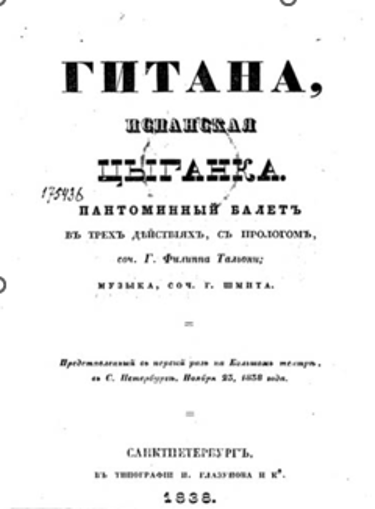
94. “La Gitana, or the Spanish Gypsy” (La Gitana): Sophie describes the action of the ballet with the precision of a libretto: the second act indeed depicts the colorful, noisy Frankfurt fair, where Taglioni’s heroine (Gitana) performs her famous gypsy dances, driving the public wild.
95. A Division in Society (Invitation to the Palace): At half past four in the afternoon, Uncle Pontus and Aunt Louisa are suddenly brought an invitation to the Grand Duke’s (most likely to the Mikhailovsky Palace). An awkwardness arises: the elders are invited, but the “Demoiselles” (the young unmarried nieces) are not. The uncle is upset by this breach of social politesse, but in the end, the elders go to the palace, while Sophie, her cousins, and her grandmother head to the rented box at the theater.
96. She was so kind as to ride with us: need one be reminded that unmarried young ladies could only appear in the theater and other public places accompanied by their elders. Only Grandmamma’s agreement to go to the theater with the young ladies saved the situation.
97. The Legendary Marie Taglioni: This is an absolute gem of the diary! Marie Taglioni (1804 Stockholm – 1884 Marseille) was an Italian ballet dancer, later a ballet teacher, and one of the central figures of the romantic ballet era. Taglioni performed in St. Petersburg from 1837 to 1842 and enjoyed phenomenal, almost hysterical success. The ballet “La Gitana” was choreographed by her father, Filippo Taglioni. Sophie’s entry (“Taglioni is pure, charming grace”) perfectly conveys the raptures of the St. Petersburg public of that time.
98. Mummers (maskirten Soldaten): a New Year’s tradition – masked caroling mummers (in this case, in soldiers’ costumes) burst into the house, sing songs, and put on a comedic performance, interrupting the sedate card game of the elders.
99. Hailing Passers-by: They send a servant out into the street with their rings to ask the names of the first passers-by he meets (it was believed that this would be the name of one’s future husband). Sophie gets the name “Peter.” Russian Yuletide Divinations – This is the most charming moment in the entire diary! Baltic German Lutheran young ladies delightedly participate in traditional Russian fortune-telling.
99.1 Divination with a Rooster: The girls sit in a circle, and each places a handful of grain (a treat) in front of her. The one whose pile the rooster approaches first will be the first to marry. Without hesitating, the rooster walks straight to Sophie!
100. A Biographical Surprise (The Broken Betrothal): In the very last lines of the year, Sophie reveals the secret behind her prolonged melancholy (aside from the death of her sister). In the departing year, she experienced a personal drama – a broken betrothal. She writes: “For a moment I believed that my lot for my whole life was already decided, but suddenly the Lord overturned everything.” This is why she so submissively places her fate in God’s hands and speaks so much of humility.
101. Readings from the “Treasury”: After the noisy fortune-telling comes a time of German piety. Aunt Louisa reads to the girls from a spiritual book. Sophie calls it “Schatze.” Most likely, this is the famous book of German Pietism – “The Golden Treasury of the Children of God” by Carl Heinrich von Bogatzky (Güldenes Schatz-Kästlein der Kinder Gottes).
102. The Failed Suitor – Cursell (Kursell): Sophie writes that at first, “when everyone (relatives) was against him, I liked him.” But ultimately she changed her mind, and in August 1841 – “gab ich ihm den Korb” – a classic German idiom meaning to refuse a suitor’s proposal.
102.2 Refusing a suitor’s proposal. Immediately following her refusal, Kursell fell gravely ill. Guilt over his illness, family pressure, and the broken engagement are what led Sophie to refer to this period as “that extremely unpleasant time with Kursell,” after which her mother hastily whisked her away to St. Petersburg to stay with Aunt Louisa for a change of scenery (ostensibly for singing lessons with Tamburini).
103. Natalya Andreevna Petrovo-Solovovo, née Princess Gagarina
National Archives of Estonia (EAA). F. 1334. Inv. 1. F. 78. EAA.5269.1.106 Tagebuch der Sophie von Knorring. [Diary of Sophie von Knorring. Volume II] (1841–1842).
← Read November 1841 | Continue to read →
Discover more from Strahlborn and De Rionzini
Subscribe to get the latest posts sent to your email.


#/media/%D0%A4%D0%B0%D0%B9%D0%BB:Olga_Nikolaievna_the_elder.jpg)

.jpg)

On these pages, St. Petersburg surprises with weather anomalies: there is an unprecedented thaw, the Neva has still not frozen over, and right beneath her windows, to the sounds of an orchestra, the Chevalier Guard Regiment conducts exercises. Sophie’s capital life is in full swing. During a walk along Liteyny Prospect, she nearly collides head-on with Grand Duke Michael Pavlovich strolling on foot, and at high-society soirées, she waltzes until one in the morning, proudly showing off her fashionable new dress of mousseline de laine. And though homesickness occasionally reduces her to bitter tears right before a vocal lesson, forcing the great Tamburini to set aside his sheet music and simply comfort his distressed pupil, the warm attitude of her new acquaintances brightens these moments. Take, for instance, the visit of the strict General’s wife Klüpfel, who turns out to be a most charming woman and personally brews a medicinal syrup of beetroot and sugar for the cold-stricken Sophie!