Ludwig’s Warsaw Escapades, Estonian Exile, and the Auction in Weißenstein.
In previous chapters, our archival historical drama bade farewell to Lieutenant Ludwig Karlovich von Strahlborn (Ludwig von Strahlborn/Straelborn) in 1844, when his trail finally vanished amid court summonses and rumors of his flight to Moscow. Most likely, all the participants in this provincial tragicomedy – from his abandoned wife Praskovya Ivanovna to the tireless Marshal of Nobility Sergei Nikanorovich Bogdanov – were convinced that the wayward hussar had either met his end in some reckless adventure or quietly perished in the back alleys of the capital, hiding from creditors and obligations to his numerous family. Ludwig truly seemed to have vanished into thin air, and this missing piece of the puzzle gave me no peace, leaving a gaping void in the overall picture.
Truth be told, several years ago I had given up hope of ever uncovering his fate. Numerous attempts to catch even a passing mention of his name in digitized Moscow newspaper chronicles or in the endless columns of the St. Petersburg “Senate Announcements” invariably came up empty. Only recently did the most obvious thought finally cross my mind: to look for the fugitive in his historical homeland.
I started with digitized Estonian newspapers – and luck smiled on me on the very first try. In the “Estonian Governorate Gazette” (Estländische Gouvernements-Zeitung) for November and December 1878, a whole series of official judicial summonses turned up. They announced the death in the district town of Weißenstein (now Paide, Estonia) of retired Lieutenant Ludwig von Strahlborn (dim. Lieutenants Ludwig v. Strahlborn), the convocation of his heirs, creditors, and debtors, as well as the scheduling of a public auction to sell his house at No. 23 along with all his belongings. I had almost no doubt: over years of searching, I had become convinced that a second retired lieutenant with that exact name and surname simply did not exist in the Russian Empire.
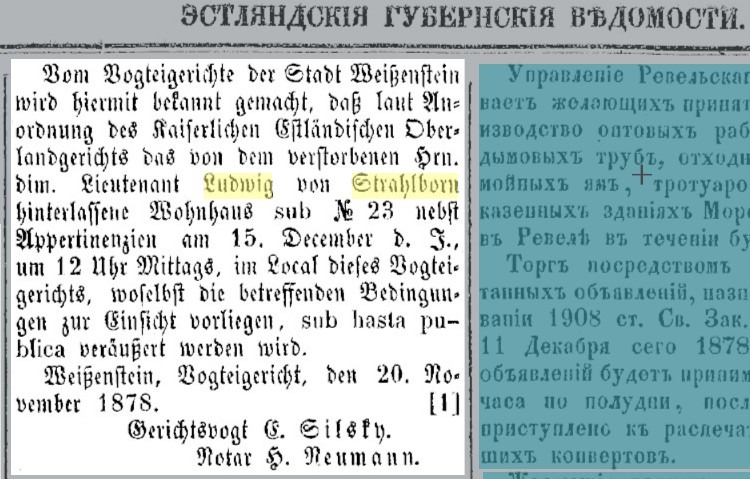
November 23, 1878

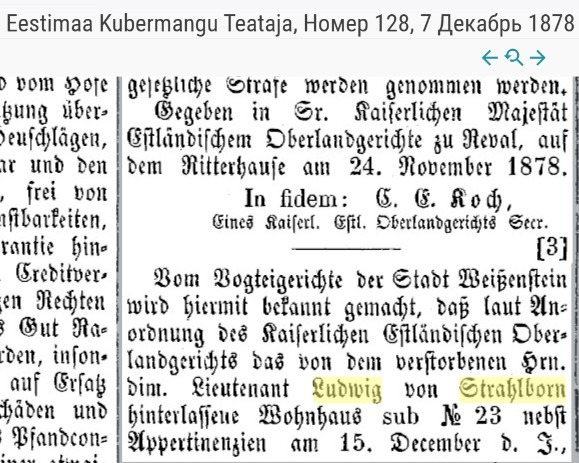
December 7, 1878
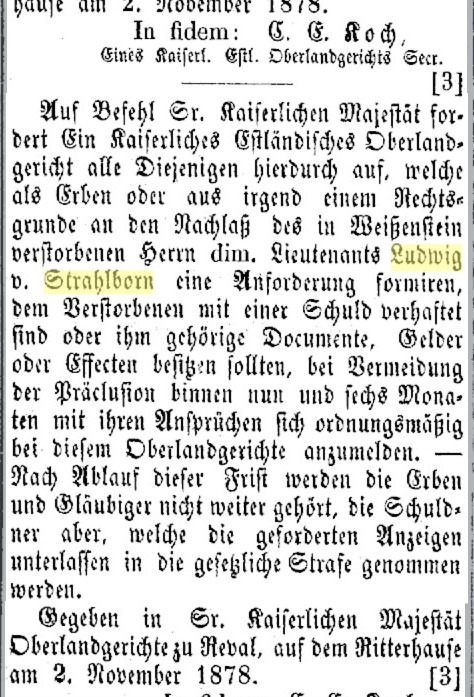
November 9, 1878
Next, in the parish registers of the Lutheran Holy Cross Congregation in Weißenstein (Paide Püha Risti kogudus), the death record itself appeared under No. 44: Ludwig E. von Strahlborn (Ludwig E. v. Strahlborn) passed away on October 31, 1878, at four o’clock in the afternoon from a massive stroke (Schlagfluß), and was buried on November 4. Yet for strict verification of his identity, this entry offered little help. On the contrary: instead of answers, it served up a fresh batch of riddles. The record listed only his name, date, and cause of death – the pastor indicated neither the deceased’s military rank nor his age, leaving the years column blank, and in the birthplace column he drew an eloquent question mark (?). Even more curious was the marital status column: the clerk first wrote “widower” (verwittwet), then crossed it out and wrote “unmarried” (ledig) above it.


This sparse information was both baffling and a dead giveaway of our hero’s character. Technically, by the autumn of 1878, Ludwig Karlovich really was a widower and had outlived nearly all the participants of the Vladimir drama: his lawful wife Praskovya had died in 1868 in Colonel Volotsky’s almshouse, their daughter Elizaveta had died of consumption in 1875 in the house of the priest Sokolov, and both of his stepdaughters by Second Lieutenant Pyotr Lyalin – Ekaterina Vzmetneva and Countess Maria Derionzini – had also passed away. But in quiet Weißenstein, hardly anyone could have known this. Clearly, the retired hussar lived in such isolation that even to the local community his past remained a mystery.
I had more than enough inner certainty, but genealogy demands documentary proof. And that proof was found, though the path to it proved quite winding. One must give Ludwig his due: he remained true to himself to the very end, and his farewell tour fit seamlessly into the fabric of our archival saga.
The Warsaw Trail, Chopin’s Godfather, and the Real Estate Scam.
The thread of the investigation unexpectedly led to the Kingdom of Poland. While back in the Vladimir province, his stepdaughters were busy dividing the boundary cherry tree and peasant hayfields; retired Lieutenant von Strahlborn turned up in Warsaw.
Having retired in 1832, shortly after marrying Praskovya, and having squandered all available assets, Ludwig, contrary to expectations, did not sink to the bottom or perish in a gutter. His unbearable lightness of being, however, was accompanied by a relentless pursuit of easy schemes, each promising to mend his fortunes, yet invariably ending in another fiasco. Ludwig clearly fell short of the title of a master schemer: he lacked strategic thinking, perseverance, and, by all appearances, the ability to learn from past failures.
What exactly brought the former cornet of the Kyiv Hussar Regiment to the banks of the Vistula remains unknown. Warsaw hosted a large Russian garrison and operated under a distinct legal jurisdiction largely beyond the reach of Russian creditors, while among former comrades-in-arms one could always live on credit, play a hand of cards, and look for an effortless hustle.
The Warsaw episode of his biography came to light thanks to a file from the National Archives of Estonia (EAA.29.3.4503) bearing an eloquent German title: “File concerning the expulsion of retired Lieutenant Ludwig-Karl von Strahlborn from Warsaw to his homeland, in Reval” (Akte betreffend die Ausweisung des verabschiedeten Leutnants Ludwig-Karl von Strahlborn aus Warschau in seine Heimat, in Reval). There were no direct genealogical certificates inside, yet from the very first lines of the dispatch from the Chancellery of the Warsaw Military Governor-General dated September 12, 1857, No. 4793, our old acquaintance deserved a standing ovation.
The Viceroy of the Kingdom, upon representation that the retired Lieutenant Ludwig-Karl von Strahlborn residing in Warsaw leads an idle life and possesses no means of subsistence, has deigned to order that he be expelled to his homeland in the Governorate of Estonia. Consequently, the aforementioned Officer, having been summoned to the Police, declared that prior to the conclusion of a lawsuit he had initiated here against a certain Wardak, he could not depart.
Even when faced with compulsory deportation for idleness and destitution, Ludwig Karlovich did not lose his composure and presented the police with an unfinished lawsuit! The story of this litigation, which we managed to piece together across Russian reports, digitized ledgers of Warsaw notaries, and old Polish newspapers, is worthy of Balzac’s pen.
In Warsaw, our cash-strapped hussar struck up an acquaintance with a 39-year-old day laborer from the suburban commune of Powązki, Franciszek (Franz) Wardak, who was blind in his left eye. This humble laborer had a far more prosperous relative (likely his brother), Andrzej Wardak, who owned a lucrative property with houses, outbuildings, and a smithy in the right-bank Warsaw suburb of Praga at No. 151 Targowa Street (Nr 151 na Pradze, przy ulicy Targowej). Back in February 1844, in the newspaper “Kurjer Warszawski” (No. 43 of February 14, 1844), this Andrzej was modestly referred to as “Mr. Andrzej Wardak” (JP. Wardak Andrzej) when he donated 200 zlotys toward the construction of the Church of St. Charles Borromeo in memory of his late wife Katarzyna Szankiewicz (Katarzyna Szankiewiczów). However, as his wealth grew, the common peasant surname Wardak began to transform in official documents into a noble-sounding gentry name – Wardziński or Wardyński (Andrzej Wardziński).
The bone of contention was the inheritance of their deceased female relative (most likely their mother or aunt) – Eleonora, née Raczyńska, married name Wardyńska (Eleonora Raczyńska/Wardzińska), which included rights to that very plot No. 151. Ludwig von Strahlborn realized that a poor relative’s resentment toward a wealthy one offered a chance to play for high stakes.
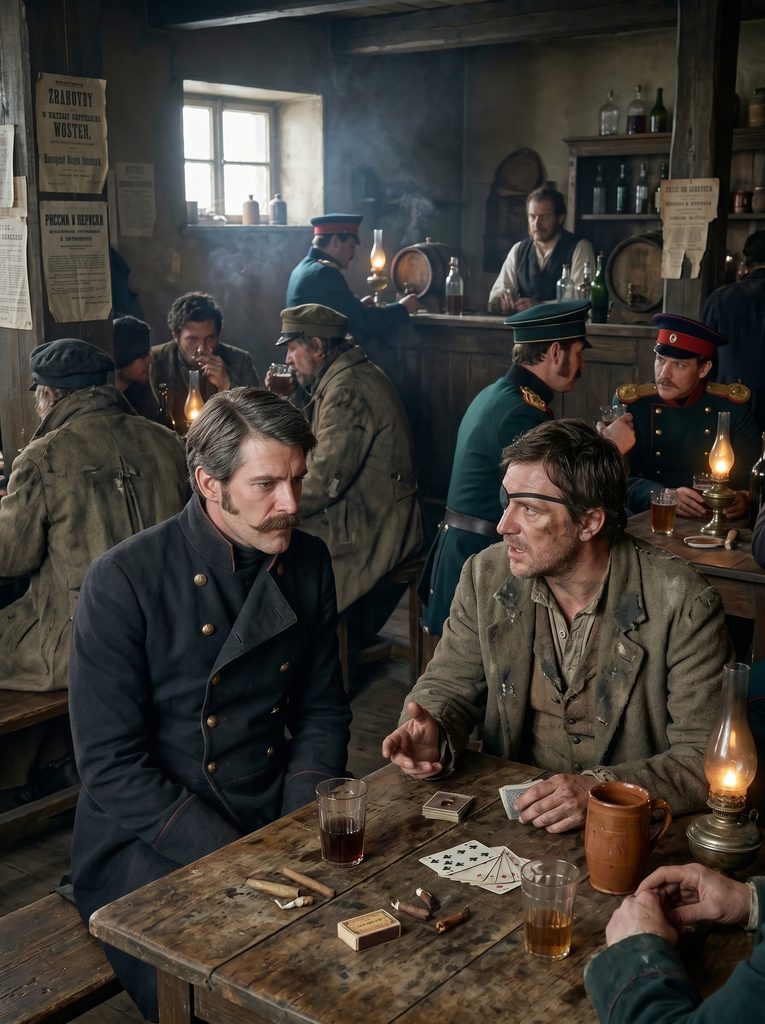
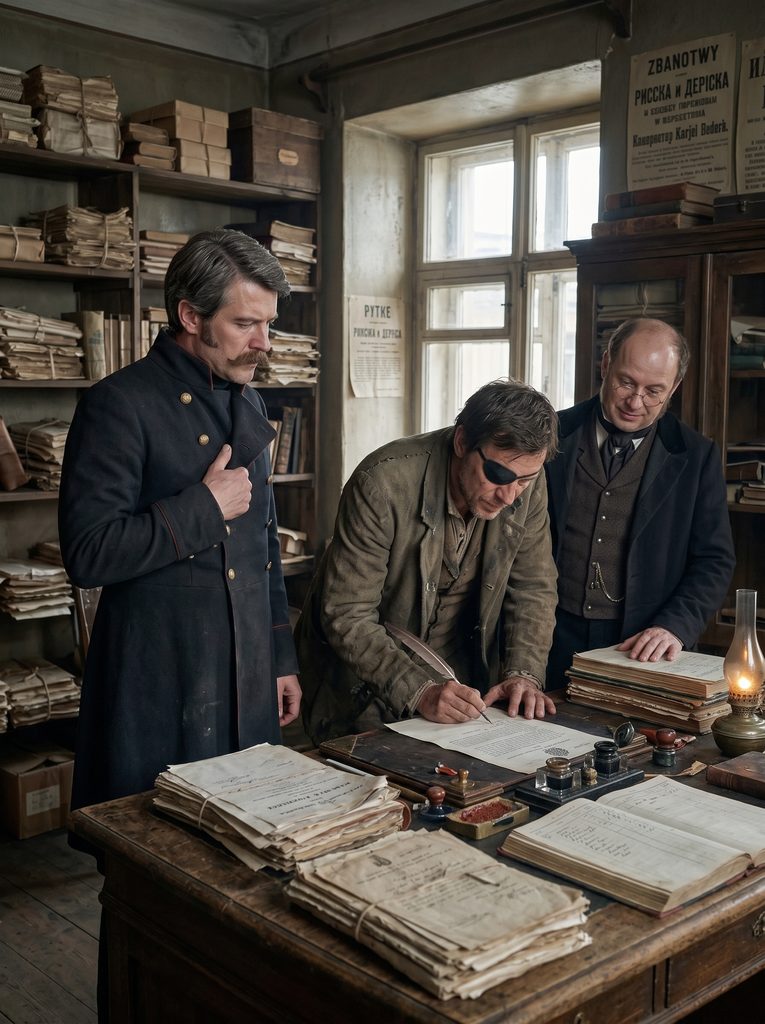
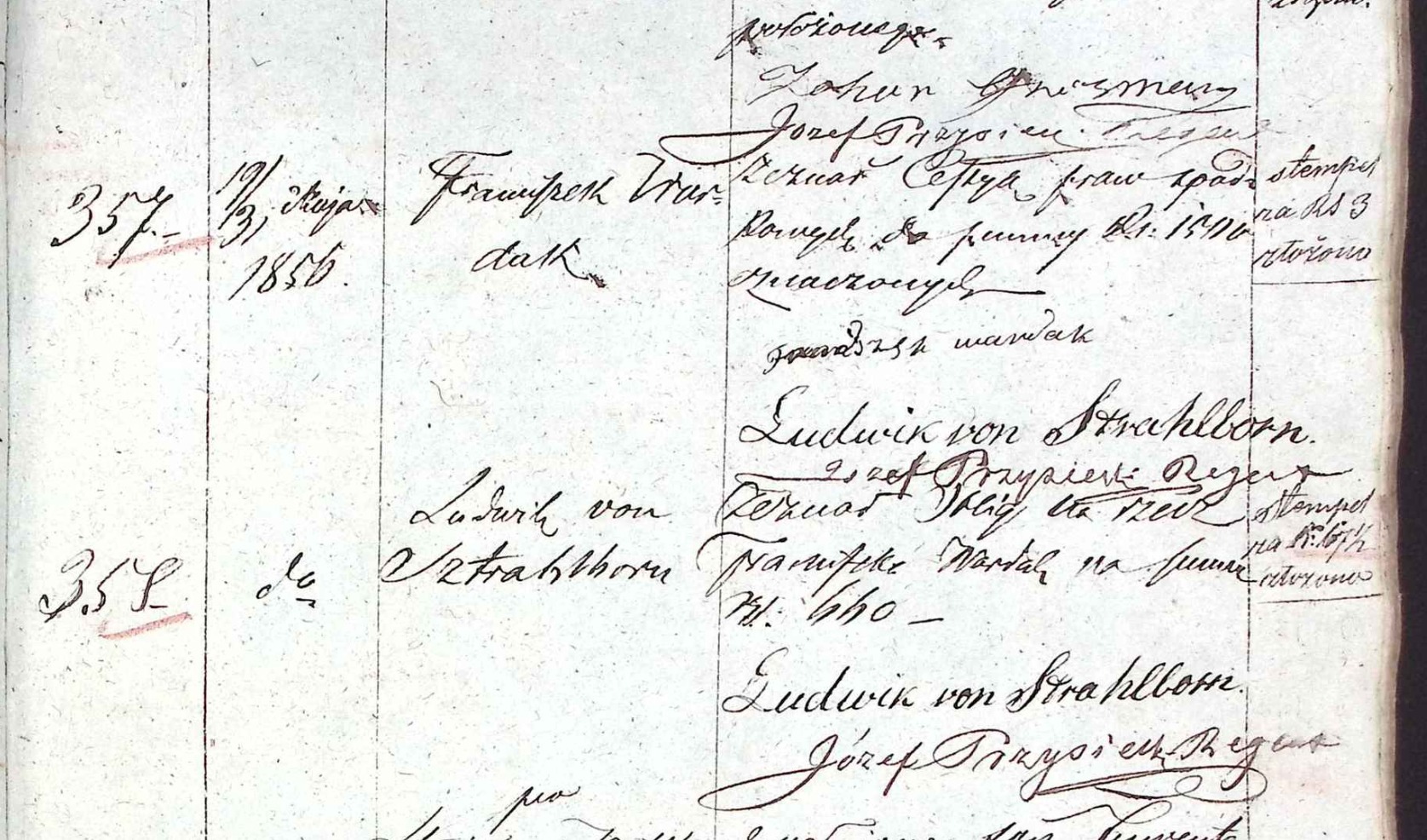
In May 1856, Ludwig brought the one-eyed day laborer Franciszek Wardak to the office of the Warsaw notary (regent) Józef Przysiecki. In a single sitting, they executed two mirrored acts in the notarial register (Repertorium). Under Act No. 357, Franciszek Wardak officially assigned his inheritance rights, valued at the impressive sum of 1,500 silver rubles, to Ludwig von Strahlborn. Needless to say, the retired hussar did not have that kind of money to his name. Therefore, right then and there, under Act No. 358, Ludwig issued Wardak a counter-promissory note for 440 silver rubles. In hand, Franciszek likely received a small sum of ready cash for the tavern.
On the page of the register beneath both acts, two signatures still stand side by side: the unsteady, dancing scrawl of the semi-literate day laborer (Franciszek Wardak) and the firm, sweeping autograph of our hero (Ludwik von Strahlborn).
At the Warsaw Civil Tribunal, an unpleasant surprise came to light: it turned out that the enterprising Franciszek Wardak had already sold that very same share in plot No. 151 to his brother Andrzej Wardziński ten years earlier – by an act dated February 12, 1846, at the office of another well-known Warsaw notary, Gross – complete with payment and a signed receipt!
Backed by a court-appointed public defender named Rakowski provided by the government, the tireless lieutenant filed a lawsuit against both brothers at once – both Andrzej Wardziński and Franz Wardak. He demanded that the ten-year-old transaction before Notary Gross be declared null and void, that his right to co-ownership of property No. 151 be recognized, and, most importantly, that Andrzej Wardziński be compelled to compile a full inventory of the estate of the late Eleonora (Raczyńska) Wardyńska and divide her inheritance. However, the scheme misfired. The summons was duly served to Andrzej Wardziński, but the second defendant and key witness – Franciszek Wardak – suddenly vanished. In March 1857, the lawyer Rakowski even obtained a default judgment against Wardak, yet the court bailiff (woźny) Pawłowski was unable to serve him the papers: the headman (wójt) of the Powązki commune declared that no such resident was registered there at all.
Where had Ludwig’s chief accomplice disappeared to? The answer turned up in the crime and incident columns of Warsaw newspapers from the spring of 1857. The distraught wife and sister of Franciszek Wardak placed a missing-person notice: it transpired that on Sunday, February 22, 1857, the one-eyed day laborer had set out from Powązki straight for Praga, got dead drunk on his way back, was left lying on the military parade ground near the Powązki tollgate, and never returned home.
Left without his key witness, Ludwig switched to delaying tactics and began firing off angry complaints to the Warsaw authorities, accusing his court-appointed lawyer Rakowski and the bailiff Pawłowski of colluding with the defendants and demanding the appointment of a “more reliable defender.”
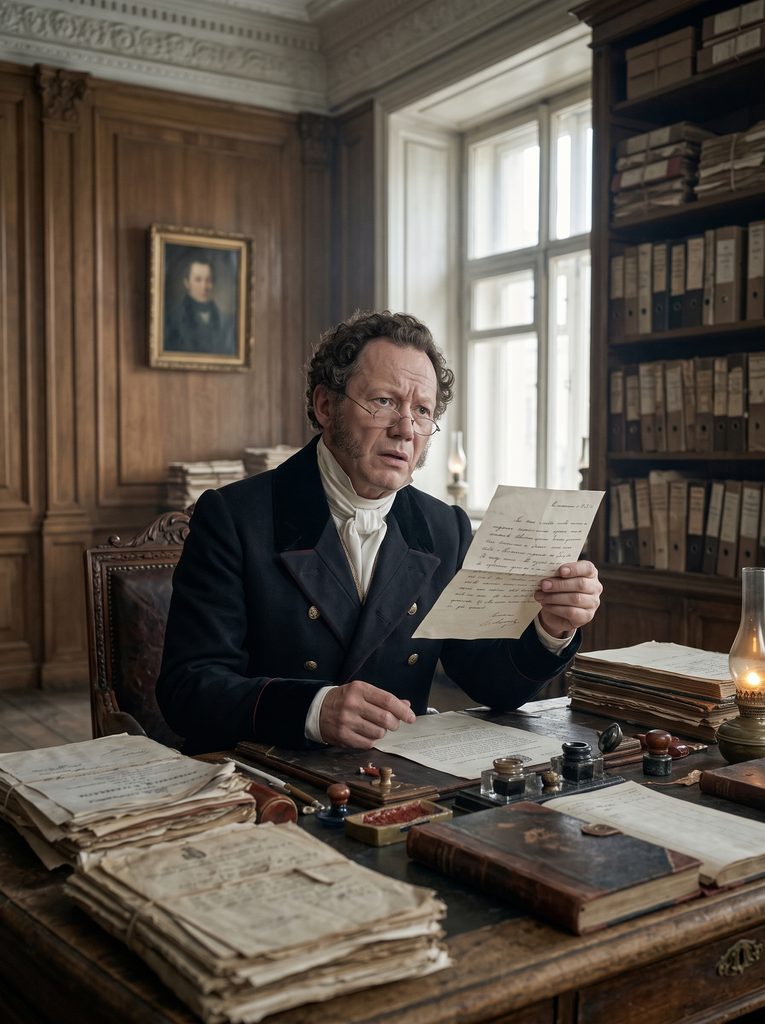
Sorting out the retired lieutenant’s complaints about dilatory bailiffs and dividing the ill-fated Praga plot fell personally to Privy Councilor Count Fryderyk Florian Skarbek (1792–1866), who from 1854 to 1858 served as Chief Director Presiding in the Government Commission of Justice (effectively the Minister of Justice of the Kingdom of Poland). Count Skarbek was a figure of European stature – a brilliant economist, writer, and reformer, and, to top it all off, the godfather of the great composer Frédéric Chopin (the musician’s father, Nicolas Chopin, had served in his youth as a tutor at the Skarbek family estate in Żelazowa Wola, and the future musical genius was named Fryderyk in honor of the young count).
In 1857, papers landed on the desk of Chopin’s godfather detailing how the fugitive Vladimir landowner Ludwig von Strahlborn and the day laborer Franz Wardak, who had vanished dead drunk under a fence, were trying to sue for a smithy and sheds in the suburb of Praga.
Count Skarbek carefully reviewed the dossier and delivered a cold verdict: the lawyer Rakowski and the bailiff Pawłowski had acted impeccably, and Strahlborn himself was to blame for stalling the proceedings by withholding the court copies. Since the lieutenant had a court-appointed defender with whom he could easily correspond by mail, his personal presence in Warsaw was no longer “deemed necessary.” By order of the Warsaw Chief of Police, Major General Anichkov (and a report by General Spichkov), in June 1857 Ludwig Karlovich was finally sent out of the Kingdom of Poland.
Incidentally, after Ludwig’s departure, Franciszek Wardak turned up alive and well! Having sobered up on the parade ground near the Powązki tollgate, he safely outlasted the deportation of his partner Strahlborn, moved into the coveted house at No. 151 years later, and continued to litigate against his own relatives over that very same plot following the death of his more fortunate brother.
Deportation to the Ancestral Homeland and Life Across from the Pastorate
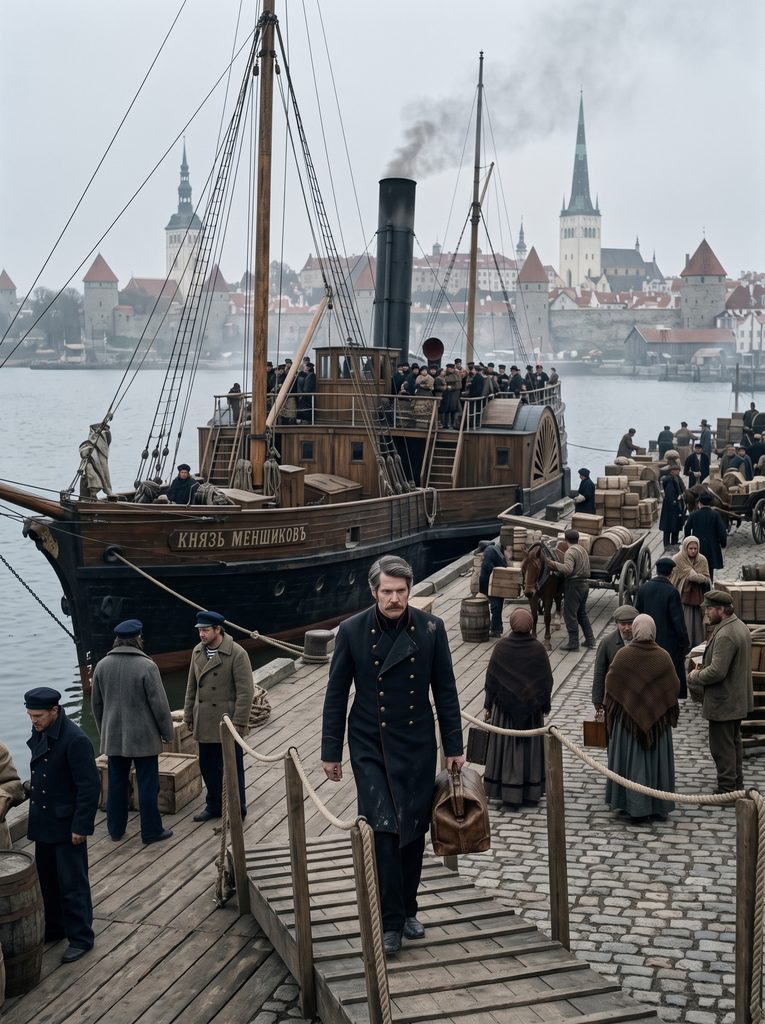
But let us return to the summer of 1857. Expelled from Warsaw for leading an “idle life” – much as his spiritual twin Alexander Yunich had been expelled from Gavrilov Posad three years earlier for endless pettifoggery – Ludwig Karlovich traveled to Estonia by the cheapest and most convenient route of the time: via St. Petersburg. In the arriving passengers chronicle of the “Estonian Governorate Gazette” (No. 28 of July 15, 1857, section Angekommene Reisende), it is recorded that on July 6, 1857, aboard the steamship “Prince Menshikov” (Dampfschiff Fürst Menschikoff) from St. Petersburg to Reval, “Lieutenant von Strahlborn” disembarked among 87 passengers.
He spent the rest of the summer and early autumn of 1857 in Reval (Tallinn). When, on September 28, 1857, the Chancellery of the Governor of Estonia received (under incoming No. 5457) the final report of the Warsaw Military Governor-General, Adjutant General Fyodor Sergeyevich Panyutin, and Chancellery Director Zmigrodsky containing Count Skarbek’s explanations, Ludwig was summoned to officially review it. On the last page of the file (EAA.29.3.4503, fol. 4), his handwritten receipt in Russian has been preserved: “Read by Lieutenant von Strahlborn” (“Читалъ Поручикъ фонъ Штральборнъ”). The road back to temptation-filled Warsaw was closed forever.

It seems this forced return to his native hearth had a sobering effect on the 52-year-old adventurer. Whereas prior to 1857 a noisy trail of guardianship disputes, unpaid promissory notes, and complaints followed him across the empire, after his move to the quiet district town of Weißenstein, almost complete silence descended around his name.
On old cadastral maps of Weißenstein (EAA.854.4.350 and in the property register), I managed to locate his final refuge – residence No. 23. Notably, on the map his house and plot look larger than almost any other property in the neighborhood! Ironically, the retired lieutenant’s house, complete with outbuildings and a garden, stood in the very heart of the tiny town, literally across the street from the main entrance to the Lutheran Church of the Holy Cross.
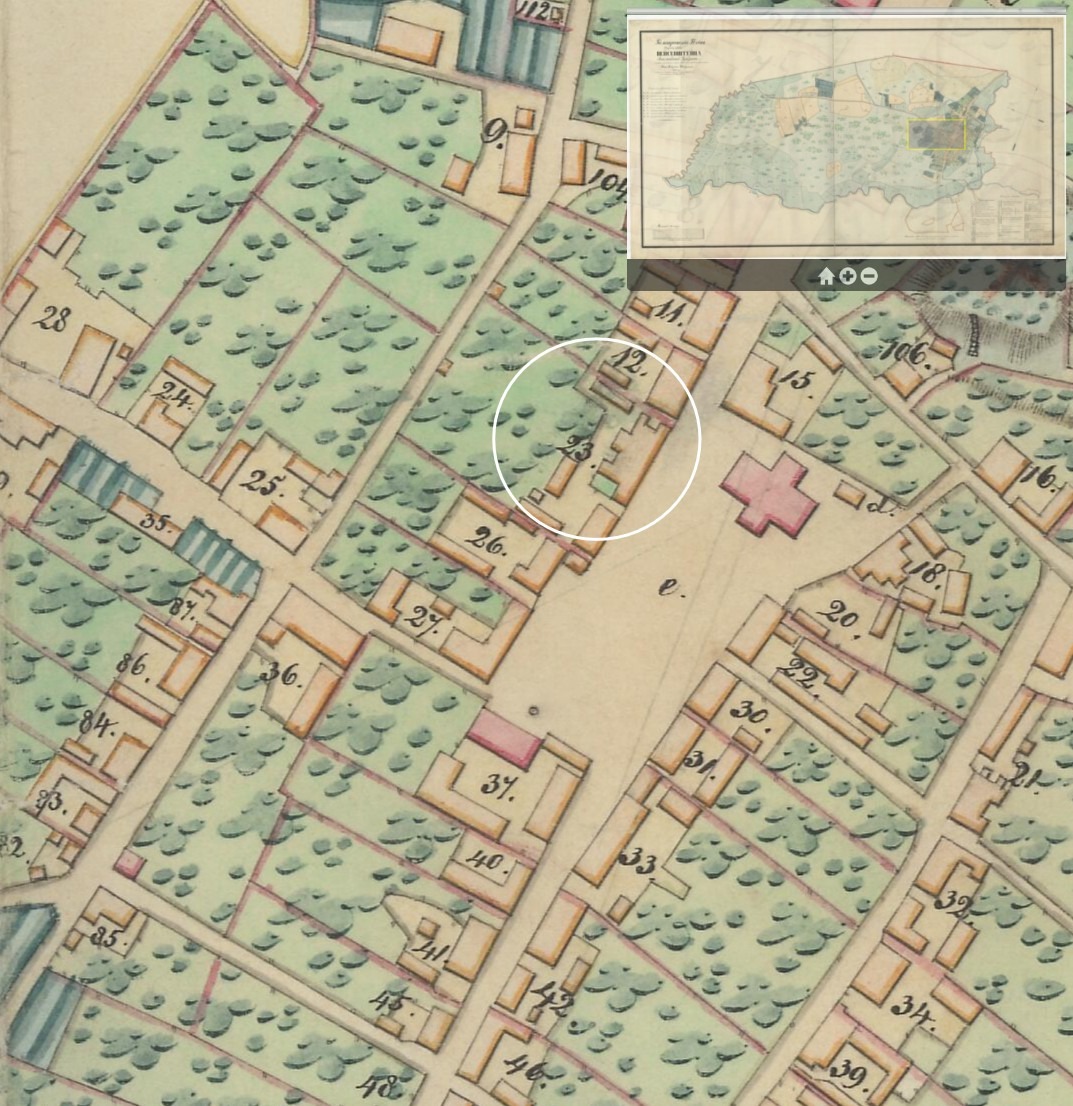
Historical plans and maps of Weißenstein (Paide): Town plan indicating plot No. 23 / 28 – record in AIS.
Ludwig looked out at the pastorate from his windows every single day, yet in twenty years of living in Weißenstein, he apparently never once crossed the threshold of the local pastor’s office to formally register. His name appears neither in the personal books of the German congregation (Personaalraamatud, saksa pihtkond) nor in the files of parish certificates (Parochialscheine / Kirikutähed, fond EAA.3159). He lived in his own house like an invisible man.
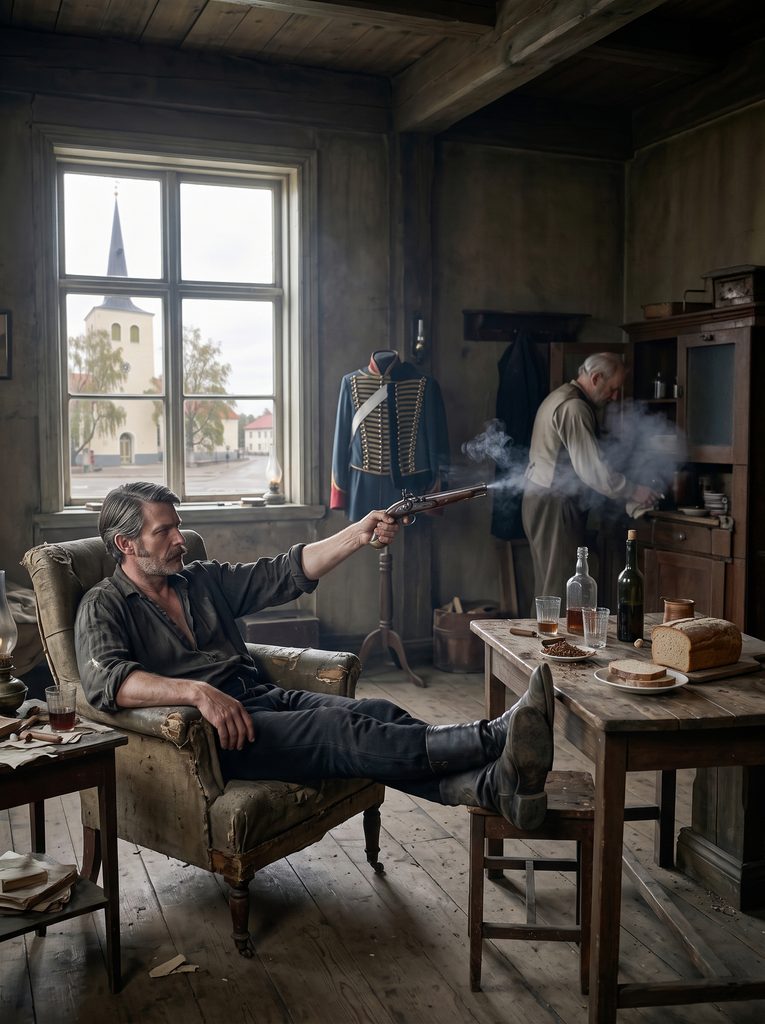
The Auction of House No. 23 and the Final Chord in Reval
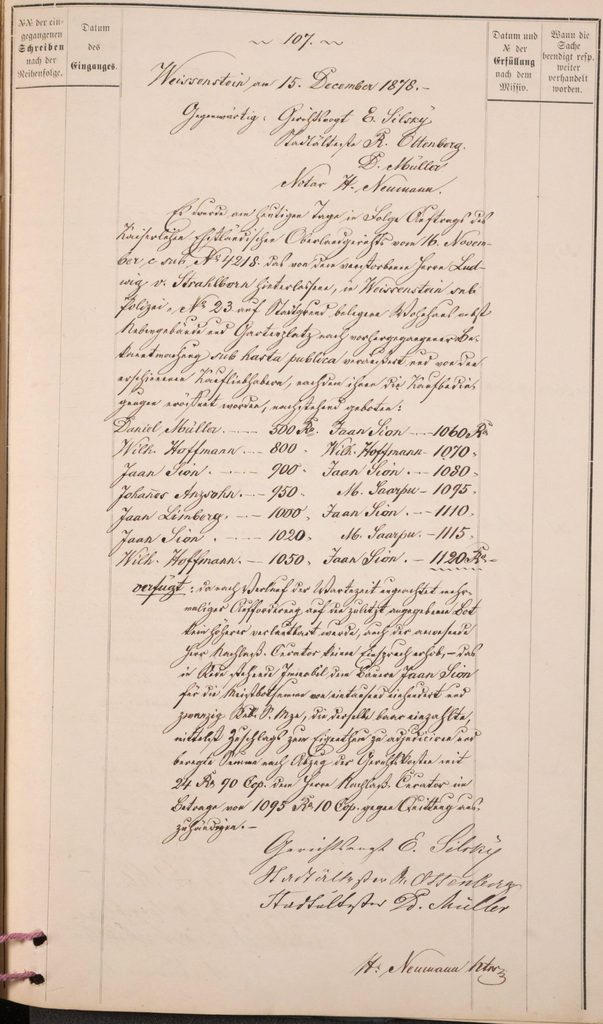
To conclusively prove that the recluse from House No. 23 in Weißenstein and the fugitive hussar from the Vladimir province were one and the same person, it remained for me to look into the judicial chronicles of 1878. Starting with the digitized journals of the Weißenstein Bailiff’s Court (Weissensteinsches Vogteigericht, fond EAA.991.1.705), presided over by Judicial Bailiff E. Silsky (Gerichtsvogt E. Silsky) with the participation of Town Hall aldermen R. Ottenberg, D. Müller, and Notary H. Neumann, I began leafing through the autumn protocols for 1878. After working with the old German cursive of Sophie von Knorring’s diary, Baltic handwriting already felt almost like second nature – in other words, I had learned to make out a few capital letters 🙂 Under November 4, 1878 (entry No. 314), my eye immediately caught the familiar surname: L. v. Strahlborn.
The entry stated that the local court, pursuant to an order from Reval under No. 3929, directed that the property left by the deceased be inventoried and handed over to the local co-curator W. Hoffmann. Next, in entry No. 331 of November 18, the court recorded a new order from above under No. 4218, scheduling the public sale of the estate.
And on the protocol page dated December 15, 1878 (entry No. 107), the scene of the public auction itself (sub hasta publica) unfolded. Ludwig’s wooden residential house at police No. 23 on municipal land, together with its outbuildings and plot (Wohnhaus nebst Nebengebäude und Grundstück), was put up for sale at a modest starting price of 500 silver rubles. A fierce bidding war broke out among six buyers for the former “nobleman’s nest”: bids were raised in turn by Daniel Müller (500 rub.), the estate curator and merchant Wilhelm Hoffmann (800, 1,050, 1,070 rub.), Johannes Anysohn (950 rub.), Jaan Limberg (1,000 rub.), and M. Saarm (1,095 and 1,115 rub.). In the end, outbidding all competitors, the final bid of 1,120 silver rubles in cash was placed by an ordinary Estonian peasant, Jaan Sion (Bauer Jaan Sion), to whom the court immediately awarded ownership. After deducting 24 rubles and 90 kopecks in court costs, the net proceeds from the retired hussar’s house amounted to 1,095 rubles and 10 kopecks.
While the auction protocol provided a wealth of everyday details, it still kept silent about the identity of the deceased owner himself. However, incoming reference numbers of orders from a higher authority – the Imperial Estonian Supreme Court (Oberlandgericht) in Reval – appeared throughout the Weißenstein minutes. Moving over to the digitized fonds of this supreme provincial court (EAA.858.1.394, civil protocols for 1878) and opening its convenient alphabetical index, I immediately found four detailed entries (dated November 2, 16, and 28, 1878) that dotted all the “i”s.
It turned out that the guardianship proceedings over the estate of the Weißenstein recluse were initiated in Reval on November 2, 1878, by his closest blood relatives: his sister Maria Theresia von Hueck, née von Strahlborn (Therese v. Hueck, geb. v. Strahlborn), and his brother-in-law, First Lieutenant Carl Eduard Koch (Oberlieutenant C. E. Koch, husband of Ludwig’s other sister, Karoline Elisabeth von Strahlborn / Karoline Elisabeth Koch). This document confirmed the identity of our hero with one hundred percent certainty!
It was his Reval relatives who petitioned the court to place the estate of their brother and brother-in-law under trusteeship “on account of the absence of several heirs from here” (wegen Abwesenheit mehrerer Erben von hier) – referring to his Russian children from his marriage to Praskovya Tregubova. The Reval relatives themselves clearly had no desire to travel to Weißenstein for the funeral or sort through the deceased’s belongings, delegating all local arrangements to the merchant Wilhelm Hoffmann. Moreover, in the minutes of an extraordinary session on November 16, 1878 (No. 4217–4218), First Lieutenant Koch, with disarming bluntness, described the late hussar’s personal belongings as “his paltry movable estate” (seines geringfügigen Mobiliar-Nachlasses):
Mr. C. E. Koch on behalf [appears and] expresses thanks for the extraordinary session hereby granted and most humbly petitions on behalf of the curatorship [board of trustees] over the estate of the late Lieutenant Ludwig von Strahlborn: 1) to order the public sale of his paltry movable estate through the Weißenstein Bailiff’s Court and to allow the proceeds to be handed over to co-curator Mr. W. Hoffmann, and: 2) upon graciously approving the enclosed auction conditions, to authorize the public sale by auction of the plot of land belonging to the same estate, located in Weißenstein under No. 23/28 together with its appurtenances, through the aforementioned Bailiff’s Court, and, if possible, for December 15 of this year
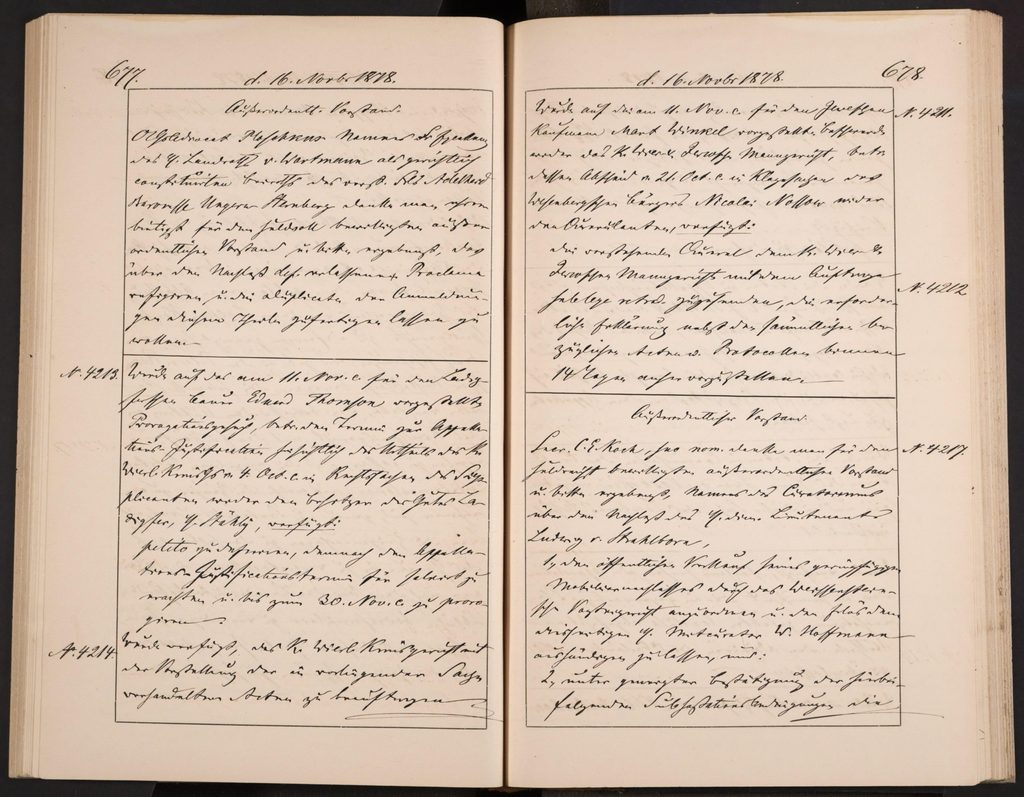
And on November 28, 1878, the Oberlandgericht ordered that official summonses regarding the estate of retired Lieutenant Ludwig von Strahlborn be forwarded to St. Petersburg for publication in the “Senate Announcements” (Senatsbekanntmachungen) – in case his lawful heirs or old creditors should be found deep within the empire.
As we recall, Praskovya and their daughter Elizaveta were already resting in Russian churchyards by that time, but Ludwig still had three sons – Fyodor, Lev, and Konstantin, whom their mother had gone to such lengths to enroll in Part 2 of the noble genealogical book of the Vladimir province back in 1849. Their subsequent fate remains a blank spot, and for over six months no one ever responded to the Reval summons.
Thus ended the earthly odyssey of Ludwig Karlovich von Strahlborn – a man who began his journey on Baltic estates, turned the heads of provincial young ladies at balls in Gavrilov Posad, litigated in Warsaw under the eye of Chopin’s godfather, and met a quiet old age in his own house across from a church he preferred not to enter.
And as a final brushstroke to this portrait, one cannot help recalling another archival curiosity that rhymes all too well with his Warsaw and Estonian adventures. Preserved in Russian archives are two thick files concerning the search for the owner of an unclaimed Savings Treasury note from 1843 worth 151 rubles and 27 kopecks, issued in the name of Lieutenant Ludwig von Strahlborn. While our hero was hiding from Vladimir bailiffs, suing Warsaw property owners, and leading a reclusive life in Weißenstein, the unhurried bureaucratic machine of the Russian Empire spent decades – right up to the very first days of the 1917 revolution(!) – stubbornly searching for him across every department and province to hand over those rightful hundred and fifty rubles.
There is something both touching and comical about this treasury note that missed its recipient. The man spent his entire life chasing phantom thousands and fled to the ends of the earth from his own debts, while the state spent another forty years after his death trying in vain to give him back his money. Such is the bureaucratic irony of fate.
← Read Chapter V | To be continued…
Archival Sources
I. National Archives of Estonia (Rahvusarhiiv – EAA / Saaga)
- File on deportation from Warsaw (1857): Chancellery of the Governor of Estonia (Eestimaa kuberneri kantselei). EAA.29.3.4503 – “Akte betreffend die Ausweisung des verabschiedeten Leutnants Ludwig-Karl von Strahlborn aus Warschau in seine Heimat, in Reval” (begun 28.09.1857, incl. dispatch from the Office of the Warsaw Military Governor-General of 12/24.09.1857 No. 4793, inc. No. 5457) – record in AIS.
- Parish Death Record (1878): Holy Cross Congregation in Paide / Weißenstein (EELK Paide Püha Risti kogudus). EAA.3159.1.405 (or register of deaths for 1878, p. 36, entry No. 44: death 31.10.1878, burial 04.11.1878, Ludwig E. v. Strahlborn).
- Protocols of the Weißenstein Bailiff’s Court (1878): Paide Bailiff’s Court (Paide foogtikohus). EAA.991.1.705 – “Protokolle” (07.01.1878–30.12.1878): entry No. 314 of 04/08.11.1878 (estate inventory), entry No. 331 of 18.11.1878 (scheduling of auction), entry No. 107 of 15.12.1878 (public auction of house No. 23) – record in AIS.
- Protocols of the Estonian Oberlandgericht (1878): Supreme Land Court in Reval (Eestimaa ülemmaakohus). EAA.858.1.394 – “Zivil-Protokolle” (1878): sessions of 02.11.1878 (No. 3926–3933, petition of Therese von Hueck and C. E. Koch), 16.11.1878 (No. 4217–4218, auction conditions for plot No. 23 / 28), and 28.11.1878 (No. 4338–4341, forwarding of proclamation to the Senate Announcements) – view on Saaga | record in AIS.
- Historical plans and maps of Weißenstein (Paide): Town plan indicating plot No. 23 / 28 – record in AIS.
II. Polish State Archives and Notarial Registers
- Notarial Act of Ludwig von Strahlborn and Franciszek Wardak (1856): State Archive in Warsaw (Archiwum Państwowe w Warszawie). Fond 72/751/0 – Chancellery of Notary Józef Przysiecki in Warsaw (Kancelaria Józefa Przysieckiego notariusza w Warszawie), unit 41 (Repertorium for 1855–1857), acts No. 357 and No. 358 of May 19/31, 1856 – view in Skanoteka database.
III. Digitized 19th-Century Press (DIGAR and CRISPA)
- Arrival of Ludwig von Strahlborn in Reval (1857): Estonian Governorate Gazette (Estländische Gouvernements-Zeitung), No. 28 of July 15, 1857, section “Angekommene Reisende” (arrival on July 6, 1857, from St. Petersburg aboard the steamship “Fürst Menschikoff”).
- Summons of Heirs and Creditors (1878): Estonian Governorate Gazette (Estländische Gouvernements-Zeitung = Eestimaa Kubermangu Teataja), No. 118 of November 9, 1878, and No. 122 of November 23, 1878 (proclamation of the Estonian Oberlandgericht dated November 2, 1878) – view in DIGAR database.
- Warsaw Chronicle of the Wardak Family and Plot No. 151 in Praga (1844–1868): Kurjer Warszawski (No. 43 of February 14, 1844 – donation by Andrzej Wardak, owner of plot No. 151 in Praga) and publications in Warsaw gazettes for 1857 (search for Franciszek Wardak of Powązki, missing since February 22, 1857) and for 1865–1868 (auctions of the real estate of Andrzej Wardak’s heirs in Praga at No. 151) – search in the Digital Library of the University of Warsaw CRISPA.
IV. Yaroslavl Archive
- GKU YaO GAYaO F. 193 Op. 3 D. 53 File on the guardianship over the property of the missing Second Lieutenant von Straelbern
🌿Genealogical Chart of the von Strahlborn, Tregubov, and Lyalin Families
ST1 Karl Friedrich von Strahlborn (Feb 8, 1755 – May 27, 1824, Reval / Tallinn), wife: Elisabeth Ernestine von Strahlborn (June 20, 1770 – Oct 11, 1810)
- ST1.1 Alexander Karlovich von Strahlborn / Alexander von Strahlborn (born Sep 1, 1802, Estonia), wife: Irina Ivanovna Tregubova
- ST1.1.1 Nadezhda Alexandrovna von Strahlborn (born 1837), husband: Alexander Nikolayevich Vladimirov (born 1823)
- 1.1.1.1 Olga Alexandrovna Nikolskaya (née Vladimirova)
- 1.1.1.2 Nikolai Alexandrovich Vladimirov (born 1862)
- ST1.1.1 Nadezhda Alexandrovna von Strahlborn (born 1837), husband: Alexander Nikolayevich Vladimirov (born 1823)
- ST1.2 Ludwig Karlovich von Strahlborn / Ludwig Karl von Strahlborn (Jan 29, 1805, Estonia – Oct 31, 1878, Weißenstein / Paide), wife: Praskovya Ivanovna Tregubova (1802–1868)
- ST1.2.1 Fyodor Ludwigovich von Strahlborn (born July 8, 1831, village of Rykovo)
- ST1.2.2 Elizaveta Ludwigovna von Strahlborn (1833 – Dec 17, 1875)
- ST1.2.3 Lev Ludwigovich von Strahlborn (born Jan 11, 1835, village of Lychevo)
- ST1.2.4 Konstantin Ludwigovich von Strahlborn (born May 14, 1838, village of Nelshi)
- ST1.3 Wilhelm Eduard von Strahlborn
- ST1.4 Friederike Luise von Hueck (née von Strahlborn)
- ST1.5 Karl Friedrich von Strahlborn
- ST1.6 Heinrich Ferdinand von Strahlborn
- ST1.7 Karoline Elisabeth Koch (née von Strahlborn), husband: First Lieutenant Carl Eduard Koch
- ST1.8 Elisabeth (Betty) Dieckhoff (née von Strahlborn)
- ST1.9 Elisabeth Dieckhoff (née von Strahlborn)
- ST1.10 Maria Theresia von Hueck (née von Strahlborn)
TR1 Ivan Mikhailovich Tregubov (1769–1829), wife: Marina Yakovlevna Tregubova
- TR1.1 Irina Ivanovna Tregubova, husband: Alexander Karlovich von Strahlborn (born Sep 1, 1802, Estonia)
- TR1.2 Praskovya Ivanovna Tregubova (1802–1868), H1 husband: Pyotr Ivanovich Lyalin (died 1830), H2 husband: Ludwig Karlovich von Strahlborn (Jan 29, 1805 – Oct 31, 1878)
- TR1.2.1-H1 Ekaterina Petrovna Lyalina (1824 – Sep 10, 1866), husband: Vasily Fyodorovich Vzmetnev (born 1813)
- TR1.2.2-H1 Marya Petrovna Lyalina (1827 – Mar 3, 1873), husband: Count Alexander Gavrilovich Derionzini (Alexander Derionzini)
- TR1.2.3-H2 Fyodor Ludwigovich von Strahlborn (born July 8, 1831, village of Rykovo)
- TR1.2.4-H2 Elizaveta Ludwigovna von Strahlborn (1833 – Dec 17, 1875)
- TR1.2.5-H2 Lev Ludwigovich von Strahlborn (born Jan 11, 1835, village of Lychevo)
- TR1.2.6-H2 Konstantin Ludwigovich von Strahlborn (born May 14, 1838, village of Nelshi)
- TR1.3 Tatyana Ivanovna Chelishcheva (née Tregubova)
- TR1.4 Ivan Ivanovich Tregubov
- TR1.5 Alexandra Ivanovna Tregubova
- TR1.6 Pyotr Ivanovich Tregubov
- TR1.7 Maria Ivanovna Khrushcheva (née Tregubova)
- TR1.8 Vasily Ivanovich Tregubov
- TR1.9 Alexander Ivanovich Tregubov
L1 Ivan Trofimovich Lyalin (died before 1807), wife: Ekaterina Fedoseevna Lyalina
- L1.1 Pyotr Ivanovich Lyalin (died 1830), wife: Praskovya Ivanovna Tregubova (1802–1868)
- L1.1.1 Ekaterina Petrovna Lyalina (1824 – Sep 10, 1866), husband: Vasily Fyodorovich Vzmetnev (born 1813)
- L1.1.2 Marya Petrovna Lyalina (1827 – Mar 3, 1873), husband: Count Alexander Gavrilovich Derionzini
- L1.2 Tatyana Ivanovna Zakharyina (née Lyalina, died 1878), husband: Vasily Borisovich Zakharyin
