The Trophy Parrot and the Cherry Tree.
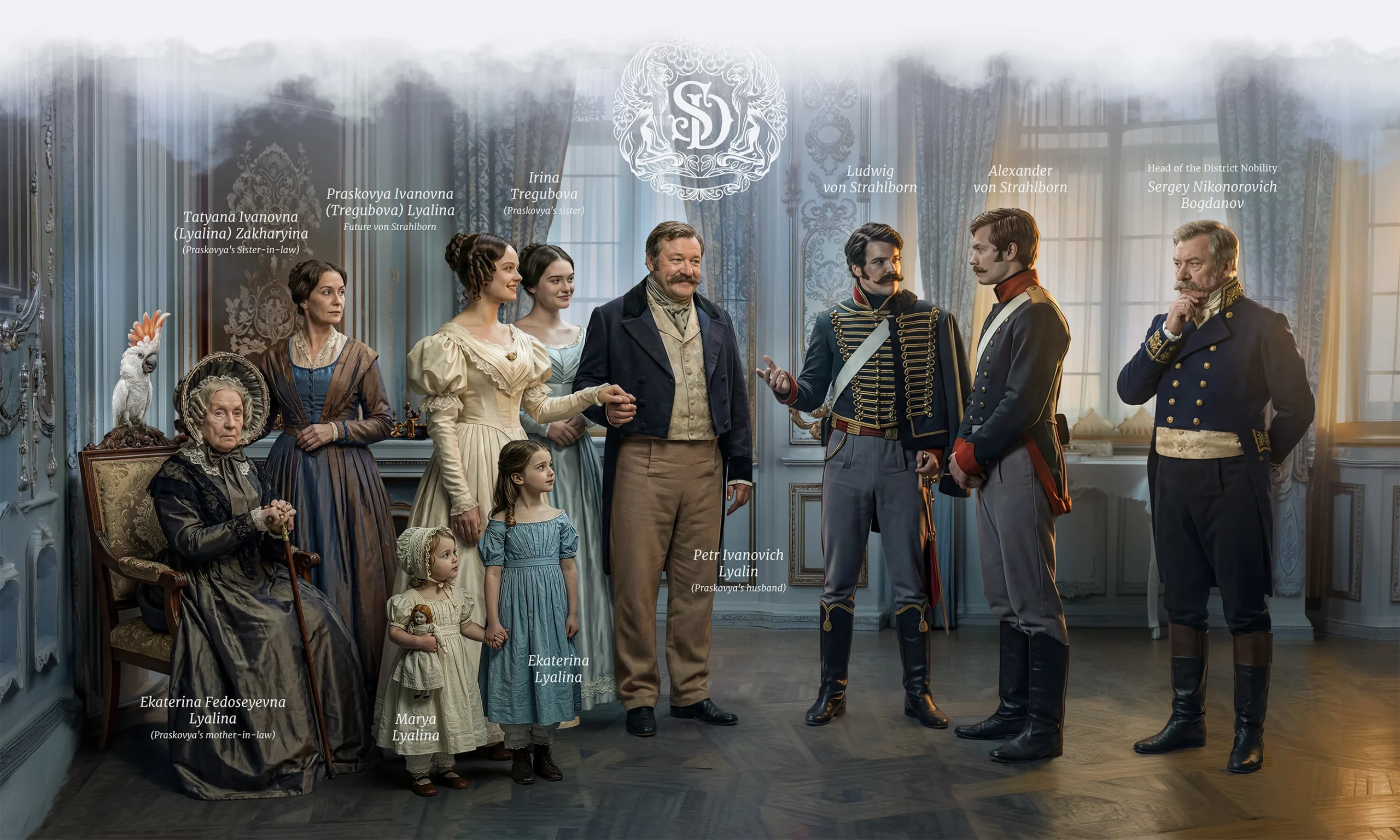
Just a few months after the mysterious death of Second Lieutenant Pyotr Lyalin from rat poison, his inconsolable widow, Praskovya, married the hussar von Strahlborn, who happened to be quartered nearby. Before that, however, the widow had more urgent matters to attend to, namely, determining the inheritance shares for herself and her young daughters.
Very little is known about the late husband himself, yet even the scattered surviving details are enough to paint a remarkably vivid portrait of a man whose biography was anything but ordinary for his circle.
Pyotr lost his father at an early age and was raised by his mother, Ekaterina Fedoseevna, alongside his only sister, Tatyana. By 1809, he was serving as a sub-ensign in the Life Guards Preobrazhensky Regiment. Judging by his age, he could almost have passed for Praskovya’s father; she herself had been born in 1802.
Lyalin took part in the war against Napoleon, but his military career then veered into a rather unfortunate direction. For unauthorized absences, stealing clothes from stores, and neglecting to pay tavern bills in full, he was personally demoted to the ranks by Barclay de Tolly and stripped of his nobility by court order, eventually finding himself in the Yaroslavl Infantry Regiment. Later, he was pardoned and, through persistence or sheer stubbornness, managed to regain the rank of second lieutenant.
You can also listen to a summary describing the events presented in the video.
The music used in both the video and audio formats is Goehr Walter – Bruckner Symph 3 (MMS-2018) 1952; source: archive.org.
The Trophy Parrot.
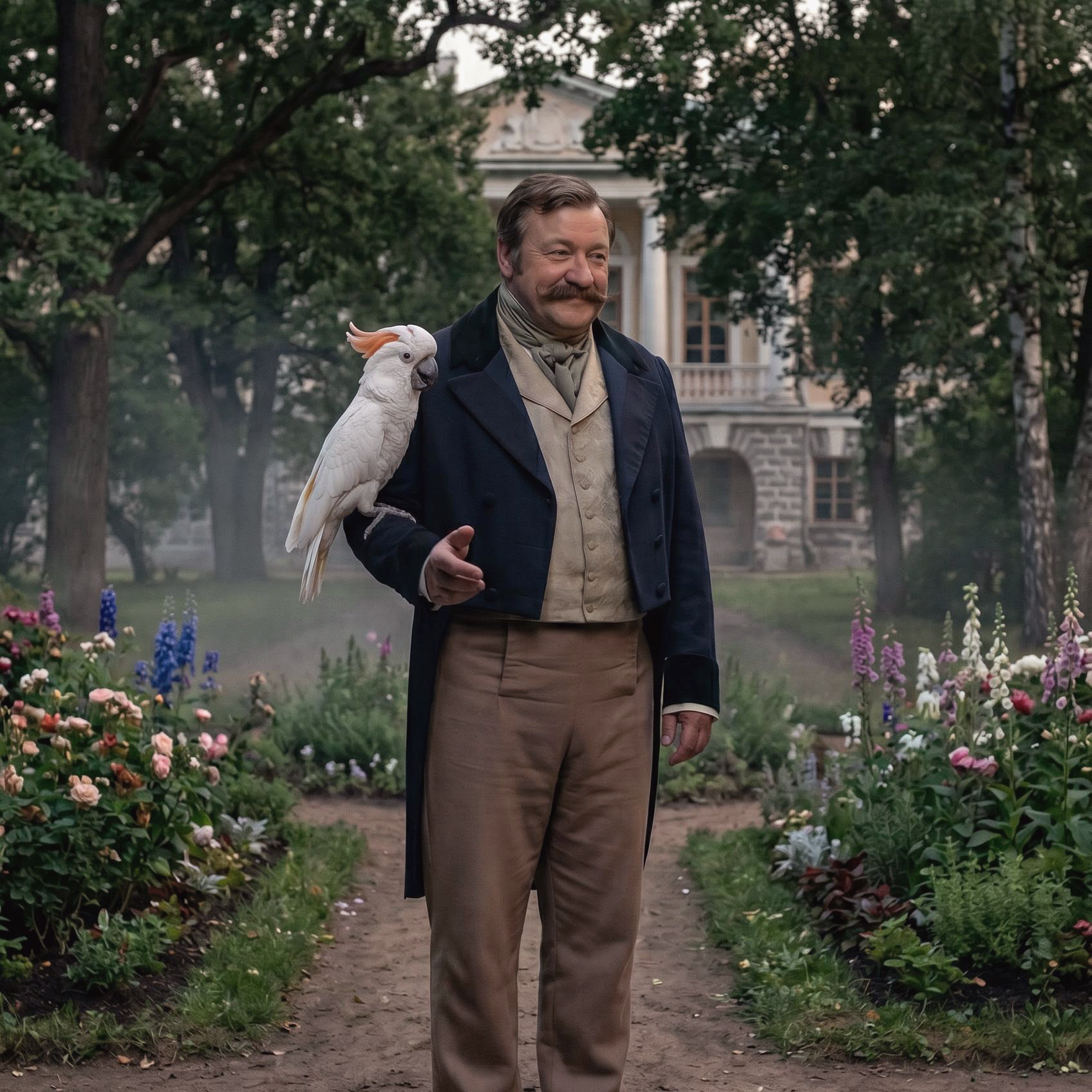
The only genuine trophy Pyotr Ivanovich brought home from the war against Napoleon was a parrot. How exactly the exotic bird came into the possession of a Russian officer remains unknown. Perhaps it was won from a French marquis during a card game; perhaps Pyotr spent his last coins on it at a Paris market instead of purchasing desperately needed boots. In any case, the bird survived the long journey across Europe and eventually settled in Vladimir Province.
In the Lyalin family, the women governed everything: the domineering mother, the severe sister Tatyana, whose formidable character is described in detail in the memoirs of her goddaughter, and the young wife Praskovya. The parrot remained almost the only creature willing to accept Pyotr with all his virtues, flaws, and general impracticalities intact.
One cannot help but picture the bird itself, Pyotr’s favorite companion, perched in the cherry tree from which it solemnly devoured fruit while the household descended into one dispute after another. Thanks to the impressive longevity granted to parrots by nature, the bird outlived many of the principal characters, survived the entire family saga, and silently observed the changing cast of actors from its perch.
From letters and testimonies, a curious image of Pyotr emerges. The reckless adventurer of his youth gradually transformed into a quiet, vulnerable, somewhat old-fashioned landowner. He was remembered as a kind neighbor, genuinely capable of admiring the virtues and successes of others without envy, though he managed his estate poorly enough that control of it effectively passed into the hands of his relatives.
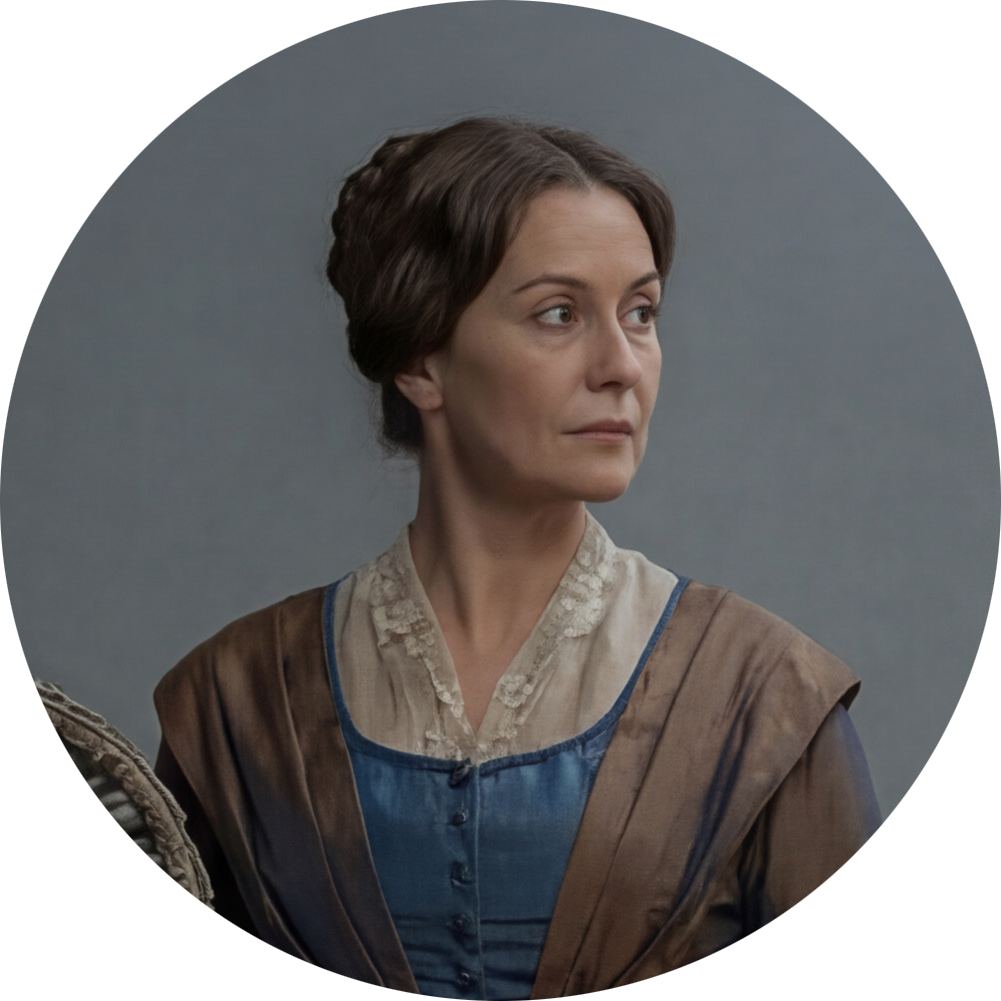
His sister Tatyana, his only blood sibling, possessed a temperament opposite to her brother’s adventurous inclinations. There was also an undercurrent of rivalry between them for their mother’s affection. Tatyana had no children of her own and, according to her sister-in-law Praskovya, Ekaterina Fedoseevna increasingly favored her daughter over her son. Pyotr himself, apparently, felt this imbalance painfully, and it was said to have become one of the reasons for his sudden death.
Tatyana married Vasily Borisovich Zakharyin in 1812 and later took an active role in the lives of her nieces, having no children herself. She lived as a prosperous landowner, avoided extravagance, and considered it her duty to keep the financial affairs of her brother, sister-in-law, and nieces under careful supervision.
The atmosphere in the house meanwhile thickened. Pyotr acutely felt that his mother favored his sister Tatyana Zakharyina (the future godmother of Sofya Tolstaya’s sister). It is possible that the family tension was also amplified by jealousy towards his young wife: brave hussars were quartered nearby, and the lines of an unknown poet could well have been written exactly about their pair:
There are representatives of the nobility
Secretaries and all sorts of nonsense
There are young beauties
There are also jealous husbands
Dashing dandies in tailcoats…
Pyotr’s Final Letter and Inventory
In 1830, Second Lieutenant Lyalin suddenly and severely fell ill. The physical ailment was accompanied by mental distress. Soon he died, leaving behind a young widow, two young daughters, and several letters. One of them, addressed to the local Marshal of Nobility Sergei Nikanorovich Bogdanov, contained the following lines →
Dear Sir,
Sergei Nikanorovich.
For God’s sake, do not blame anyone for my death, no one is to blame. It is hard to survive my mother’s preference for my sister; do not abandon my orphans, I entrust them to you.
Your devoted and most humble servant,
Pyotr Lyalin
Immediately after the tragic outcome, Praskovya prudently decided to go to her mother’s for a while to restore her shattered nerves.
She returned to the estate only to pick up her daughters’ favorite, that very parrot. Entering the study where her husband had spent his last days in a gloomy state of mind, and taking the birdcage, Praskovya stumbled upon Pyotr’s letters. They were addressed to her, to the noble assembly, and to the uyezd marshal of nobility. Allegedly, so as not to upset the relatives, Praskovya hid these papers and remembered them only ten years later, when she decided they could mend her financial affairs (more on this in the next chapter). Many years later, in the guardianship case, she would detail her version of events: her husband could not bear the moral torment and poisoned himself with rat poison “due to the machinations of his own sister Tatyana Zakharyina, who robbed him and took the father away from the children.” Of course, she was an interested party and protected her own interests, so the reliability of her story may raise doubts and leave room for various theories, including highly conspiratorial ones.
But for now, left as the sole guardian over her daughters’ (Ekaterina and Marya) shares, Praskovya simply initiated the inventory of the deceased’s estate.
One cherry tree, standing near the boundary line at the estate, is included in the property of the minor Lyalins.
Archival documents of this kind are surprisingly informative. Officials methodically described the household serfs, peasant allotments, and outbuildings. However, the cherry tree received a separate mention in a special document dating to the first months after Lyalin’s death:
“The Case of the Inclusion of the Cherry Tree, Located at the Estate in the Village of Lychevo, into the Inventory of the Estate of the Minor Lyalins, under the Guardianship of Their Mother Praskovya Lyalina”.
The tree is highlighted separately as standing “at the estate,” rather than as part of the garden, which looks unusual. Obviously, the ownership of the tree growing on the border of plots claimed by different heirs was not obvious even then. A direct dispute is not recorded in the file, but the wording itself reveals its hidden presence. Thus, the cherry tree appears in documents for the first time as a minor bureaucratic detail, destined to take on a much more prominent role over time.
Two Sisters, Two Brothers, and the Uyezd Marshal.
Having finished with the inventory of the property and having mourned her first husband exactly as much as propriety required, just a couple of months later, Praskovya stood before the altar of the regimental church. On September 10, 1830, in the village of Lychevo, she was wed to the cornet of the Kyiv Hussar Regiment, Ludwig von Strahlborn. The witnesses were the regimental rittmeister Alexander Reichekh and the bride’s own brother Ivan Tregubov. In July 1831, the couple’s first son, Fyodor, was born, followed by two more sons and a daughter, Elizaveta.
The hussar regiment stationed in Gavrilov Posad provided the local landowning ladies not only with brilliant balls but also with family continuity. The two blood Tregubov sisters married two hussar brothers, the von Strahlborn: Alexander married Irina, and Ludwig married the widowed Praskovya. Thus, the Estonian brothers found in the Vladimir province not only a rest from military exploits but also a solid dowry.

The sisters’ father died in 1829, a year before this double wedding. As archival files show, the still-unmarried Irina instructed my direct ancestor, the village headman Vasily Afanasyev Bogdanov, to inventory the estate and mortgage it along with the peasants to the Moscow Guardianship Council for the sum of 3,800 rubles. The decision to mortgage was clearly linked to the upcoming wedding. Notably, one of the documents was signed on behalf of the illiterate headman by Irina’s future husband, Staff-Rittmeister Alexander von Strahlborn, taking a very direct part in pledging the bride’s property.


However, there was one superfluous element in this marital-financial idyll. His name was Sergei Nikanorovich Bogdanov – the local marshal of nobility and the addressee of Lyalin’s suicide note.
A friend of the deceased, he belonged to the type of people respectfully called “defenders of the truth” in obituaries. Sergei Nikanorovich was pathologically virtuous. Having no family of his own, he zealously unleashed all his unspent care upon Praskovya’s daughters and upon herself.
Bogdanov became a real thorn in the side of Praskovya and her entourage. Every attempt by the newlyweds to manage the property encountered his resistance and complaints to various authorities. He was an exceptionally honest man who sincerely believed he was saving the orphans from their mother’s frivolity. As his contemporaries wrote of him:
“An enemy of all intrigues, of any two-faced act, the deceased was always a defender of the truth. He used every means to support the falling, to save the unfortunate guilty, to help the poor. Entire families were benefacted by him materially; noticing abilities in a person, he gave them the opportunity to apply them to action, and many people are still alive who owe their well-being to him and, of course, fervently pray for the repose of the soul of their benefactor, Sergei Nikanorovich Bogdanov.”
Subsequently, the fates of the Strahlborn brothers turned out differently. After his marriage, Alexander retired from military service, became a district police officer, and remained in this post for a couple of decades. He did not find himself in the center of scandals and did not appear in a negative context, unlike his wife Irina, who periodically participated in judicial conflicts with peasants.
Ludwig, on the other hand, did not trouble himself with civil service. He served as an imposing heartthrob who loved entertainment and wine. With these qualities, he forced every mamzelle hired to educate his stepdaughters to flee across the fields in search of protection from neighboring landowners. The retired lieutenant Ludwig von Strahlborn’s behavior was testified to by his stepdaughter, the peasants, and that very marshal of nobility, Bogdanov. The eldest stepdaughter, Ekaterina, reported:
«He inflicted punishments on the household serfs, because of which a servant girl ran away. Moreover, the indecent curses he utters, which not only should not reach the ears of noble maidens, but even the lower class».
The peasants, in turn, complained about his hot temper and harsh treatment. Apparently, he was equally lacking in practicality and common sense; numerous announcements in the Senate gazettes are replete with summons for him to court over debts, property disputes, and other similar claims.

← Read the “Introduction” | Meet the Characters | Continued in Chapter II →
