Moscow Almshouses, the Criminal Investigation of 1814, and the Traveling Trunk of Annibal de Rionzini
Following the adventures of the restless Lieutenant Ludwig Karlovich von Strahlborn in Warsaw and quiet Estonian Weissenstein, the plot of our archival saga takes an even more dizzying turn. This time, the thread of the investigation leads us out of Vladimir Province straight into the merchant and burgher lanes of old Moscow, and from there to Vienna, Venice, The Hague, and a good dozen eighteenth-century European cities on the trail of the mysterious Italian Counts Derionzini (De-rion-zini / de Rionzini / de Rion Zini).
In previous chapters, as we examined the noisy 1844 case concerning the elopement of a nobleman’s daughter from the Strahlborn household, a new and, as it initially seemed, entirely minor character flashed across the background. He was the young son-in-law of the landowner Praskovya Ivanovna von Strahlborn (née Tregubova, 1802-1868, the husband of her younger daughter from her first marriage to Second Lieutenant Pyotr Ivanovich Lyalin (who had died by taking poison, Maria Petrovna Lyalina. The young husband was styled nothing less than Count Alexander Gavrilovich Derionzini. As for Maria Petrovna herself, after her marriage she took obvious pleasure in signing all official papers as the “Italian Countess Derionzini.”


Maria Petrovna Lyalina and her husband, Count Alexander Gavrilovich Derionzini
The young couple had more than enough occasions to flaunt their aristocratic title across the entire Russian Empire. Whenever another official notice of a court summons appeared in the St. Petersburg “Senate Announcements”, whether it was a fierce dispute over the ownership of a boundary cherry tree, litigation over peasant hayfields, or the recovery of a microscopic debt of 50 rubles, the comital title of the Derionzini family proudly soared above the dry bureaucratic phrasing. There was no shortage of such notices: apart from a resonant Italian name and a count’s coronet, all the young husband had to his name was a modest post as a chancery clerk (first in the Vladimir Noble Deputy Assembly, and later in the 7th Department of the Governing Senate in Moscow) and an impressive collection of petty promissory notes.
One episode from this judicial chronicle paints the couple’s financial standing more eloquently than any inventory. In yet another lawsuit, where Alexander Gavrilovich desperately refused to remain the losing party and was already preparing to file an appeal, he was forced to officially abandon his claim. The reason proved painfully prosaic: the illustrious count simply had no money to pay the state court fee, and he chose instead to sign a formal declaration of his own insolvency.
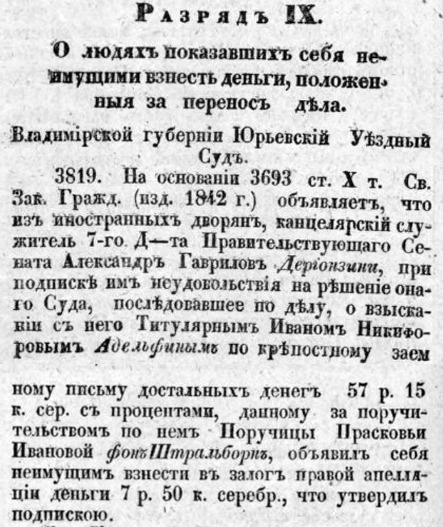
CATEGORY IX.
On persons who have declared themselves indigent to pay the money required for transferring a case.
Yuryev District Court of Vladimir Province.
Pursuant to Art. 3693, Vol. X of the Digest of Civil Laws (1842 ed., hereby announces that Alexander Gavrilov Derionzini, of foreign nobility, chancery clerk of the 7th Dept. of the Governing Senate, upon signing his dissatisfaction with the decision of said Court rendered in the case concerning the recovery from him by Titular Councillor Ivan Nikiforov Adelfin, under a notarized loan letter, of the remaining sum of 57 rubles 15 kopecks in silver with interest, issued under the surety of Lieutenant’s Wife Praskovya Ivanova von Strahlborn, declared himself indigent to deposit the 7 rubles 50 kopecks in silver required as security for a lawful appeal, which he affirmed by his signature.
The figure of this provincial “Italian count” intrigued me for several reasons at once. By the mid-1840s, the Strahlborn family was by no means rolling in luxury; rather, they represented an encyclopedia of economic disasters. Both Praskovya Ivanovna herself and her fugitive husband Ludwig were up to their ears in debt and endless litigation; their estates were remortgaged, and due to mismanaged administration, their real estate had been placed under noble guardianship altogether. One might ask: what genuine count in his right mind would covet such a modest and troubled dowry as the one Maria Petrovna inherited from her late father upon coming of age?
Once again, I was reminded that there are simply no random characters in this archival series. I was determined to find out where this Italian count had come from, who his European ancestors were, what winds had blown them to Russia, and why, by the mid-nineteenth century, nothing remained of their former grandeur but a handsome surname.
Moscow in 1812: A Count of “Good Character” Under Arrest and the Magic of Wildcards in the Archives
In Russian history, the Counts Derionzini were never public figures. Their names cannot be found in society chronicles, nor in imperial orders granting generalships and decorations, nor on the sprawling family trees of classical noble genealogical reference books. In essence, their forgotten biographies have taken on flesh and blood only in our own day, thanks to technologies for the automated optical recognition of handwritten archival holdings.
At first, a superficial search in open Russian sources yielded only a couple of meager clues. First, the surname Derionzini flashed on the Vladimir local history forum “Opolye” in a list of local landowners of the mid-nineteenth century (that very couple, Maria Petrovna Lyalina and Alexander Gavrilovich Derionzini, as well as in general consolidated lists of titled families of the Russian Empire of foreign origin. Second, the rare surname turned up in the monumental two-volume documentary collection

After Emperor Napoleon Bonaparte’s army abandoned devastated Moscow, the police compiled detailed ward-by-ward registers of residents who had not left the city prior to the enemy’s entry. These lists meticulously recorded each person’s social estate, occupation, the reasons they had remained in the occupied capital, the nature of their conduct under the French, and their overall degree of political reliability.
And there, among other Moscow residents of the Yakimanskaya District living in house No. 265 belonging to Collegiate Registrar’s Wife Natalya Dmitrievna Verigina (see also the confessional list: CGA Mos, f. 203, op. 747, d. 849, l. 130, two bearers of the surname in question turned up at once: the future father of our Vladimir son-in-law, Gavrila Klementyevich Derionzini (born c. 1780/1784, cautiously recorded by the police as “styling himself an Italian count” and his relative (as soon became clear from confessional lists, his first cousin, the copyist Alexander Alexandrovich Derionzini.
Both relatives explained to the authorities that they had failed to leave Moscow before the enemy invasion solely “out of poverty and ignorance.” And although in one column both were attested as men “of good character,” Gavrila Klementyevich’s exit from the Napoleonic epic proved quite scandalous: the landlady, Natalya Verigina, accused her lodger of having pilfered her hidden property under cover of the general chaos. For this, the tenant, “styling himself a count,” now marked “of bad conduct,” was sent straight to the prison castle pending an investigation.
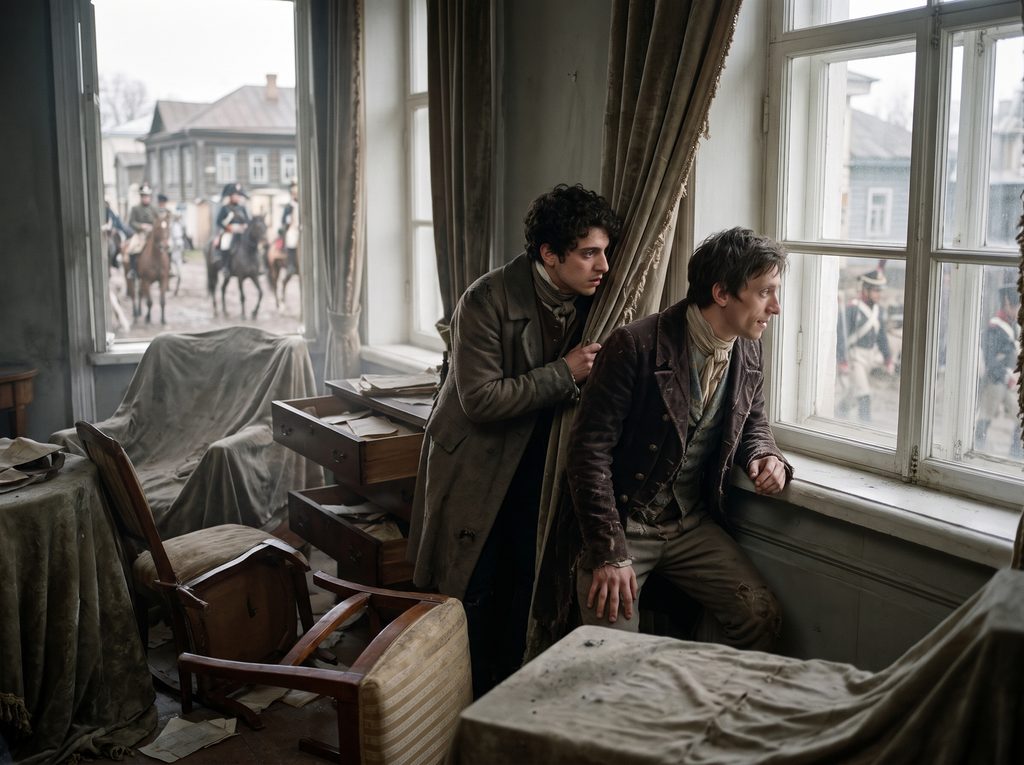
To clarify the picture, I put to use my favorite method of searching the digitized holdings of “Yandex.Archives” using truncated word stems and asterisk wildcards. The task was complicated by the fact that the long foreign surname gave Moscow parish clerks and chancery scribes a hard time: each mangled it according to his own imagination (Derionzin, Derionzina, Derionzio, Dereozni, Dereozina, Derinzini…, and neural-network text recognition algorithms added another dozen bizarre mutations on top. Nevertheless, the flanking maneuver worked flawlessly: where a direct query yielded only isolated hits, I managed to gather more than a hundred archival mentions of the family in Moscow starting from the second half of the eighteenth century!
The Big Archival Catch: Three Moscow Cases and Two Viennese Folders
In addition to over a hundred parish register entries, marriage inquiries, and confessional lists fished out of “Yandex.Archives,” the real breakthrough came from three voluminous archival files in the Central State Archive of the City of Moscow (CGA Mos) and two unexpected finds in the catalogs of the Austrian State Archives in Vienna:
- The Consistory File of February 1776, “On the petition of Clement Augustus Derionzini, of the Catholic faith, to enter into lawful marriage with Evfimia Fyodorova, of the Orthodox faith, widow of a man eternally emancipated by Brigadier Mikhail Alexandrovich Zybin” (CGA Mos, f. 203, op. 761, bundle 2289, d. 44, l. 18, which preserved inside it a copy of a passport issued by the State College of Foreign Affairs on May 15, 1761, containing Klementy’s youthful interrogation, a copy of a guild ticket from the Moscow Magistrate dated March 8, 1771, and a copy of the bride’s certificate of emancipation dated June 14, 1774.
- The Civil Court Case of 1790-1798 (144 folios) on the lawsuit of “Afimya Fyodorova, wife of the Italian master goldsmith Klementy Pavlov son of Derionzini, against Captain’s Wife Elisaveta Ivanova Defosh” concerning the non-return of diamonds, snuffboxes, and a debt for seven months of room and board (CGA Mos, f. 81, op. 2, t. 2, l. 63, Nos. 1711, 1822, 1882, 2003).
- The Criminal Investigation File of 1814 concerning the strangulation of Lieutenant Molchanov (Moltschanow; CGA Mos, vyazka 493, d. 106481 / f. 50, op. 2, t. 1, p. 105, into which Moscow detectives, verifying on what grounds the suspect Gavrila Derionzini styled himself a count, bound a Russian translation of old European passports and baptismal certificates from 1727-1752, certified back on July 24, 1790, at the Moscow Roman Catholic Church of Saints Peter and Paul (Ecclesia SS. Petri et Pauli).
- Two Dossiers in the Austrian State Archives in Vienna (discovered thanks to a colleague’s tip and old printed inventories on Archive.org, Archivalien zur neueren Geschichte Österreichs, 1907, p. 427 and p. 706): the 1739-1740 correspondence of Annibale Pauli de Rion Zini (Annibale Pauli de Rion Zini / Pauli de Rionzinni) with the Minister Plenipotentiary of the Austrian Netherlands, Count Friedrich August von Harrach-Rohrau (AT-OeStA/AVA FA Harrach Fam. in spec 568.25, as well as an inquiry from 1846-1851 by Alexander Rionzini requesting official confirmation regarding the comital title allegedly belonging to his family (AT-OeStA/AVA Adel HAA AR 798.43).
So as not to get lost in the intricacies of four generations or jump back and forth between eras, let us first travel to the most distant past preserved in the family papers and retrace the entire journey of the Derionzini family step by step, from the roads of Western Europe in the first half of the eighteenth century to Moscow and Vladimir Province in the mid-nineteenth century.
I. The Traveling Trunk of a Venetian Count: A European Grand Tour and High-Ranking Godparents (1727-1750)
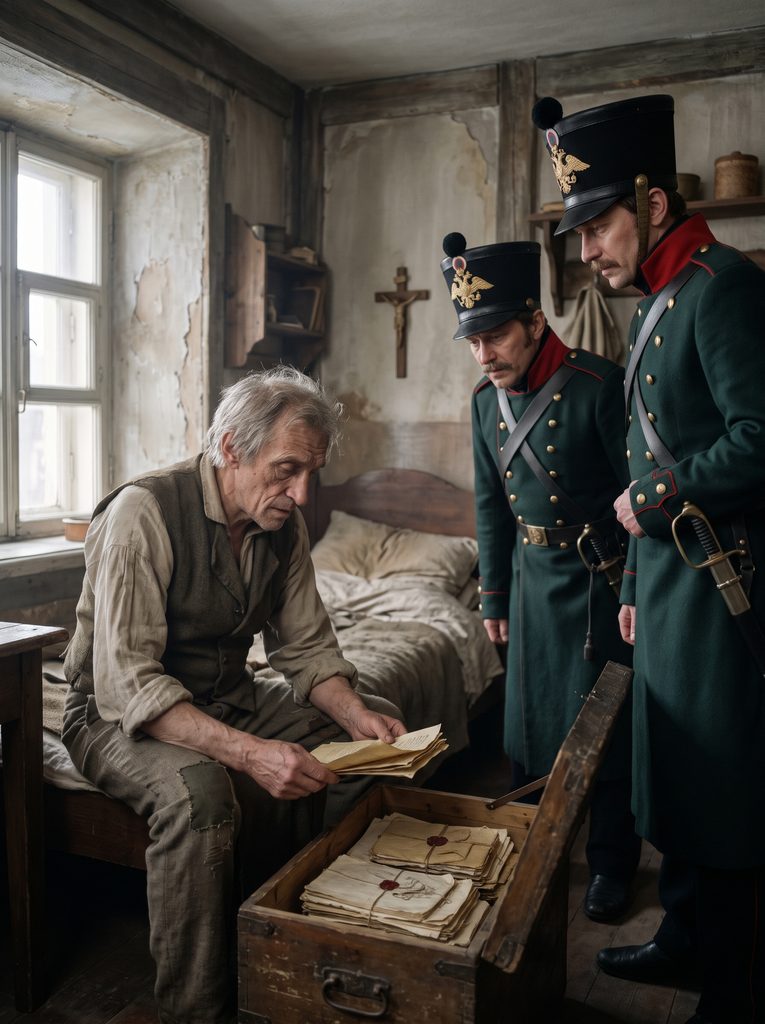
The family’s earliest documents survived thanks to the skepticism of the Moscow police. In 1814 (shortly after Napoleon’s invasion), Gavrila Klementyevich Derionzini came under investigation in the high-profile criminal case concerning the strangulation of Lieutenant Molchanov; detectives demanded proof of his comital dignity and went to the almshouse to see his elderly father, Klementy Pavlovich Derionzini (Clemens Augustus de Rionzini, 1744-1816). In the old man’s trunk, they found a packet of copies of European travel passports and church certificates in Latin, French, and Italian, transcribed from the originals and sealed by the Moscow Catholic church on July 24, 1790, by Father Tadeusz Oliczewski.
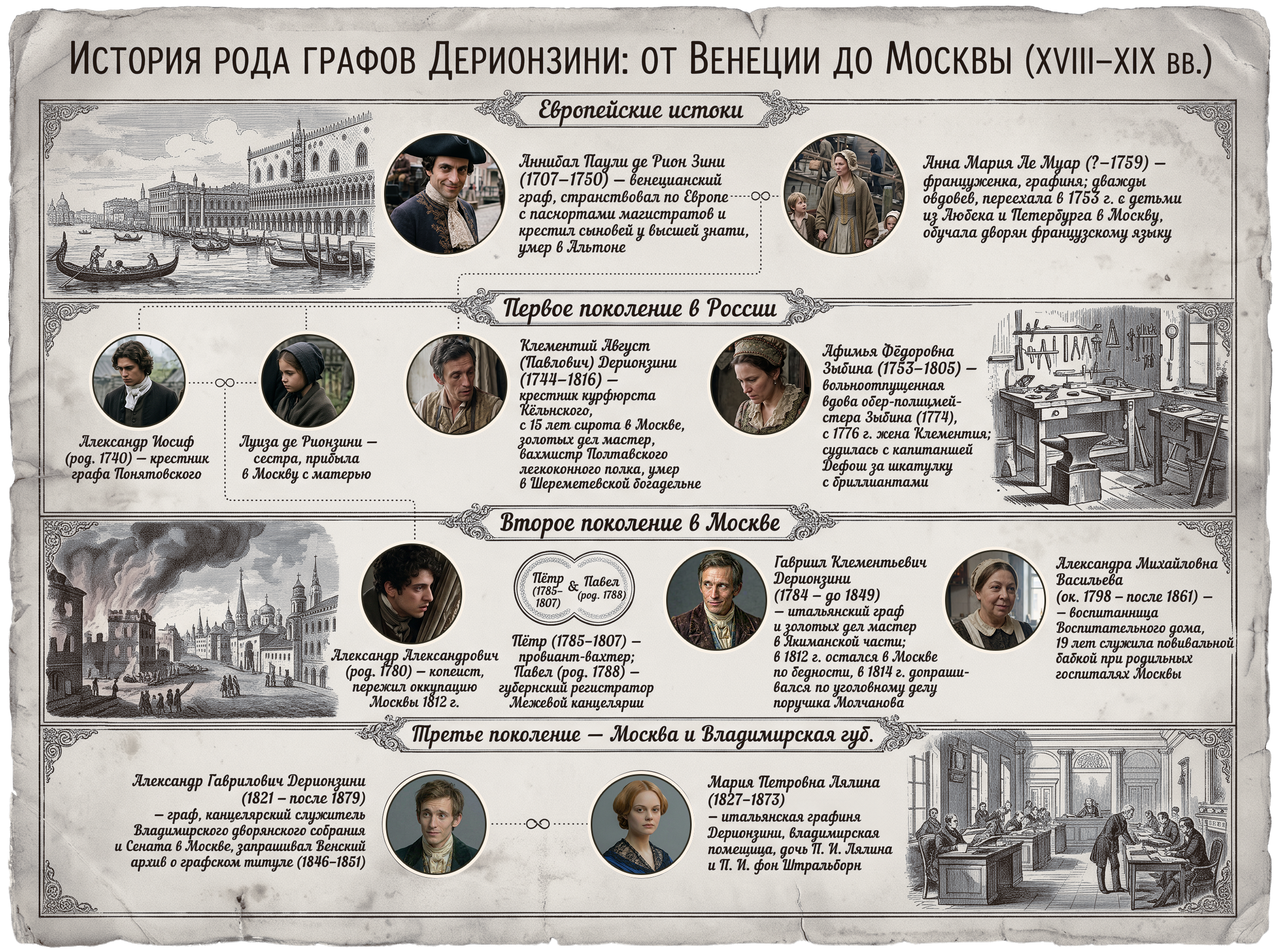
The protagonist of these papers and founder of the dynasty turned out to be a native of Venice (Venezia, Count Annibal Pauli Rion de Zini (Annibal Pauli de Rionzini, c. 1707 – November 19, 1750, the very man whose 1739-1740 correspondence with Count Friedrich August von Harrach-Rohrau, Minister Plenipotentiary of the Austrian Netherlands, was preserved in the Vienna archives!
The travel certificates trace a twenty-three-year itinerary of the Venetian aristocrat’s movements across Western Europe, reading like an early eighteenth-century picaresque novel:
- Autumn 1727 – The Côte d’Azur of France (France). On September 30, 1727, the consuls and governors of the city of Toulon, commissioners of police, and administrators of the valley of Val d’Ardenne issue a passport bearing the municipal coat of arms to a twenty-year-old native of Venice (“from Venise”, a man “of medium stature,” Count Annibal Rion de Zini, and his servant Stephan Dory, bound for Nice.
- 1730-1734 – From Brittany and Flanders (Flandria) to the Loire Valley. In May and December 1730, the Venetian count resides in Flemish Lille, having arrived there from the Breton town of Bain (Bain-de-Bretagne) with a certificate from the mayor (seneschal) and sole judge of the Barony of La Marzelière and Bain (Baronnie de La Marzelière et de Bain, subdelegate of the Intendant of the Province of Brittany (Bretagne, Monsieur de Lambilly; and on January 8, 1734, he receives a new travel certificate after a fifteen-day stay in the historic French city of Blois.
- June 1734 – Marriage and Passage Through Switzerland. On June 2, 1734, the governor of the Castle of Joux (the border mountain fortress Château de Joux) of the town and district of Pontarlier in Franche-Comté records in the margin of the Blois passport an important change in the 27-year-old traveler’s life: Count Annibal is now traveling toward Venice together with his young wife, the Frenchwoman Anna Maria Le Moir (Le Moire). Having spent their honeymoon in Lausanne, Switzerland, where the couple “conducted themselves as honest and noble persons,” on June 29, 1734, they received two formal passports at once from the authorities of Lausanne and the Republic of Bern, instructing all officials along their route to Italy (Italia) and back “to assist them in every way.”
- Certificate of the Venetian Resident in London Issued by Giacomo Busenello on September 11, 1736, to Annibal Pauli di Rionzini. Giacomo Busenello arrived in London and assumed his post as Resident on August 10, 1736, meaning he wrote out a certificate for our Annibal Pauli literally three weeks after his arrival in England. Less than a year later, on July 4, 1737, a major international scandal erupted in London: King George II of Great Britain officially expelled Giacomo Busenello from the country. Simultaneously with Giacomo, our Annibal also leaves London, and both turn up at the same time in the south of France!
- Spring 1738 – Languedoc. By April 10, 1738, the count and countess have been living for six months in the south of France, in the university city of Montpellier, and once again receive a passport to return to their homeland from the Royal Intendant of Languedoc, Louis-Basile de Bernage* (rendered in the 1790 Russian translation as Lev Vasily de Bernazh).
*Louis-Basile de Bernage, Seigneur de Saint-Maurice, Vaux, and Chassy (1691-1767; in the 1790 Russian translation, “Lev Vasily de Bernazh, Lord of Saint Maurice, Vaux, Chassy, and other places”, French statesman, Councillor of State, Knight Grand Cross of the Royal and Military Order of Saint Louis, Royal Intendant of the Province of Languedoc in Montpellier (1725-1743, and later Provost of the Merchants (mayor) of Paris (1743-1757).
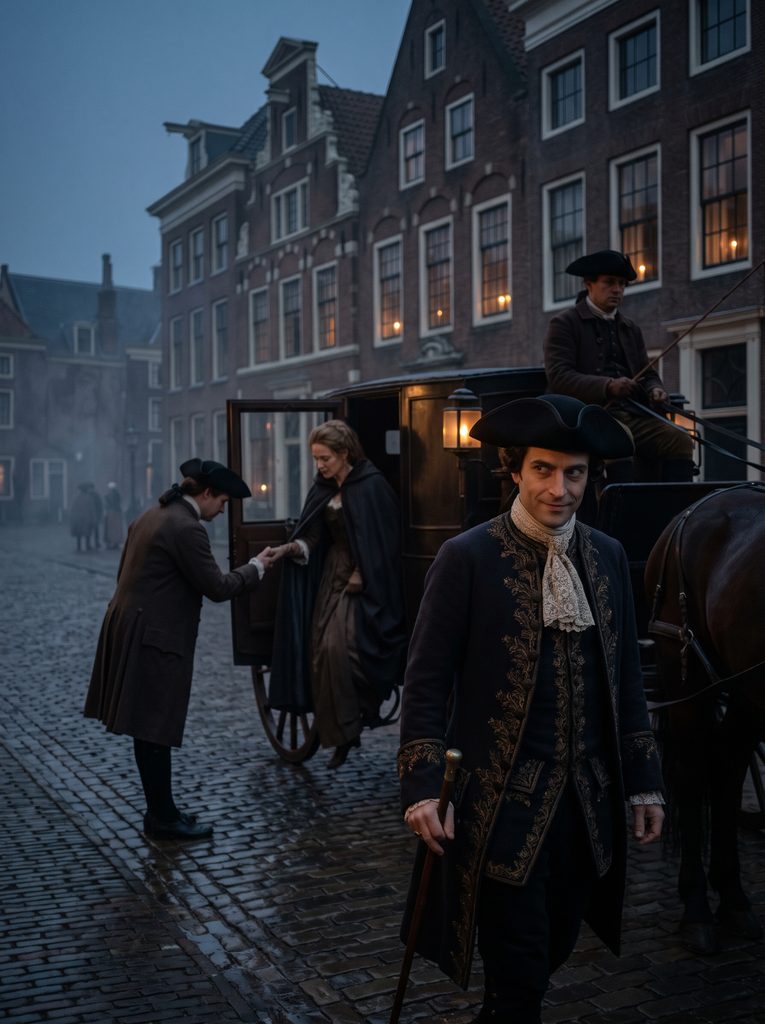
While the travel passports characterized Annibal Pauli as a noble traveler, church records of his sons’ baptisms in the 1740s show a royal level of connections. Leading figures of European politics and diplomacy agreed to stand as godparents to the Venetian count’s children:
Baptismal Record No. 1. Baptism of the Eldest Son, Alexander Joseph (April 26, 1740, The Hague)
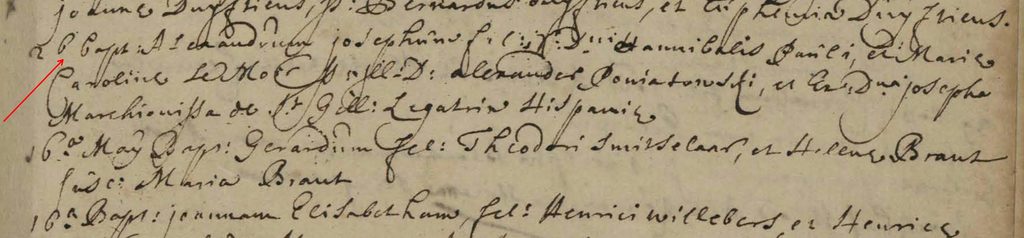
On April 26, 1740, the christening of Annibal Pauli’s firstborn took place in the Chapel of the French Envoy on Casuariestraat (Kapel van de Franse gezant aan de Casuariestraat) in the very heart of The Hague, where Count Alexander Poniatowski* and the wife of the Spanish envoy in The Hague, the Marquise de Saint-Gilles**, met at the baptismal font!
*Count Alexander Poniatowski (Aleksander Poniatowski, 1725-1744, scion of the Polish magnate House of Poniatowski (Alexander was the son of Stanisław Poniatowski, Castellan of Kraków, and the full brother of the future last King of the Polish-Lithuanian Commonwealth, Stanisław August).
**Wife of the serving ambassador of the Spanish Crown to the Netherlands (The Hague, the Marquise de Saint-Gilles (Marquise de Saint-Gilles / Marquesa de San Gil).
Archive and Holding: Municipal Archive of The Hague (Haags Gemeentearchief, Toegangsnummer 0377-01, Inv.nr. 345, bl. 161; alphabetical index card of the father: Inv.nr. 6364, scan 64). Also known from the certified extract of July 24, 1790, from the Moscow Church of Saints Peter and Paul (CGA Mos, vyazka 493, d. 106481, ll. 11-11v). Parish: Chapel of the French Envoy on Casuariestraat (Kapel van de Franse gezant aan de Casuariestraat / Frankrijks Kerk) in The Hague (’s-Gravenhage / Den Haag, Holland (according to the 1790 extract, the baptism was performed by the Jesuit and apostolic missionary Wilhelmus Matthias, S.J.).
Text: 26 [Aprilis 1740] Bapt[izavi] Alexandrum Josephum, fil[ium] D[omi]ni Hannibalis Pauli et Mariæ Carolinæ Le Moir; s[usceptore]s: Ill[ustrissimus] D[ominus] Alexander Poniatowski et Ex[cellentissima] D[omi]na Josepha Marchionissa de St. Gill[es], Legatrix Hispaniæ.
“On the 26th [of April 1740], I baptized Alexander Joseph, son of Lord Hannibal Pauli and Maria Carolina Le Moir; godparents: the Most Illustrious Lord Alexander Poniatowski and the Most Excellent Lady Josepha, Marquise de Saint-Gilles, Ambassadress of Spain**.”
The Poniatowski family was indeed in The Hague in 1740. According to dispatches from the British envoy in The Hague, Robert Trevor, in 1740 the head of the family, the renowned diplomat and military commander Stanisław Poniatowski (1676-1762, father of Alexander and of the future King Stanisław August, arrived in The Hague in person together with his elder sons.
In The Hague, the elder Poniatowski conducted closed-door negotiations with French and Swedish diplomats (including the Swedish envoy Baron Joachim Fredrik Preis and the French diplomat Chavigny) on the eve of his official mission to the court of Louis XV in Paris.
British envoy Trevor specifically reported to London that when General Poniatowski left The Hague for six weeks in August 1740 to take the waters at Aachen (Aix-la-Chapelle, his son remained behind in The Hague at the residence of Envoy Preis, arousing British suspicions that a new Franco-Swedish-Polish alliance was being prepared.
General Poniatowski’s sons (the eldest, Kazimierz, born in 1721, and Alexander, born on June 6, 1725, in Gdańsk) were just then, in 1739-1741, making their European educational Grand Tour through Holland and France before young Alexander entered the French Royal Army as an officer (in whose ranks he would be killed on the Rhine in July 1744 at the age of 19).
Marsha Keith Schuchard, “Emanuel Swedenborg, Secret Agent on Earth and in Heaven”, Brill, Leiden-Boston, 2012, Chapter 9: “On the Threshold in Holland, England, and Sweden”
Baptismal Record No. 2. Baptism of the Son Johann Adrian Wilhelm Albert Alexander (April 26, 1742, Kleve)

Archive and Holding: State Archive of North Rhine-Westphalia, Rhineland Department (Landesarchiv Nordrhein-Westfalen, Abteilung Rheinland, formerly Personenstandsarchiv Rheinland, collection of parish registers (Kirchenbücher, reference BA 1275 (Catholic baptismal registers of the town of Kleve, 1730-1798). View register in DFG-Viewer | Search on Archive.nrw.de. Parish: Roman Catholic Parish of the Assumption of the Blessed Virgin Mary in Kleve (Katholische Pfarrei St. Mariä Himmelfahrt, Kleve, Duchy of Cleves (Kingdom of Prussia).
Text: 26. Anibal Pauli, An: Maria Moir. | Joes, Adrian, Guilhelm, Albert, Alexander. | L.[iber] B.[aro] de Driesberg, Madame Becker L.[iber] B.[aro] de Kinfs [or Rinfs/Rieffs], 26 [April 1742]. Parents: Annibal Pauli, An[na] Maria Moir. Name of child: Johann Adrian Wilhelm Albert Alexander. Godparents: Free Baron (Freiherr) von Driesberg and Madame Becker, Free Baroness von Kinfs.
Baptismal Record No. 3. Baptism of the Son Clemens Augustus, Future Founder of the Moscow Branch (June 17, 1744, Kleve)
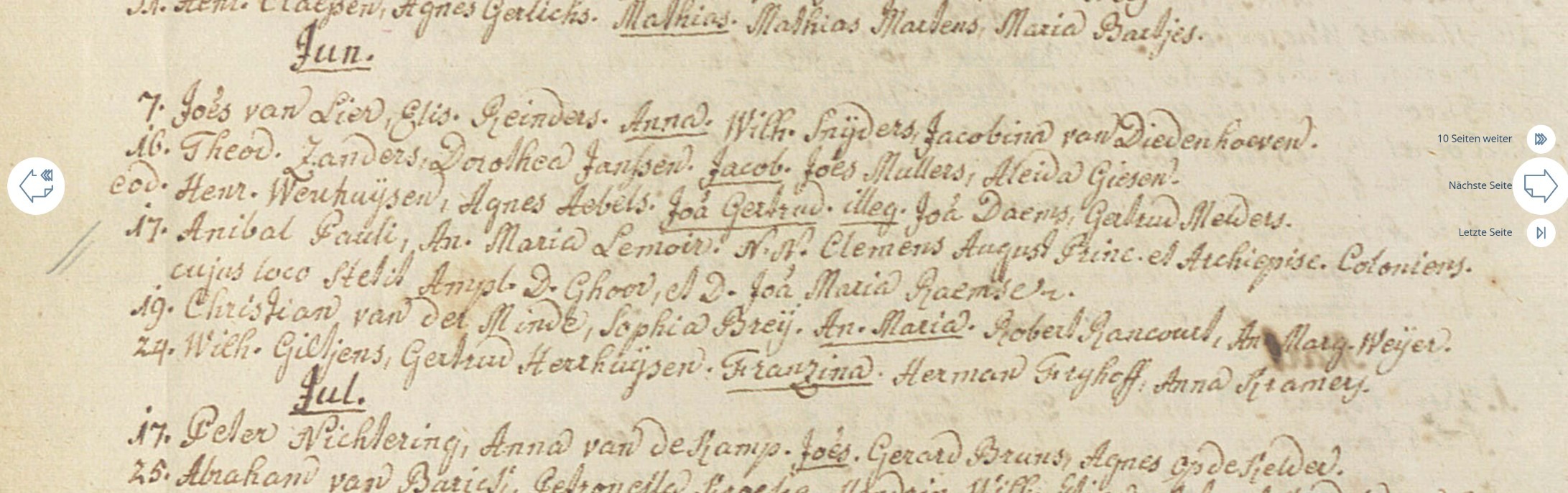
The document fully confirms that the boy was stood for by proxy at the font by Dean Ghoor (Amplissimus Dominus Ghoor) on behalf of one of the highest hierarchs of the Holy Roman Empire, Prince Clemens August of Bavaria*, Archbishop and Elector of Cologne.
*Clemens August of Bavaria (Clemens August von Bayern, 1700-1761, prince of the House of Wittelsbach, Archbishop and Elector of Cologne (Kurfürst und Erzbischof von Köln, Grand Master of the Teutonic Order.
Archive and Holding: State Archive of North Rhine-Westphalia, Rhineland Department (Landesarchiv Nordrhein-Westfalen, Abteilung Rheinland, collection of parish registers (Kirchenbücher, reference BA 1275. Digital Catalog Links: View register in DFG-Viewer | Archive.nrw.de Portal. Parish: Roman Catholic Parish of the Assumption of the Blessed Virgin Mary in Kleve (Katholische Pfarrei St. Mariä Himmelfahrt, Kleve).
Text: 17. Anibal Pauli, An: Maria Lemoir. | R.[everendissimus] D.[ominus] Clemens August Princ:[eps] et Archiepisc:[opus] Coloniens:[is] cujus loco stetit Ampl:[issimus] D:[ominus] Ghoor, et D:[omina] Joa[nna] Maria Raem…[?] Transcription and Translation: 17 [June 1744]. Parents: Annibal Pauli, An[na] Maria Lemoir. Godparents (and namesake patron of the infant): The Most Reverend and Most Serene Lord Clemens August, Prince and Archbishop of Cologne [in whose honor the infant was named Clemens Augustus], in whose place [by proxy at the font] stood the Most Worthy Lord Ghoor (Ghoor, Dean in Kleve, and Lady Joanna Maria Raem… [rendered in the 1790 extract as Johanna Christina von Bovenstein].
Baptismal Record No. 4. Baptism of the Youngest Son, Carolus Franciscus (February 2, 1749, Mainz)
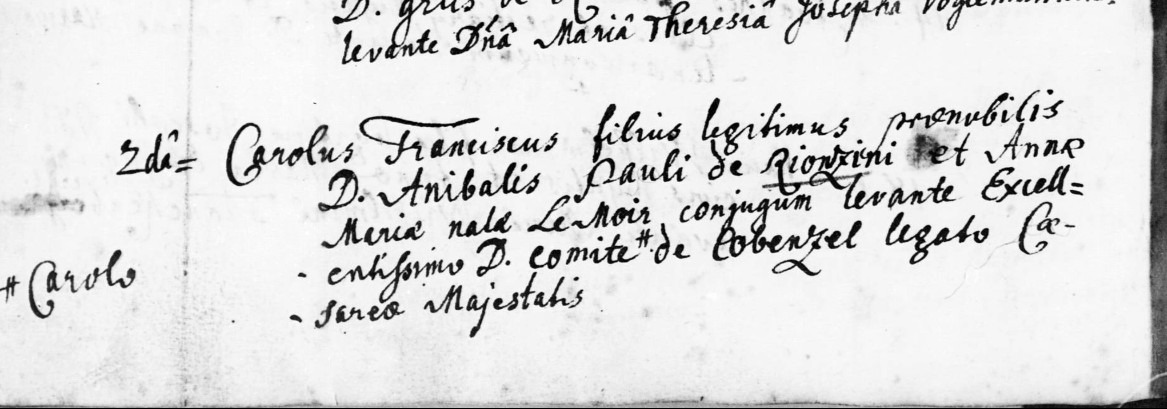
A year and a half before his death in Altona, the infant’s father is recorded with the honorific noble style prænobilis Dominus (“Most Noble Lord”) and the full compound surname Anibalis Pauli de Rionzini, and his wife with her French maiden surname (natæ Le Moir). The child’s godfather was the famous Austrian diplomat Count Johann Karl Philipp von Cobenzl** (1712-1770, Imperial Envoy to the Rhenish Electorates, who would soon (in 1753) head the administration of the Austrian Netherlands in Brussels, the very chancery to which Annibale Pauli’s petitions addressed to Count Friedrich von Harrach*, discovered in Vienna, had been submitted in 1739-1740.
Archive, Holding, and Reference Code: Municipal Archive of Mainz (Stadtarchiv Mainz, collection of parish registers (Kirchenbücher, Parish of St. Quintin (Pfarrei St. Quintin, reference (Signatur): 20 / 040, frame/scan No. 00119 (official digital copy provided by the Stadtarchiv Mainz, file Az. 47.10.03-001/0002). Parish: Roman Catholic Parish of Saints Quintin and Blaise in Mainz (Katholische Pfarrei St. Quintin / SS. Quintini et Blasii, Mainz, Electorate of Mainz.
Text: Mense Februario 2da = Carolus Franciscus filius legitimus prænobilis D. [Domini] Anibalis Pauli de Rionzini et Annæ Mariæ natæ Le Moir conjugum levante Excellentissimo D. [Domino] Comite # de Cobenzel legato Cæsareæ Majestatis. (In the left margin, an insertion marked with a hash sign: # Carolo*)* Transcription and Translation: In February [1749], on the 2nd day: [Baptized] Carolus Franciscus, legitimate son of the Most Noble Lord Annibal Pauli de Rionzini and Anna Maria, née Le Moir, spouses. Standing as godfather at the font was His Excellency Lord Count Karl von Cobenzl, Envoy [Legate] of His Imperial Majesty.
*Count Friedrich August von Harrach (Friedrich August von Harrach-Rohrau, 1696-1749, Austrian statesman and diplomat, Minister Plenipotentiary (de facto governor) of the Austrian Netherlands in 1732-1741 and Supreme Chancellor of Bohemia.
**Count Johann Karl Philipp von Cobenzl (Johann Karl Philipp Graf von Cobenzl, 1712-1770, Habsburg diplomat, Imperial Envoy to the Rhenish Electorates, and future Minister Plenipotentiary of the Austrian Netherlands (1753-1770).
Alas, the brilliant European tour was cut short in an instant. According to an extract from the parish register of the Catholic church* in the port town of Altona (then under the Danish crown adjacent to Hamburg, on November 19, 1750, Count Annibal de Pauli de Rion de Zini passed away at the age of about 43, and on November 25 he was buried “in the presence of a large congregation.” Left in the hands of his widow, Anna Maria, in a foreign land were their young children: ten-year-old Alexander, six-year-old Klementy, a little daughter named Luisa, and one-and-a-half-year-old Carolus Franciscus.
*In Altona (near Hamburg, where Annibal Pauli de Rion de Zini died on November 19, 1750, and was buried on November 25, only one Catholic church existed in the eighteenth century: the Church of St. Joseph on Große Freiheit (Kirche St. Joseph, Große Freiheit, Altona), ministered to by Jesuit fathers.
Officials, Priests, and Witnesses in the European Papers of 1727-1752, Along with the Full Text of the “Translation of Proof of Title” from the 1814 File:
Names of European officials and clergy who certified the documents of Count Annibal Pauli de Rion Zini:
- Passport in Toulon (September 30, 1727): Consul Enno and Secretary-Archivist Toussaint.
- Passports in Lille (May 19, 1730, and December 28, 1730): Clerk of the board of the “Eight Men” Vulpudeman, courier Gilles Robert, mayor (seneschal) and sole judge of the magistrate of the Barony of La Marzelière, Bain, and police (Baronnie de La Marzelière et de Bain, subdelegate of the Intendant of the Province of Brittany and the Department of Bain (Bain-de-Bretagne) de Lambilly (de Lambilly, alderman Le Roy.
- Passport in Blois (January 8, 1734): Mayor/alderman Druillon (Pierre Druillon, 1679-1759) and municipal secretary Guillery.
- Border visa in Pontarlier (June 2, 1734): Governor of the Castle of Joux [fortress of Château de Joux] Roussache (for the police administration).
- Passports in Lausanne (June 29, 1734): Lord of the Manor of Kehrsatz (Seigneur de Kehrsatz, member of the Council of State of the Republic of Bern, bailiff (mayor) of Lausanne, and former Lieutenant General in the service of Sardinia (Sardegna) Karl Hackbrett (1674-1737, translator Detallant (De Tallens, and secretary of the municipal council J. L. Milor (J. L. Milot / Milor).
- Passport in Montpellier (April 10, 1738): Intendant of Languedoc, Lord of the Seigneuries of Saint-Maurice, Vaux, and Chassy, Lev Vasily de Bernazh / Le Bernage (Louis-Basile de Bernage) and secretary Gracel.
- Baptism of Alexander Joseph in The Hague (April 26, 1740, Chapel of the French Embassy on Casuariestraat): Jesuit and apostolic missionary Wilhelmus Matthias, S.J.; godparents, Count Alexander Poniatowski and the wife of the Spanish envoy in The Hague, Josepha, Marquise de Saint-Gilles (Josepha Marchionissa de St. Gilles, Legatrix Hispaniæ).
- Baptism of Clemens Augustus in Kleve (June 17, 1744): Priest of the Church of the Blessed Virgin Mary and Dean in Kleve J. J. Gor (Ghoor, Dekan in Kleve, standing at the font by proxy for the Elector of Cologne; godmother Johanna Christina von Bovenstein (in the parish register, Joanna Maria Raem…); and Canon Mors (Mors, Canonicus).
- Baptism of Carolus Franciscus in Mainz (February 2/4, 1749, Parish of Saints Quintin and Blaise / SS. Quintini et Blasii): Archpriest Matthaeus Gor (archipresbyter) and godfather, Envoy of His Imperial Majesty Count Karl von Cobenzl (Karl Graf von Cobenzl).
- Certificate of death in Altona (issued August 10, 1752): Jesuit Father P. F. Clouet (Pater Franciscus Clouet, Societatis Jesu).
- Certification of copies and translation in Moscow (July 24, 1790): Priest of the Moscow Roman Catholic Church of Saints Peter and Paul Tadeusz Oliczewski and Collegiate Registrar Alexander Kronsberg (page-by-page countersignature of the translation).
Translation of Proof of Title (Verbatim Text from the Archival File)
Translation. (CGA Mos, vyazka 493, file No. 106481, ll. 6-13)
We, the Consuls and Governors in the province of the city of Toulon (Toulon, Commissioners of Police and Administrators of Val d’Ardenne (Val d’Ardenne / Dardenne).
Certify and attest to whom it may concern that Monsieur Count Annibal Rion de Zini, of Venise [Venice] (Venise / Venezia, 20 years of age, of medium stature, and Stephan Dory, his servant, are departing from this city for Nice (Nice). We request administrators, governors, mayors, consuls, and all others whom it may concern to grant them free passage and unhindered sojourn. In witness whereof this certificate has been given to them under our signature, with the municipal coat of arms affixed, countersigned by the secretary and archivist of the administration. At Toulon, September 30, 1727.
Enno, Consul. By order of Messieurs the Consuls, Toussaint. (Countersignature at bottom: Translated from the originals by Chancery Clerk…)
We, the Chiefs and Aldermen of the city of Lille (Lille) in Flanders (Flandria, notify and certify to whom it may concern that Monsieur Count Annibal Rion de Zini, a native of the city of Venice, has resided in this city for about two months; having requested from us a certificate for free passage on the journey he is undertaking, we have issued him this document with the municipal coat of arms affixed. December 28, 1730.
Signed: Le Roy.
The Eight Men in the city of Lille in Flanders declare and certify to whom it may concern that there is no contagious disease in this city and that Monsieur Count Annibal Rion de Zini, traveling from Bain (Bain-de-Bretagne) with a certificate from Monsieur Gilles Robert, courier, and Monsieur de Lambilly, mayor and sole judge of the magistrate of the Barony of La Marzelière, Bain, and police (Baronnie de La Marzelière et de Bain, deputy to His Excellency in the Province of Brittany and the Department of Bain (Subdélégué de l’Intendant de Bretagne au département de Bain, is currently in this city. At his request for a certificate from us, we have given him this document and ask all whom it may concern to grant him free passage. In witness whereof, the seal of the aforesaid city is affixed and signed by our clerk. May 19, 1730.
Of the Board, Vulpudeman.
We, the Mayors and Aldermen of the city of Blois (Blois, certify to whom it may concern that Monsieur Count Annibal Rion de Zini, a native of the city of Venice, has stayed in this city for 15 days and declared to us that he wishes to depart tomorrow to continue his journey; in witness whereof we have signed this certificate, to which we have affixed the municipal coat of arms, countersigned by the municipal secretary. Given at Blois, January 8, 1734.
Druillon (Pierre Druillon). Guillery, Secretary.
(Written in the margin)
We, the Governor of the Castle of Joux [Château de Joux] of the town and district of Pontarlier (Pontarlier) in Franche-Comté (Franche-Comté, certify that the bearer hereof, Monsieur Count Annibal Rion de Zini, passed through this town with his wife, stating that he is returning to Venice. Pontarlier, June 2, 1734.
For the Police, Roussache.
We, Karl Hackbrett, Lord of the Manor of Kehrsatz (Karl Hackbrett, Seigneur de Kehrsatz, of the Council of State of the City and Republic of Bern (Bern, Bailiff of the city of Lausanne (Lausanne, in the name and by order of Their Excellencies of the said Council of Bern, our lords and sovereigns, formerly Lieutenant General and Colonel of a Swiss regiment in the service of His Majesty the King of Sardinia, certify that Monsieur Count Annibal Rion de Zini, a native of the city of Venice, and his wife resided in this city of Lausanne for about one month, during which time they conducted themselves as honest and noble persons, and, intending to continue their journey to Venice, whence Monsieur the Count departed several years ago for travel, requested us to grant them a passport, whereby we request and require all administrators, officials, governors, rulers, bailiffs, and all those with whom they may have dealings to grant them free passage there and back and unhindered sojourn, not permitting any trouble or hindrance to be caused to them, but on the contrary assisting them in every way; and we offer to act in the same manner toward all who may be recommended to us by them; in witness whereof this has been given to them at the Castle of Lausanne with the coat of arms of our seal affixed and signed by our secretary. June 29, 1734.
Translator Detallant (De Tallens).
We, the Burgomasters and Council of Lausanne, declare that Monsieur Count Annibal Rion de Zini appeared before us and requested us to issue a passport both for himself and for his wife to travel to Italy; granting his request, we ask all administrators, governors, rulers, and all other officers subordinate to them to grant free passage there and back to the aforesaid count and his wife, not permitting any trouble or hindrance to be caused to them; on the contrary, we ask them to assist him in all things, offering on our part to act in like manner toward all who may be recommended to us by them. In witness whereof we have affixed our seal beside the signature of our secretary. June 29, 1734.
J. L. Milor (J. L. Milot / Milor). (Countersignature across the folios: Collegiate, Registrar, Kronsberg)
Louis-Basile de Bernage, Lord of Saint-Maurice, Vaux, Chassy, and other places, Councillor of State, Knight Grand Cross of the Royal and Military Order of Saint Louis, Intendant of Justice, Police, and Finance in the Province of Languedoc (Languedoc).
We certify that Monsieur Count Annibal Rion de Zini resided with his wife for about 6 months in this city, where they conducted themselves honorably and in a manner befitting their rank; he declared to us that he is setting out on his way to return to Venice, his homeland. We request all whom it may concern, and command all others, to grant them free passage and not to allow any trouble or hindrance to be caused to them, but on the contrary to render them assistance in case of need. Given at Montpellier (Montpellier), April 10, 1738.
Le Bernage. By command, Gracel.
I, the undersigned Wilhelmus Matthias, Jesuit, apostolic missionary of the Christian faith, hereby certify that according to the rite of the Roman Catholic Church I baptized in Gravenhage [The Hague] (’s-Gravenhage, in Holland, Alexander Joseph (Alexander Josephus, legitimate son of His Honor Annibal Paul and Her Honor Anna Maria Le Moir. The godparents were: Count Alexander Poniatowski and Her Excellency the Marquise von Saint-Gilles. In witness whereof, I have given this under my own hand. Gravenhage, April 26, 1740.
[L. S.] Wilhelmus Matthias. [L. S.] Marquise Saint-Gilles. [L. S.] Alexander Poniatowski. Alexander.
To the readers, the grace of God.
I, the undersigned, certify that Carolus Franciscus, legitimate son of Annibal Paul von Rion de Zini and Her High Honor Anna Maria, née Le Moir, was baptized in our parish of Saints Quintin and Blaise (SS. Quintini et Blasii) on February 2, 1749. The godfather was: His Illustriousness Count von Cobenzl (Graf von Cobenzl, Envoy of His Majesty. In witness whereof I have given this baptismal certificate, transcribed from the register of all the baptized, under my own hand and with my customary seal affixed. Mainz (Mainz, February 4, 1749.
[L. S.] Matthaeus Gor, Archpriest (archipresbyter). Karl Graf von Cobenzl.
I, the undersigned, certify that Clemens Augustus, legitimate son of Annibal Paul and Madame Anna Maria Le Moir, was baptized according to the rite of the Roman Catholic Church on June 17, 1744. The godparents were: His Serene Highness the Elector and Archbishop of Cologne (in whose place stood Monsieur Gor, priest of the Church of the Blessed Virgin Mary, and Her High Honor Johanna Christina von Bovenstein. In witness whereof I have signed this with my own hand and affixed my customary seal.
Mors, Canon (Canonicus). J. J. Gor, Dean in Kleve (Dekan in Kleve).
Thus reads the original, and that this has been faithfully transcribed from the original, I certify by my signature and by affixing the seal of the Roman Catholic Church in Moscow. Given in Moscow at the Church of Saints Peter and Paul. July 24, 1790.
Tadeusz Oliczewski, priest at the Roman Catholic Church in Moscow.
Certificate of Death
Extract from the register of deaths at the church in the town of Altona (Altona, written out by me word for word. August 10, 1752.
Count Annibal de Pauli de Rion de Zini of Venice died on November 19, 1750, and was buried on November 25 in the Catholic church in the town of Altona (Katholische Kirche St. Joseph zu Altona, in the presence of a large congregation, having first received the Holy Sacraments. For greater assurance, I, the undersigned, certify this:
Father P. F. Clouet, Jesuit (Pater Franciscus Clouet, Societatis Jesu).
Thus reads the original, and that this has been faithfully transcribed from the original, I certify by my signature and by affixing the seal of the Roman Catholic Church of Saints Peter and Paul. July 24, 1790. Tadeusz Oliczewski, priest at the Roman Catholic Church in Moscow. Collegiate Registrar Alexander Kronsberg.
II. From Altona and Lübeck to Moscow: A French Stepfather, the Goldsmith’s Trade, and a Freedwoman Bride (1750-1776)
What happened to the bereaved family after Count Annibal’s death in November 1750, and by what twist of fate did his children end up in Russia? The answer was found inside the consistory file of February 1776 concerning Klementy Derionzini’s marriage (CGA Mos, f. 203, op. 761, bundle 2289, d. 44, l. 18, into which was bound a copy of a passport issued by the State College of Foreign Affairs on May 15, 1761, along with the record of young Klementy’s personal interrogation on March 5, 1761.
As the teenager Klementy himself recounted at the College of Foreign Affairs (shaving a couple of years off his age during questioning and claiming to be fourteen, events after his father’s death in Altona unfolded rapidly:
- Left a widow in a foreign land with young children (Alexander, Klementy, and daughter Luisa; traces of the youngest, Carolus Franciscus, disappear). Countess Anna Maria Le Moir (recorded in Russian as Maria Morova) remarried in that same Altona, to a Frenchman named Joseph de Kolb (Decolb, with whom the family moved to the Hanseatic city of Lübeck.
- In 1752, stepfather Joseph de Kolb, leaving his wife and stepsons behind in Lübeck, traveled alone to St. Petersburg. Soon afterward, their mother obtained a travel passport for herself and the children from the Lübeck Magistrate and followed her husband to the Russian capital.
- Yet her second marriage also proved short-lived: already in 1753, stepfather Joseph de Kolb died in St. Petersburg! That same year, 1753, the twice-widowed Frenchwoman took her children and, using the same Lübeck passport, moved to Moscow, where she rented an apartment and supported the family by giving lessons, “for teaching the French dialect to Russian nobles.”
- In 1759, their mother died in Moscow, leaving the three teenagers complete orphans. To survive, fifteen-year-old Klementy, godson of the Elector of Cologne, was apprenticed to a Moscow master goldsmith named Karl, in whose house he lived.
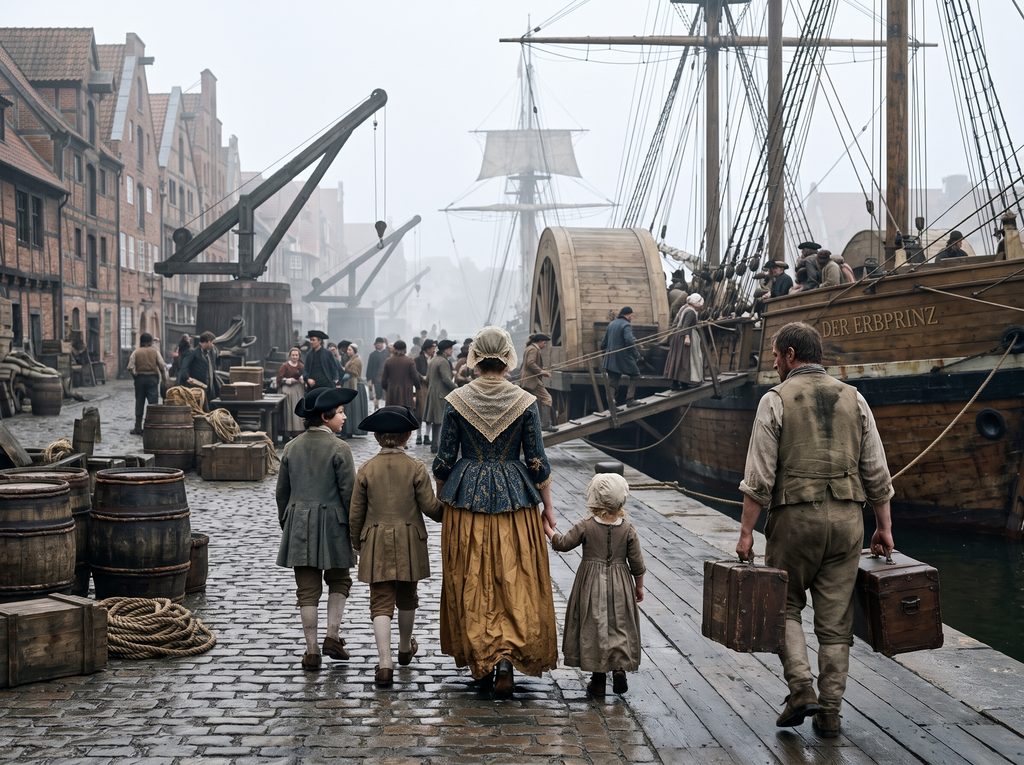
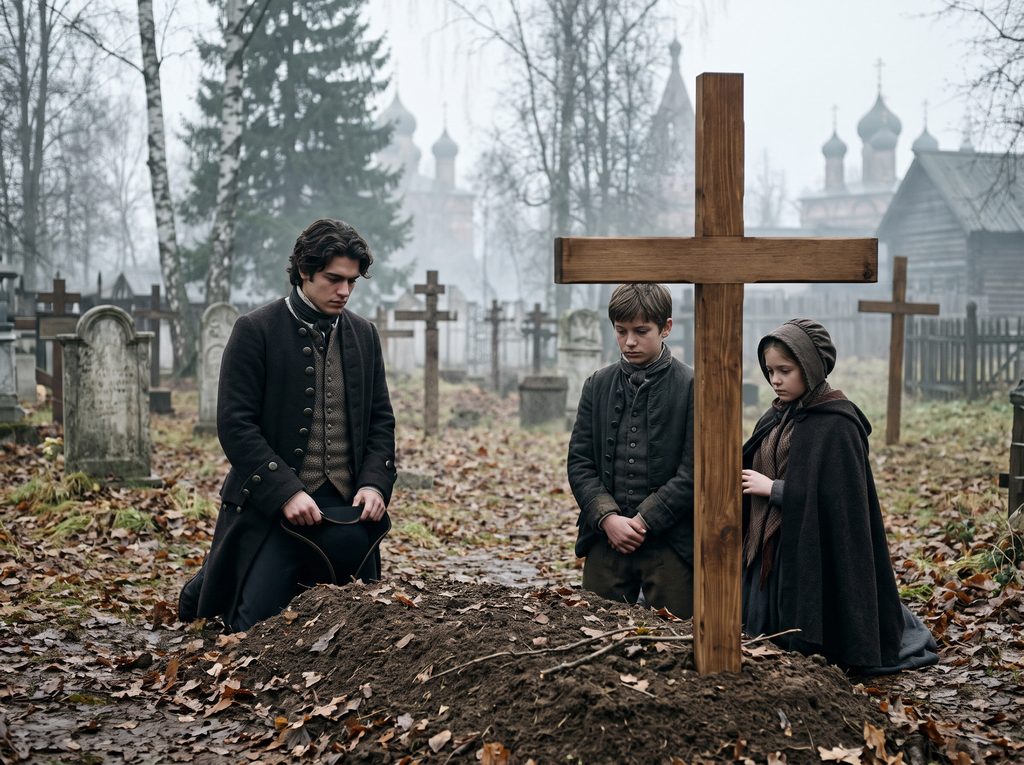
It is fascinating to trace through this 1761 interrogation how the European name Annibal Pauli de Rionzini was transformed on Russian soil: young Klementy called his late father “Pavel Anibolev son of Dergotsin” (thus the second part of the surname, Pauli, turned into the given name Pavel and the patronymic Pavlovich!, and from childhood memory he named Naples rather than Venice as his father’s birthplace, adding that he “could not recall” his father’s rank “on account of his tender years at the time.” By contrast, the physical description of young Klementy Derionzini himself when his passport was issued on May 15, 1761, was recorded with photographic precision: “face clear, fair, hair and eyebrows dark blond, eyes brown, nose medium.”
Having completed his goldsmith’s apprenticeship, on March 8, 1771, the 26-year-old Italian Klementy Pavlov, son of Dereonzini, submitted a deposition to the Moscow Magistrate, swore an oath of eternal allegiance to Empress Catherine II, and enrolled for ten years in the Moscow artisans’ guild “for the making of gold and silver snuffboxes, buckles, and other similar craftsmanship,” with the obligation to use a personal hallmark and present his wares to the Assay Office. Besides the jeweler’s workbench, however, during the second half of the eighteenth century Klementy Pavlovich also served as a quartermaster sergeant (Wachtmeister) in the Poltava Light Cavalry Regiment (in one parish register entry from the 1770s, the clerk mistakenly recorded him as Wachtmeister “Demyan Pavlov son of Derionzin”, CGA Mos, f. 203, op. 745, d. 92, l. 78, and later worked as a chancery clerk at the Moscow Post Office.
In February 1776, the 31-year-old master goldsmith (named in his petition by his baptismal name, Clement Augustus Derionzini) petitioned Platon (Levshin), Archbishop of Moscow and Kaluga, for permission to marry an Orthodox bride, Evfimia (Afimya) Fyodorova Zybina (c. 1745/1753 – 1805). The copy of her certificate of emancipation dated June 14, 1774, bound into the file, delivered a genuine sensation: the future “Countess Derionzini” turned out to be an emancipated household serf woman and soldier’s widow from the St. Petersburg household of Brigadier and St. Petersburg Chief of Police (Ober-Polizeimeister, head of the capital’s police!) Mikhail Alexandrovich Zybin, after whose surname she was recorded as Zybina in several documents!
Before authorizing a mixed marriage at the Church of Sophia the Wisdom of God at the Cannon Yard (in the Kuznetsky Most area, where foreign craftsmen traditionally settled, the Moscow Spiritual Consistory subjected the bride and groom to strict questioning and “exhortation.” Afimya was urged to choose an Orthodox groom, and Klementy to convert from Catholicism to Orthodoxy. Both displayed enviable stubbornness: the bride refused to look for another betrothed, pledging to steadfastly keep the Orthodox faith and baptize all future children solely in the Orthodox Church, while Klementy declared that he “did not wish to change his faith,” but signed a pledge never to induce his wife into Catholicism and never to leave the Russian Empire with her. Since Klementy could not read or write Russian, he signed beneath the consistory protocols three times in a firm European Latin hand: Clemenes pauli Deronsiny!
Klementy’s Residential Addresses in 1774-1775, Officials, and Clergy from the 1776 Marriage File
- Issuance of the passport by the State College of Foreign Affairs in Moscow (May 15, 1761, fee 50 ¼ kopecks): the document was signed by State Councillor Mikhail Grigoryevich Sobakin, Secretary Pyotr Stokasimov, and Junior Chancery Clerk Vasily Kolesnitsyn. With their petition, Klementy and his sister Luisa presented a certificate from the prefect of the Catholic church attesting that they were “truly Italians and free persons.”
- Guild ticket of the Moscow Magistrate (March 8, 1771) and Klementy’s rented lodgings: the original ticket was signed by Secretary Prince Ivan Shakhonskoy, and the copy was verified by Chancery Clerk Pyotr Timofeyev. According to police endorsements on the ticket (signed by Archivist Ivan Kozlov / Iwan Koslow and Chancery Clerk Yakov Bobrov, the artisan Klementy Derionzini lived in rented quarters: on November 20, 1774 (No. 1153, at the house of the foreigner Ivan Ivanov son of Dilimeyer; on September 11, 1775 (No. 821, at the house of the merchant’s widow Anisya Dmitrieva daughter of Yerofeyev; on October 8, 1775 (No. 649, at the house of the foreigner Ivan Fyodorov son of Robert (Jean Robert).
- Certificate of emancipation of Afimya Fyodorova (issued in St. Petersburg on June 14, 1774, by Chief of Police Brigadier M. A. Zybin): upon receipt of the original document, Semyon Stepanov, sexton of the Church of the Great Martyr George in the village of Berezhki, Pekhryanskaya Deanery, Moscow District, signed on behalf of the illiterate widow.
- Marriage file in the Moscow Spiritual Consistory (February 1776, CGA Mos, f. 203, op. 761, sv. 2289, d. 44): the petition on behalf of Klementy was written out by Ivan Afanasyev (Sergiyev); in the Consistory, Roman Tarasov, a servant of Colonel Prince Nikolai Ivanovich Trubetskoy, signed for the illiterate Afimya; the groom’s surety and the priest to whom the marriage decree was addressed was Andrei Ivanov, priest of the Church of St. Sophia at the Cannon Yard (Sretensky Deanery). The marriage dispensation (based on 1 Cor. 7:13-14 and the Holy Synod decree of 1721) was signed by: Archimandrite Feofilakt of the Simonov Monastery, Abbot Ioakim of the Znamensky Monastery, Abbot Ioasaf of the Krestovozdvizhensky Monastery, Archpriest Ioakim of the Dormition Cathedral, and Secretary Simeon Protopopov.
III. Gold Snuffboxes, the Lawsuit over a Box of Diamonds, and the End of the Road at the Sheremetev Almshouse (1776-1816)
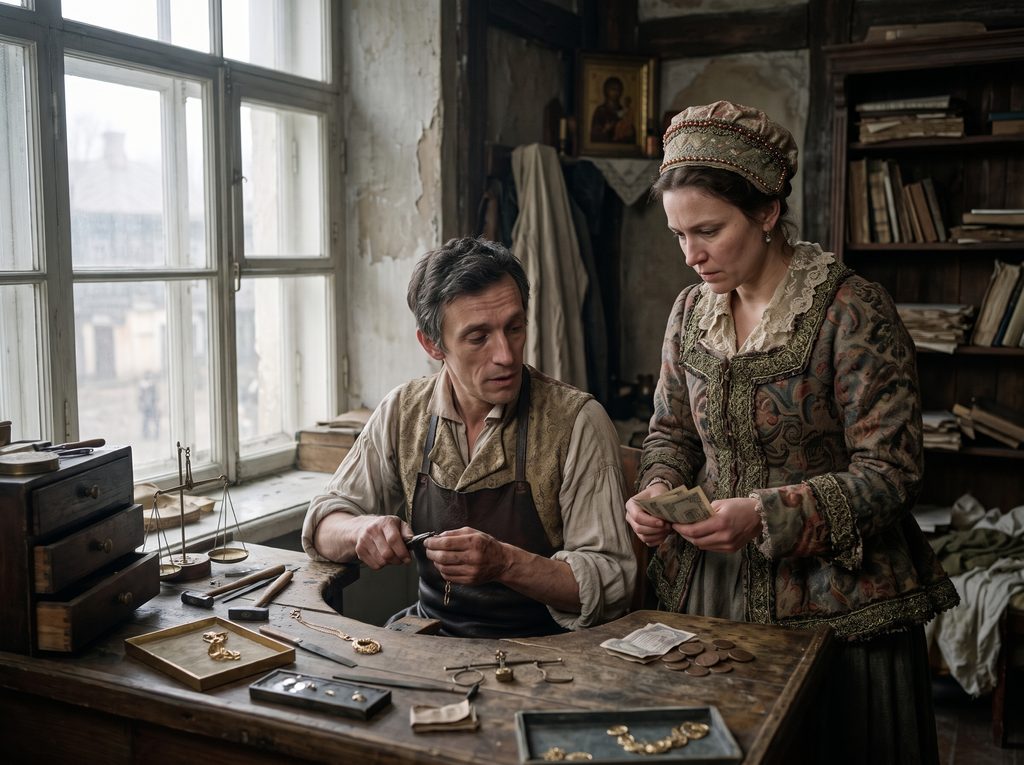
Having married in 1776, the Catholic jeweler Klementy Pavlovich and the former serf Afimya Fyodorovna lived together for nearly thirty years and raised five children (among whom their eldest son, Gavrila, will play the leading role in our story). Curiously, in numerous Moscow parish and confessional records (for instance, in the confessional list CGA Mos, f. 203, op. 747, d. 684, l. 212 or the master goldsmith entry in f. 2125, op. 1, d. 1264, l. 5, Klementy and his sons are quite officially styled “foreign” or “Italian counts of the Catholic faith.”
In July 1790, literally in the very days when Klementy Pavlovich was having his father’s European passports certified by Father Tadeusz Oliczewski (on July 24, 1790, at the Church of Saints Peter and Paul, and on that very same day, July 24, 1790, in the journal of the 3rd Department of the Moscow Lower Aulic Court!, his enterprising wife Afimya Fyodorovna launched a protracted lawsuit against a foreign woman, Captain’s Wife (in other folios, Second Lieutenant’s Widow) Elisaveta Ivanova daughter of Defosh (Deforsh) (Elisabeth Defoche / Deforsch) over 658 rubles 50 kopecks (CGA Mos, f. 81, op. 2, t. 2, l. 63).
As Afimya claimed in her petitions, the foreigner Defosh and her entire family had lived for seven months in the Derionzinis’ apartment at their full expense, running up a debt of 350 rubles for room and board, and on top of that had borrowed from her landlady silver tableware, finery, and jewelry (diamond earrings, turquoise and ruby rings set with diamonds, and Saxon porcelain and tortoiseshell snuffboxes in gold and silver mounts) worth another 308 rubles 50 kopecks. Because Afimya herself was illiterate, the jewelry inventory was signed on her behalf by her grown son Pavel Klementyevich Derionzini, who was then serving as a “first-class pupil of the Novgorod Guardianship Office.”
Captain’s Wife Defosh, however, promptly hired experienced legal attorneys and filed counterclaims asserting the exact opposite: she had paid her rent faithfully, whereas the master goldsmith’s wife Afimya Derionzini had forcibly seized her casket of jewels and fans and was refusing to return it! Because all dealings between the two women had been conducted “in view of the familial relations then existing between them” without a single written receipt, the judicial red tape dragged on for eight years (from 1790 to 1798) and ended in nothing: Afimya was unable to present either receipts or witnesses to the court, stopped appearing when summoned, and in March-December 1798 the case was consigned to the archives.
Full “Inventory of Taken Items” of 1790 and Participants in the Lawsuit Between Afimya Derionzini and Captain’s Wife Defosh. Inventory of items claimed for recovery by the master goldsmith’s wife Afimya Derionzini in July 1790 / July 1791 (CGA Mos, f. 81, op. 2, t. 2, l. 63, No. 1711)
- Six silver dram cups, 10 rubles;
- Six silver tablespoons, 15 rubles, and one additional gilt spoon, 1 ruble;
- Turquoise ring set with diamonds, 15 rubles;
- Ruby/sapphire [yakhont] ring, 5 rubles;
- Ring with natural multicolored stones, 50 rubles;
- Saxon porcelain snuffbox, mounted in silver and gilt, 25 rubles;
- Upper diamond earrings set with brilliant-cut diamonds, 50 rubles;
- Tortoiseshell snuffbox with a medallion and gold rim, 25 rubles;
- Gold ring with blue glass, stone, and diamond monogram, 15 rubles;
- Gold bracelets with white glass over blue with roses, 10 rubles;
- Two pairs of paste [strass] earrings, 20 rubles, and a silver ring, 2 rubles;
- Four embroidered taffeta fans, 20 rubles;
- Dress mantilla embroidered with sequins, 15 rubles, and a pink taffeta under-mantilla, 4 rubles 50 kopecks;
- Thirty poods of chalk/copper, 15 rubles;
- Overpayment for forwarding and delivering letters by order of Defosh, 5 rubles.
Attorneys, legal representatives, and judges appearing in the folios of the case (1790-1798):
- On behalf of Afimya Derionzini: her son Pavel Deriondzini (first-class pupil of the Novgorod Guardianship Office and Chancery) and her legal representative, Afanasy Semyonov son of Vasilyev, servant of Colonel Bogdan Alexeyevich Pensky.
- On behalf of the foreigner Elisaveta Defosh (petitions Nos. 1822, 1882, 2003): Provincial Company Sergeant Mikhail Vasilyev (Michail Wassiljew, legal representatives Osip Titov and Yegor Osipov, junior scribe Afanasy Ivanov son of Dmitriev Simonov (servants of the households of Captain-Lieutenant’s Wife Alexandra Mikhailovna, Premier Major’s Wife Pavla Matveyevna Rtishcheva, and Dmitry Simonov).
- Judicial officials of the Moscow Lower and Upper Aulic Courts and the Chamber of Court and Redress: Acting Clerk Fyodor Smirnov, Aulic Councillor Vasily Alexeyev Surkov, Collegiate Assessor Gleb Polozov, Secretaries Ivan Belov, Fyodor Savelyev, Ivan Timofeyev, Ivan Anisimov, and Registrar Mikhail Vasilyev.
At the beginning of the nineteenth century, the older generation’s fortunes went into decline. In 1804, Klementy Pavlovich’s family was still renting a corner in the house of Prince Pyotr Alexeyevich Volkonsky (Pjotr Wolkonski, CGA Mos, but already in 1805 his spirited wife Afimya Fyodorovna passed away (CGA Mos). The widowed and aging jeweler appeared once more in 1806 as a godfather in parish registers, and by 1810 he had moved into charitable care at the newly opened Hospice House of Count Sheremetev in Moscow (the Sheremetev Hospital and Almshouse, confessional list of 1810). There, still invariably listed as a foreigner of the Catholic faith, the 72-year-old Klementy Pavlovich quietly passed away on September 11, 1816, and was buried at the Lazarevskoye Cemetery with the proud notation of his title, Count!
IV. The Second Generation in Moscow: Count Gavrila’s Misadventures in 1812 and 1814 and His Marriage to a Midwife (1812-1861)

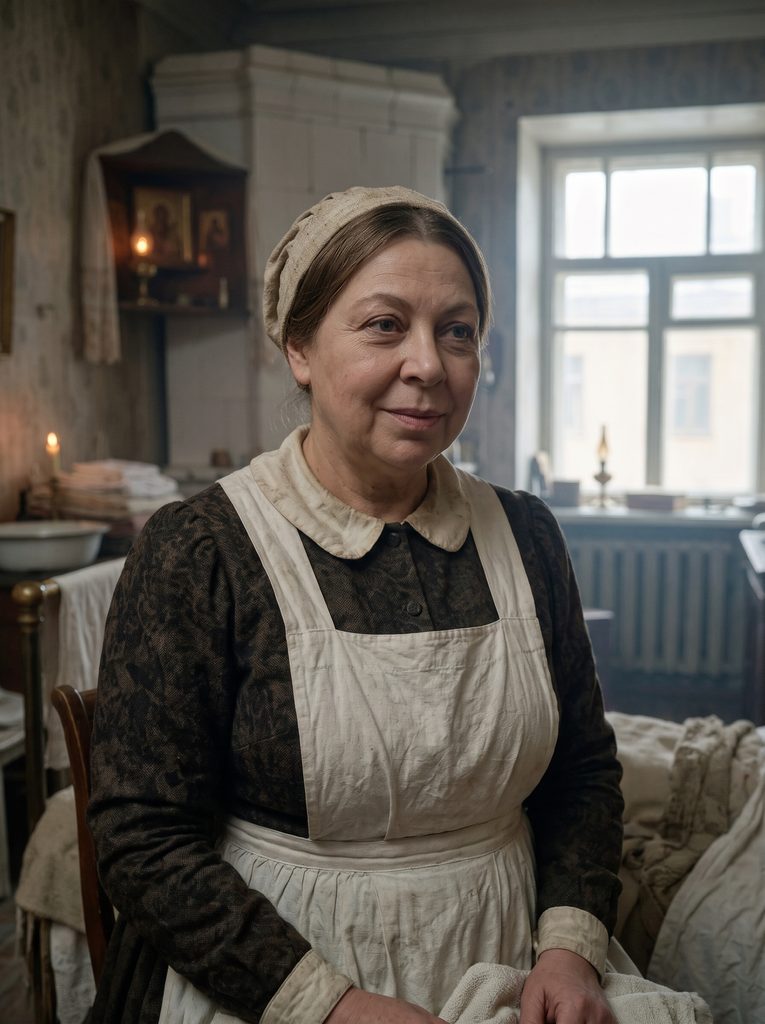

Alexandra Mikhailovna and her husband, Count Gavrila Klementyevich Derionzini
And now the chronological thread of our narrative brings us straight back to the events of 1812 with which our archival quest began!
While the elderly Klementy Pavlovich resided at the Sheremetev Hospice House, his eldest son Gavrila Klementyevich (c. 1780/1784 – before 1849, who had inherited from his father both the trade of master goldsmith (CGA Mos, f. 203, op. 745, d. 280, l. 83) and the status of a “non-serving nobleman” in Moscow’s Yakimanskaya District, met the Napoleonic occupation in the house of Collegiate Registrar’s Wife Verigina together with his cousin Alexander. As we recall, this ended with an accusation of stealing the landlady’s property and the dispatch of the lodger “styling himself an Italian count” to the prison castle.
His troubles with criminal investigators did not end there, however. Just two years later, in 1814, Gavrila Klementyevich once again found himself under interrogation, this time in the grim case of the strangulation of Lieutenant Molchanov (CGA Mos, vyazka 493, d. 106481, where he was suspected of stealing the murdered officer’s belongings. It was then that skeptical investigators requisitioned from the almshouse his father Klementy Pavlovich’s trunk containing the passports of Count Annibal Pauli de Rion Zini certified in 1790. And it must be admitted, the array of seals from European magistrates and the illustrious names of the Elector of Cologne, Count Poniatowski, and Count von Cobenzl made a due impression on the Moscow police: the Derionzinis were never accused of imposture again.
In April 1819, leaving the turbulent episodes of 1812 and 1814 behind him, Gavrila Klementyevich was married in the private chapel of Princess Olimpiada Gavrilovna Sibirskaya (CGA Mos, f. 203, op. 745, d. 223, l. 84). His bride was a ward of the Imperial Moscow Foundling Home, Alexandra Mikhailovna (recorded in some confessional lists with the patronymic/surname Vasilyeva, CGA Mos).
The profession of the new Countess Derionzini surprisingly echoed our familiar Vladimir storylines: much like the sister of the irrepressible Gavrilov Posad chancery clerk Alexander Yunich (Alexander Junitsch, Alexandra Mikhailovna served for more than nineteen years at Moscow maternity hospitals as a state-appointed midwife! She delivered the babies of soldiers’ wives, burgher women, and almshouse inmates, and whenever illegitimate infants came into the world, her husband, the “Italian count” Gavrila Klementyevich, readily stood as their godfather (for example, in 1827). Widowed by 1849 and having earned a pension of 203 rubles a year, the elderly countess-midwife submitted a petition to the Board of Trustees in February 1861 requesting admission as a pensioner to the Widows’ Home (CGA Mos, f. 127, op. 2, t. 7, l. 19, d. 2307/10238).
Court Cases, Addresses, and the Complete List of the Seven Children of Gavrila Klementyevich and Alexandra Mikhailovna Derionzini
- Addresses and lawsuits of Gavrila Klementyevich in Moscow: in various years he lodged as a “non-serving nobleman” in the Yakimanskaya District in the house of Mr. Yeremeyev (Eremejew, CGA Mos, f. 203, op. 745, d. 307, l. 1152, and in 1836 he received a residence passport (CGA Mos). From May 2 to August 9, 1823, a 77-folio court case dragged on concerning a lawsuit brought by an official’s wife, Praskovya Maximova (Praskowja Maximowa, against Count Derionzini to recover money under a loan letter (CGA Mos, f. 81, op. 7, t. 1, l. 117, d. 133 / No. 8690); notably, back in 1807 this very Praskovya Maximova had been listed in the young count’s household as a simple domestic servant (confessional entry of 1807).
Children of Gavrila Klementyevich and Alexandra Mikhailovna Derionzini (seven children, five of whom survived infancy):
- Alexander Gavrilovich Derionzini (born 1821, birth record: CGA Mos, f. 203, op. 745, d. 230, l. 346; see also confessional list, the main protagonist of the Vladimir chapters of our saga, husband of Maria Petrovna Lyalina.
- Elena Gavrilovna Derionzini (Elena Derionzina, born May 10, 1823, who married on November 13, 1842, a chancery clerk of the 3rd Moscow Gymnasium, Mikhail Stefanovich (Stepanovich) Stefanov (Michail Stefanow, CGA Mos, f. 203, op. 745, d. 366, l. 195). In the “Book of Addresses of Moscow Residents for 1848” (Part 2, p. 174, the collegiate registrar residing in the Yauzskaya District near St. Nicholas in Vorobinsky Lane, in Bogdanov’s house, was recorded by a curious compiler’s error under his wife’s surname as “Mikhailo Stepanovich Derionzini.”
- Maria Gavrilovna Derionzini (Maria Derionzina, born January 15, 1831, entry 1, entry 2).
- Olga Gavrilovna Derionzini (Olga Derionzina, born May 14, 1832, entry 1, entry 2).
- Leonid Gavrilovich Derionzini (Leonid Derionzini, mentioned as a godfather in 1877, CGA Mos, f. 203, op. 756, d. 14, l. 246).
- Elizaveta Gavrilovna Derionzini (Elisaweta Derionzina, died at the age of 9 months, entry 1, entry 2).
- Mikhail Gavrilovich Derionzini (Michail Derionzini, died at the age of 9 months, entry 1, entry 2).
V. The Third Generation Between Moscow, Vladimir, and Vienna: Why a Senate Clerk Sought a Count’s Coronet from the Habsburgs (1844-1879)
At last we return to the man with whom our entire investigation began, the firstborn of Gavrila and the midwife Alexandra Mikhailovna, Alexander Gavrilovich Derionzini (born 1821, who in the mid-1840s married the Vladimir landowner Maria Petrovna Lyalina, stepdaughter of Ludwig von Strahlborn.

Knowing the true history of the family, we can now easily explain the young husband’s strange split identity: why in the Vladimir district courts were he and Maria Petrovna grandly styled “Italian Counts Derionzini,” whereas in parish registers the title vanished without a trace?
Let us look at the parish register entry of April 2, 1850 (baptism on April 5) recording the birth of their daughter Olga Alexandrovna Derionzini at the Moscow Church of St. Nicholas in Vorobino (next to the house of his brother-in-law Mikhail Stefanov on Vorontsovo Field). In the column for parents, the parish deacon Pyotr Fyodorov Shabolovsky wrote dryly and strictly: “Chancery clerk serving in the Chancery of the 7th Department of the Governing Senate, Alexander Gavrilov Dereonzini and his lawful wife Maria Petrova; both of the Orthodox faith. Residing in the house of the St. Nicholas-Vorobino deacon Pyotr Fyodorov Shabolovsky.” The newborn’s godparents were Titular Councillor and Cavalier Nikolai Petrovich Tolstoy and her grandmother, Lieutenant’s Wife Praskovya Ivanovna Strahlborn.
The reason lay on the surface: during the reign of Nicholas I, the Department of Heraldry of the Governing Senate conducted a strict audit of noble families, and Alexander Gavrilovich served as a minor scribe directly in the 7th Department of the Senate, where unauthorized use of an unconfirmed title could cost him his post immediately. Worse still: because his grandfather Klementy had taken Russian subjecthood upon enrolling in an artisans’ guild and had never earned officer’s rank, and under Russian law nobility was transmitted to children exclusively through the male line, the children of the hereditary noblewoman Maria Petrovna Lyalina, their firstborn Alexander Alexandrovich (who lived only 10 days in 1849 and died “of weakness”, CGA Mos) and Olga, born the following year, could not be entered into the Noble Genealogical Book without official confirmation of their father’s noble status!
It was precisely this legal trap (as well as the desire to qualify more quickly for the first graded rank on the Table of Ranks, and the example of his mother-in-law Praskovya Strahlborn, who in those same years was fighting to have her sons entered into the Vladimir Genealogical Book) that compelled Alexander Gavrilovich in 1846-1851 to submit an official inquiry to Vienna requesting confirmation of his family’s ancestral comital title (AT-OeStA/AVA Adel HAA AR 798.43).
On March 7, 1873, Alexander’s wife Maria Petrovna died in Moscow of an apoplectic stroke (CGA Mos, f. 203, op. 764, d. 40, l. 601, and exactly five and a half months later, on August 24, 1873, an archival note appeared in the margin of the 1850 parish register entry for her daughter Olga’s birth recording the issuance of a birth certificate, needed by the 23-year-old heiress to claim the estate left by her mother. As for the widowed Alexander Gavrilovich himself, he made his final appearance in the Moscow archives in 1879 in a rather mysterious file, No. 362: he unsuccessfully petitioned the authorities for permission to take into his care from the Preobrazhenskaya Psychiatric Hospital the widow of a collegiate councillor, Evfrosinya Tumanskaya.
The entire Russian saga of four generations of the Derionzini family, from the twelve-year-old orphan from Altona and Lübeck chasing silver snuffboxes in Moscow to his great-granddaughter Olga in Vorobinsky Lane, had fallen into place as a single unbroken chain. All that remained was to open those Viennese folders and the original eighteenth-century European parish registers to discover who the mysterious Venetian Count Annibal Pauli de Rionzini really was, and what answer the Viennese archivists had prepared for his great-grandson…
🌿Genealogical Register of Known Members of the Derionzini Family (Line D):
D1 Annibal Pauli de Rion Zini (in his son’s 1761 testimony, Pavel Anibolev son of Dergotsin) (c. 1707, Venice [according to his son’s deposition, Naples] – November 19, 1750, Altona / Hamburg, bur. November 25, 1750, Venetian count; m. (before June 1734) Anna Maria Le Moir (Le Moire; in the 1761 deposition, Maria Morova) (d. 1759, Moscow; married secondly in 1750-1753 the Frenchman Joseph de Kolb, d. 1753, St. Petersburg; from 1753 in Moscow, where she taught French to noble children)
- D1.1 Alexander Joseph (Pavlovich) Derionzini / Alexander Josephus de Rionzini (bapt. April 26, 1740, The Hague – after 1761, Moscow)
- D1.1.1 Alexander Alexandrovich Derionzini (c. 1780 – after 1816, copyist in Moscow; in 1812 remained in Moscow in the house of Collegiate Registrar’s Wife N. D. Verigina
- D1.2 Klementy (Clemens Augustus) Pavlovich Derionzini / Clemens Augustus de Rionzini (autograph: Clemenes pauli Deronsinij) (bapt. June 17, 1744, Kleve – September 11, 1816, Moscow, Hospice House of Count Sheremetev, bur. at Lazarevskoye Cemetery, Italian count of the Catholic faith; brought in 1752 by his mother and stepfather from Lübeck to St. Petersburg, from 1753 in Moscow; in 1761 apprentice to the master goldsmith Karl, from March 8, 1771 enrolled in the Moscow guild of gold and silver masters, also quartermaster sergeant (Wachtmeister) of the Poltava Light Cavalry Regiment and chancery clerk of the Moscow Post Office; m. (February 1776, Moscow, Church of St. Sophia at the Cannon Yard) Afimya (Evfimia) Fyodorovna (by her former owner, Zybina) (c. 1745/1753 – 1805, Moscow, soldier’s widow, emancipated household serf of St. Petersburg Chief of Police Brigadier Mikhail Alexandrovich Zybin (emancipated in St. Petersburg on June 14, 1774)
- D1.2.1 Pavel Klementyevich Derionzini (b. c. 1776/1788 – after 1815, in 1790, first-class pupil of the Novgorod Guardianship Office and Chancery in Moscow; in 1815, count, provincial registrar, official at the Land Survey Chancery
- D1.2.2 Gavriil (Gavrila) Klementyevich Derionzini (c. 1780/1784, Moscow – before 1849, Italian count, non-serving nobleman, master goldsmith; m. (April 1819, Moscow) Alexandra Mikhailovna (by patronymic in confessional lists, Vasilyeva) (b. c. 1798 – after 1861, ward of the Imperial Moscow Foundling Home, midwife at maternity hospitals
- D1.2.2.1 Alexander Gavrilovich Derionzini (b. 1821, Moscow – after 1879, count, chancery clerk of the Vladimir Noble Deputy Assembly and of the 7th Department of the Governing Senate in Moscow, landowner of Vladimir Province; m. Maria Petrovna Derionzini, née Lyalina (1827 – March 7, 1873, Moscow, daughter of Second Lieutenant Pyotr Ivanovich Lyalin and Praskovya Ivanovna Tregubova (in her second marriage von Strahlborn)
- D1.2.2.1.1 Alexander Alexandrovich Derionzini (1849 – 1849, lived 10 days)
- D1.2.2.1.2 Olga Alexandrovna Derionzini (b. April 2, 1850, bapt. April 5, 1850, Moscow, Church of St. Nicholas in Vorobino – mentioned August 24, 1873)
- D1.2.2.2 Elena Gavrilovna Derionzini (b. May 10, 1823, Moscow, m. (November 13, 1842) Mikhail Stefanovich (Stepanovich) Stefanov, chancery clerk of the 3rd Moscow Gymnasium, collegiate registrar
- D1.2.2.3 Maria Gavrilovna Derionzini (b. January 15, 1831, Moscow)
- D1.2.2.4 Olga Gavrilovna Derionzini (b. May 14, 1832, Moscow)
- D1.2.2.5 Leonid Gavrilovich Derionzini (mentioned in 1877 in Moscow)
- D1.2.2.6 Elizaveta Gavrilovna Derionzini (died at the age of 9 months)
- D1.2.2.7 Mikhail Gavrilovich Derionzini (died at the age of 9 months)
- D1.2.2.1 Alexander Gavrilovich Derionzini (b. 1821, Moscow – after 1879, count, chancery clerk of the Vladimir Noble Deputy Assembly and of the 7th Department of the Governing Senate in Moscow, landowner of Vladimir Province; m. Maria Petrovna Derionzini, née Lyalina (1827 – March 7, 1873, Moscow, daughter of Second Lieutenant Pyotr Ivanovich Lyalin and Praskovya Ivanovna Tregubova (in her second marriage von Strahlborn)
- D1.2.3 Pyotr Klementyevich Derionzini (c. 1785 – January/February 1807, Moscow, bur. at Pereslavskoye Cemetery, commissariat storekeeper (Proviant-Wächter) of the Commissariat Commission
- D1.2.4 Nastasya Klementyevna Derionzini
- D1.2.5 Ivan Klementyevich Derionzini (c. 1792 – April 15, 1800, Moscow)
- D1.3 Luisa (Luviza) Pavlovna Derionzini / Luisa de Rionzini (b. in the 1740s, The Hague or Kleve – after 1761, Moscow)
- D1.4 Carolus Franciscus Derionzini / Carolus Franciscus de Rionzini (bapt. February 2, 1749, cert. February 4, 1749, Mainz – …)
Archival and Printed Sources:
I. Central State Archive of the City of Moscow (CGA Mos / Yandex.Archives)
- File on the marriage dispensation of the Catholic Clemens Augustus Derionzini and the Orthodox widow Afimya Fyodorova (February 1776, incl. copy of the passport of the College of Foreign Affairs of May 15, 1761, copy of the guild ticket of the Moscow Magistrate of March 8, 1771, copy of the certificate of emancipation issued by Chief of Police M. A. Zybin on June 14, 1774, and personal autographs of Clemenes pauli Deronsinij), view inventory (CGA Mos, fond 203, opis 761, bundle 2289, delo 44; in inventory, scan 18).
- Court case of the master goldsmith’s wife Afimya Fyodorova Derionzini against the foreign Captain’s Wife Elisaveta Ivanova Defosh for the recovery of money for board and lodging and taken jewelry items (1790-1798, Nos. 1711, 1822, 1882, 2003, 144 folios), view inventory (CGA Mos, fond 81, opis 2, tom 2, scan 63).
- Investigative file on the strangulation of Lieutenant Molchanov, containing translations of travel documents and baptismal certificates of the Counts Derionzini for 1727-1752, certified on July 24, 1790, at the Roman Catholic Church of Saints Peter and Paul in Moscow by Father Tadeusz Oliczewski (1814) (CGA Mos, fond 50, opis 2, tom 1, p. 105; vyazka 493, delo 106481).
- Parish registers and confessional lists concerning Klementy Pavlovich Derionzini, his nephew, and his children:
- Entry on Poltava Light Cavalry Regiment Wachtmeister Klementy (mistakenly “Demyan”) Pavlov, son of Derionzini and his wife Afimya Fyodorova (1770s), view (CGA Mos, fond 203, opis 745, delo 92, scan 78).
- Confessional list with detailed family composition of Klementy Pavlovich Derionzini (1795), view (CGA Mos, fond 203, opis 747, delo 684, scan 212).
- Death of the youngest son, Ivan Klementyevich Derionzini, at the age of 8 (April 15, 1800), view (CGA Mos, scan 171).
- Mention of Klementy Pavlovich Derionzini as master goldsmith and post office clerk, view (CGA Mos, fond 2125, opis 1, delo 1264, scan 5).
- Residence of Klementy Pavlovich Derionzini’s family in the house of Prince Volkonsky (1804), view (scan 5) and view (scan 6) (CGA Mos, scans 5, 6).
- Death of his wife, Afimya Fyodorovna Derionzini, at the age of 60 (1805), view (CGA Mos, fond 203, opis 745, delo 159, scan 75).
- Klementy Pavlovich Derionzini as godfather at a baptism (1806), view (CGA Mos, scan 331).
- Death of his son, Commissariat Storekeeper Pyotr Klementyevich Derionzini, at the age of 22 (January/February 1807): entry 1, view (CGA Mos, fond 203, opis 745, delo 160, scan 202); entry 2, view (CGA Mos, fond 203, opis 745, delo 159, scan 88).
- Confessional list: Klementy Pavlovich Derionzini in the almshouse (1810), view (CGA Mos, scan 560).
- Record of the death and burial at the Lazarevskoye Cemetery of “Count Klementy Pavlovich Derionziny,” inmate of the Hospice House of Count Sheremetev, aged 75, of old age (September 11, 1816), view (CGA Mos, fond 2126, opis 1, delo 28, scan 50).
- Entry on his son Pavel Klementyevich Derionzini, view (CGA Mos, scan 7).
- Entry on his daughter Nastasya Klementyevna Derionzini, view (CGA Mos, scan 8).
- Confessional list on his nephew, the copyist Alexander Alexandrovich Derionzini, aged 36 (1816), view (CGA Mos, fond 2125, opis 1, delo 1782, scan 15).
- Documents concerning Gavrila Klementyevich Derionzini, his wife Alexandra Mikhailovna, and their children:
- Confessional entry on the domestic servant Praskovya Maximova in the household of Gavrila Derionzini (1807), view (CGA Mos, scan 140).
- Residence of Gavrila Klementyevich and Alexander Alexandrovich Derionzini in the house of Collegiate Registrar’s Wife N. D. Verigina, No. 265 (1812), view (CGA Mos, fond 203, opis 747, delo 849, scan 130).
- Marriage of Gavrila Klementyevich Derionzini and the ward Alexandra Mikhailovna in the private chapel of Princess O. G. Sibirskaya (April 1819), view (CGA Mos, fond 203, opis 745, delo 223, scan 84).
- Confessional list: Gavriil Klementyev, his wife Alexandra Mikhailova (Vasilyeva, and their son Alexander, view (CGA Mos, scan 30).
- Birth of their firstborn, Alexander Gavrilovich Derionzini (1821), view (CGA Mos, fond 203, opis 745, delo 230, scan 346).
- Case of Count Gavrila Derionzini and the official’s wife Praskovya Maximova concerning a loan letter (May 2 – August 9, 1823, 77 folios), view inventory (CGA Mos, fond 81, opis 7, tom 1, scan 117; delo 133 / No. 8690, bundle 135).
- Gavrila Klementyevich Derionzini as godfather to an illegitimate infant (1827), view (CGA Mos, scan 1045).
- Mention of Gavrila Klementyevich Derionzini as a master goldsmith (1830), view (CGA Mos, fond 203, opis 745, delo 280, scan 83).
- Birth of daughter Maria Gavrilovna Derionzini (January 15, 1831): parish copy, view (CGA Mos, scan 160); consistory copy, view (CGA Mos, scan 1050).
- Birth of daughter Olga Gavrilovna Derionzini (May 14, 1832): parish copy, view (CGA Mos, scan 184); consistory copy, view (CGA Mos, scan 17).
- Residence of the non-serving nobleman Gavrila Klementyevich Derionzini in the Yakimanskaya District in the house of Mr. Yeremeyev (1834), view (CGA Mos, fond 203, opis 745, delo 307, scan 1152).
- Issuance of a residence passport to Gavrila Klementyevich Derionzini (1836), view (CGA Mos, scan 75).
- Death in infancy (at 9 months) of daughter Elizaveta Gavrilovna Derionzini: entry 1, view (CGA Mos, scan 823); entry 2, view (CGA Mos, scan 82).
- Death in infancy (at 9 months) of son Mikhail Gavrilovich Derionzini: entry 1, view (CGA Mos, scan 53); entry 2, view (CGA Mos, scan 522).
- Marriage of daughter Elena Gavrilovna Derionzini to M. S. Stefanov, chancery clerk of the 3rd Moscow Gymnasium (November 13, 1842), view (CGA Mos, fond 203, opis 745, delo 366, scan 195).
- Death of the infant Alexander Alexandrovich Derionzini, who lived 10 days (1849), view (CGA Mos, scan 79).
- Birth and baptism of daughter Olga Alexandrovna Derionzini at the Church of St. Nicholas in Vorobino, with a marginal note recording the issuance of a certificate on August 24, 1873 (April 2/5, 1850) (CGA Mos, parish register of St. Nicholas Church in Vorobino for 1850, No. 2).
- File on the admission of the widowed midwife Countess Alexandra Mikhailovna Derionzini as a pensioner to the Widows’ Home (February 1-9, 1861), view inventory (CGA Mos, fond 127, opis 2, tom 7, scan 19; file No. 2307/10238).
- Death of Alexander Gavrilovich’s wife, Maria Petrovna Derionzini, née Lyalina, of an apoplectic stroke (March 7, 1873), view (CGA Mos, fond 203, opis 764, delo 40, scan 601).
- Mention of Leonid Gavrilovich Derionzini as a godfather (1877), view (CGA Mos, fond 203, opis 756, delo 14, scan 246).
II. Russian State Historical Archive (RGIA) and Printed Reference Works
- Service file of Land Survey Chancery official Count Pavel Klementyevich Derionzini (1815), object card in RGIA.
- Moscow Resident Lists of 1812: Moskva i Otechestvennaya voina 1812 g.: V 2 kn. [Moscow and the Patriotic War of 1812: In 2 Books] / Compiled by D. I. Gorshkov. Moscow: Publishing House of the Main Archival Administration of the City of Moscow, 2011, Book 1 on Calameo | Book 2 on Calameo.
- Moscow Address Books: Kniga adresov zhitelei Moskvy na 1848 god. Ch. 2. Kalendar’ lits nesluzhashchikh v Moskve [Book of Addresses of Moscow Residents for 1848. Part 2. Directory of Non-Serving Persons in Moscow], p. 174; Kniga adresov zhitelei Moskvy na 1866 god. Ch. 1-2 [Book of Addresses of Moscow Residents for 1866. Parts 1-2], p. 561 (National Electronic Library).
III. European State and Church Archives (Netherlands, Germany, and Austria)
Municipal Archive of Mainz (Stadtarchiv Mainz): Baptismal record of the youngest son Carolus Franciscus de Rionzini (February 2, 1749), index on FamilySearch (Stadtarchiv Mainz, Kirchenbücher, Pfarrei St. Quintin, Signatur: 20 / 040, Bild 00119; duplicate on FamilySearch microfilm DGS 007991382_001_M9XX-6VN, scan 122).
Baptismal Record No. 1. Baptism of the eldest son Alexander Joseph (April 26, 1740, The Hague) Municipal Archive of The Hague (Haags Gemeentearchief, Toegangsnummer 0377-01, Inv.nr. 345, bl. 161; alphabetical index card of the father: Inv.nr. 6364, scan 64).
State Archive of North Rhine-Westphalia (Landesarchiv NRW, Abteilung Rheinland): Baptismal records of Annibal Pauli’s sons in Kleve (April 26, 1742, Johann Adrian Wilhelm Albert Alexander; June 17, 1744, Clemens Augustus), view register in DFG-Viewer (Landesarchiv NRW, Abteilung Rheinland, Kirchenbücher, Pfarrei St. Mariä Himmelfahrt Kleve, Signatur: BA 1275).
Austrian State Archives (Österreichisches Staatsarchiv, Vienna): Correspondence of Annibale Pauli de Rionzinni with Friedrich August (1739-1740), file card in OeStA (AT-OeStA/AVA FA Harrach Fam. in spec 568.25, “Pauli de Rionzinni, Annibale, Korrespondenz mit Friedrich August”).
Austrian State Archives (Österreichisches Staatsarchiv, Vienna): Inquiry of Alexander Rionzini concerning the family’s comital title (1846-1851), file card in OeStA (AT-OeStA/AVA Adel HAA AR 798.43, “Rionzini, Familie, Ersuchen von Alexander Rionzini um Auskunft über den angeblich seiner Familie gebührenden Contetitel”).
Printed Inventory of the Harrach Archive (1907): Archivalien zur neueren Geschichte Österreichs. Verzeichnet im Auftrage der Kommission für neuere Geschichte Österreichs, Vol. 1, Vienna, 1907, pp. 427, 706 (Annibale Pauli de Rion Zini, 1739/40), view on Archive.org (p. 427) | index (p. 706).
← Read Chapter VI | To be continued…
