Venetian counts, midwives and the war for the cherry tree.
While Praskovya von Strahlborn was locked in battle with the guardianship councils, and her steadfast agent in matters of both business and the heart, Alexander Yunits, was busy penning complaints and doing a grand tour of the local prisons, her two eldest daughters from her first marriage, Ekaterina and Maria Lyalin, were quietly reaching marriageable age. Judging by the parish registers, the sisters temporarily resided in Moscow before their marriages. It seems likely that Praskovya Ivanovna, having despaired of bringing order to her ravaged Vladimir estates, dispatched her daughters to the old capital for a sort of bridal fair, where the odds of hooking a respectable rank were decidedly better than in Gavrilov Posad.
Their presence there is corroborated by a curious 1838 entry recording the birth of not one, but two Elenas to their house serfs:
In the house of the Moscow townsman Ilya Gavrilov, to the house serf Vasily Ignatyev, residing in the rented apartment of the minor Mistresses Ekaterina and Maria Petrovna Lyalin, and his lawful wife Anna Petrova, twin daughters were born, both christened Elena. Godparents: Matrona Vasilyeva, wife of the peasant Alexei Kozmin Devyatov (belonging to the Durkov masters of the village of Sakon, Ardatov district), and Flegont Minin, a freed house serf of Madame Ekaterina Theodosievna Lyalina.
(Central State Archive of Moscow, F. 203, Inv. 745, File 326).


The capital’s bridal showcase was crowned with success: both sisters were safely married off to representatives of the petty bureaucracy. Naturally, the exchange of rings immediately set in motion a fresh cascade of elegant financial machinations.

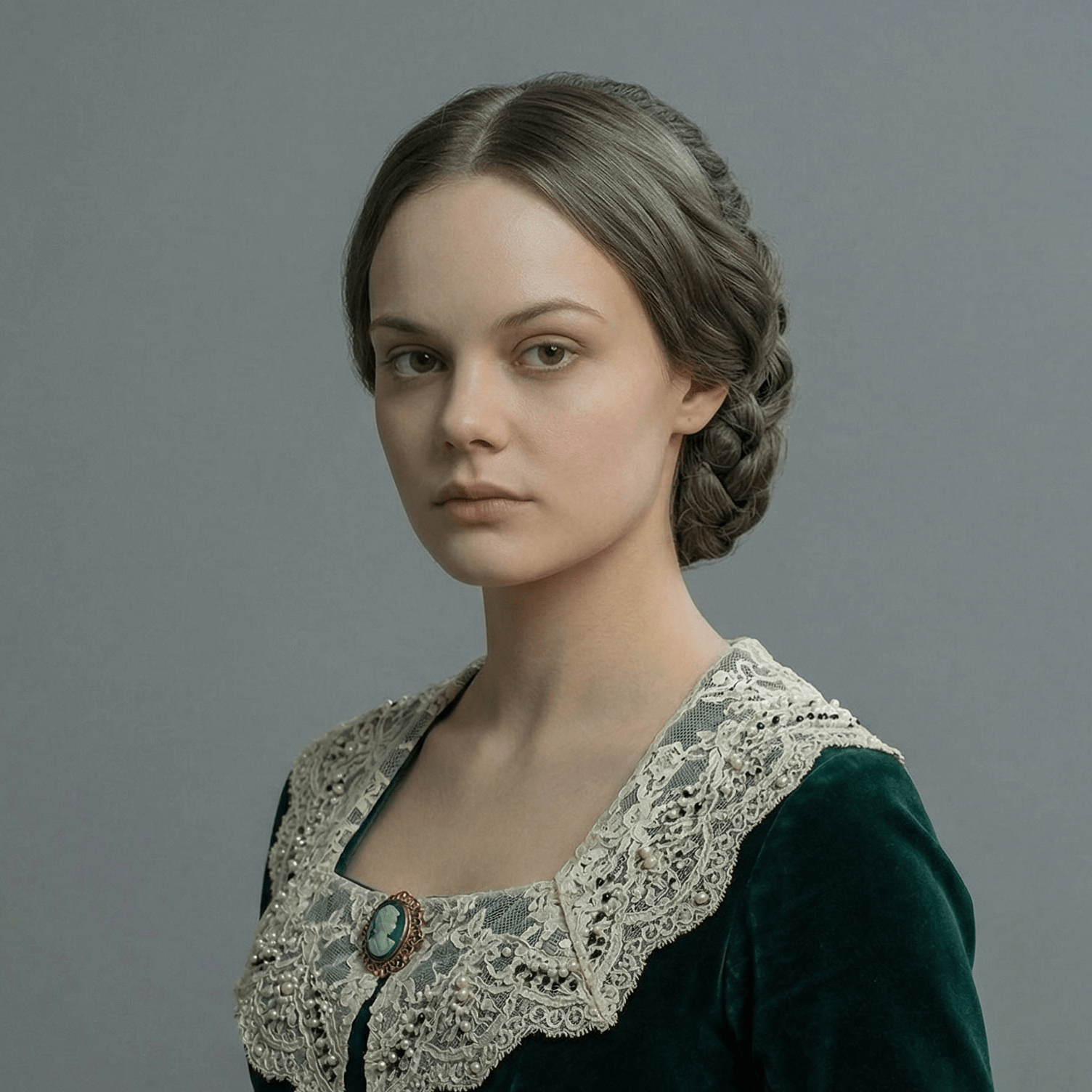
A Wedding and the Familial Cycle of Capital
As we recall from the tale of the great escape, Ekaterina had barely turned sixteen when she was hastily marched down the aisle. The chosen one was a 27-year-old Provincial Secretary, Vasily Fyodorovich Vzmetnev. The parish register scrupulously records all the accomplices to this event:
“November 1840: Groom: Serving in the Chancellery of the 2nd Division of the 6th Department of the Governing Senate, of the Nobility, Provincial Secretary Vasily Fyodorov son Vzmetnev, of the Orthodox faith, first marriage. Bride: Maiden of the deceased Second Lieutenant Pyotr Ivanov Lyalin, Ekaterina Petrovna, of the Orthodox faith. Besides the groom who signed the pre-nuptial inquiry, the guarantors were: serving in the 6th Department, 2nd Division of the Governing Senate, Titular Councilor Grigory Vasilyev son Krasnopolsky. Besides the bride: her birth mother, the female guarantor Praskovya Ivanova von Strahlborn (Lyalina by her first husband), and her stepfather, Lieutenant Ludwig Karlovich von Strahlborn. For the groom: serving in the Moscow Imperial Post Office, Titular Councilor Yakov Ilyin son Vereshkevich.”
But the most fascinating development occurred exactly one month after the wedding. In December 1840, stepfather Ludwig, who was already packing his bags for a clandestine departure to Moscow to put some healthy distance between himself and his creditors, decided to present his new son-in-law with a rather peculiar gift. Not entirely free of charge, naturally.
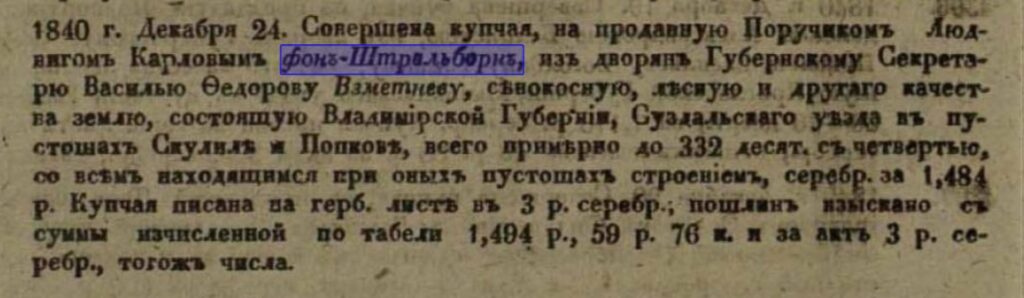
“December 24, 1840. A bill of sale was executed for hay-cutting, forest, and other lands sold by Lieutenant Ludwig Karlovich von Strahlborn to the nobleman and Provincial Secretary Vasily Fyodorovich Vzmetnev, located in the Vladimir Governorate, Suzdal district, in the wastelands of Skulil and Popkovo, totaling approximately 332 and a quarter dessiatines, with all structures situated upon the said wastelands, for 1,484 silver rubles.”
In other words, Ludwig sells a substantial chunk of land from his own wife’s estate to her daughter’s husband. Capital performed a seamless familial merry-go-round as the hussar desperately liquidated real estate into hard cash right before his final vanishing act.
The Venetian Count and the Midwifery Network
The second daughter, Maria Petrovna Lyalina, was married off with no less color. Her spouse was Alexander Gavrilovich Derionzini. For Praskovya, who always harbored a weakness for beautiful façades, this marriage was an absolute triumph: her son-in-law held the status of a Venetian count. His lineage boasted a rich history (complete with papers from Europe authenticated by the Catholic Cathedral of Saints Peter and Paul in Moscow). Still, from a strictly practical standpoint, the count was utterly penniless. In Russia, his title conferred no special privileges; he hadn’t a penny to his name, and on paper, the illustrious Derionzini was officially listed as a mere “clerk of the 1st rank.”
Where on earth did provincial land-owning ladies manage to unearth a genuine, albeit impoverished, Italian count? All roads, it seems, lead straight back to the tireless Alexander Yunits.

Yunits’s family was clearly ahead of its time, demonstrating the morals of rather free-spirited bohemians. One of his sisters shared a Moscow roof with a painter out of wedlock, bringing new life into the world without the slightest regard for ecclesiastical conventions. Another sister served as a metropolitan midwife in almshouses, frequently delivering infants born under the rare circumstances of that time.
A striking coincidence: Count Derionzini’s mother practiced the exact same trade in Moscow. Both ladies moved in the same professional circles, delivering babies for the middle class and the impoverished nobility alike. It seems it was precisely within this midwifery network that Mr. Yunits fished out a suitable groom for his patroness’s daughter.
This detail elegantly solves the riddle from the previous chapter: whence did Yunits and the young Elizaveta von Strahlborn bring an unknown infant to Gavrilov Posad? It is only logical to assume that this delicate problem was quietly resolved either by Yunits’s own sister or Mother Derionzini, who reliably swept the noble family’s little secret under the rug.

Sisterly Wars
Having acquired husbands, sonorous surnames, and the remnants of their inheritance, sisters Ekaterina and Maria immediately launched full-scale hostilities, both against neighboring landowners and against each other. For years, the Provincial Secretary’s wife Vzmetneva and Countess Derionzini practically took up permanent residence in the pages of the Senate Announcements, dragging each other to court over hay meadows and boundary lines.
By the way, having attained her new status, Maria Petrovna made it her golden rule to style herself an “Italian Countess” at every conceivable opportunity, appropriate or otherwise. Whether the matter involved the division of peasant households, official grievances, or a mundane lack of cash, the illustrious title had to be aired, lending a light flair of Venetian drama to even the most penny-ante provincial squabbles.
Both sisters ran their households on a truly aristocratic scale, which is to say, they existed in a state of chronic financial deficit. Ekaterina’s estate was under an injunction due to a debt of 2,660 rubles owed to the Moscow Guardianship Council. Meanwhile, Maria Derionzini’s country estate in the village of Lychevo was slapped with an embargo over an absolutely farcical tax arrear of a mere 162 rubles:
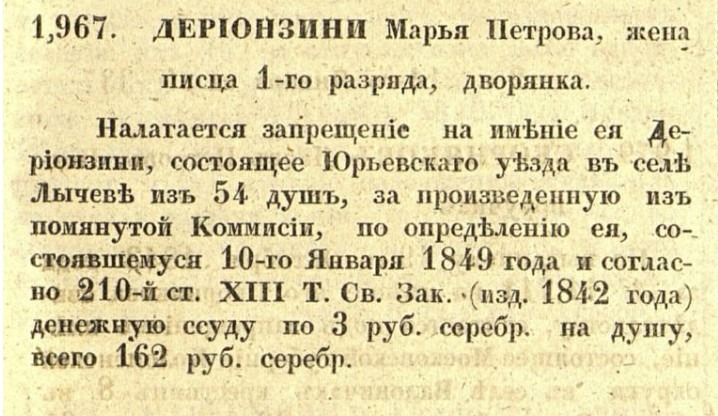
An embargo is imposed upon the estate of the said Derionzini, located in the Yuriev district in the village of Lychevo, consisting of 54 souls, for a monetary loan issued by the aforementioned Commission, by its resolution of January 10, 1849, and in accordance with Art. 210, Vol. XIII of the Code of Laws (1842 ed.), at 3 silver rubles per soul, totaling 162 silver rubles.
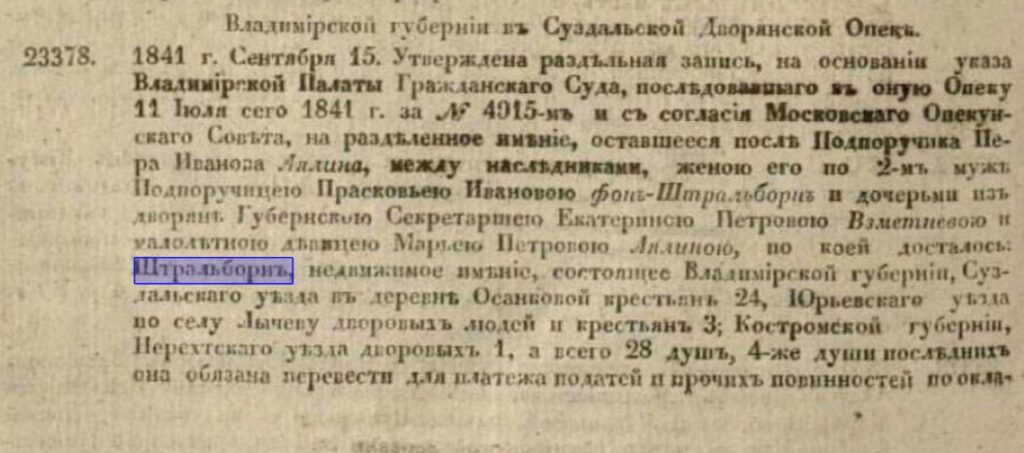
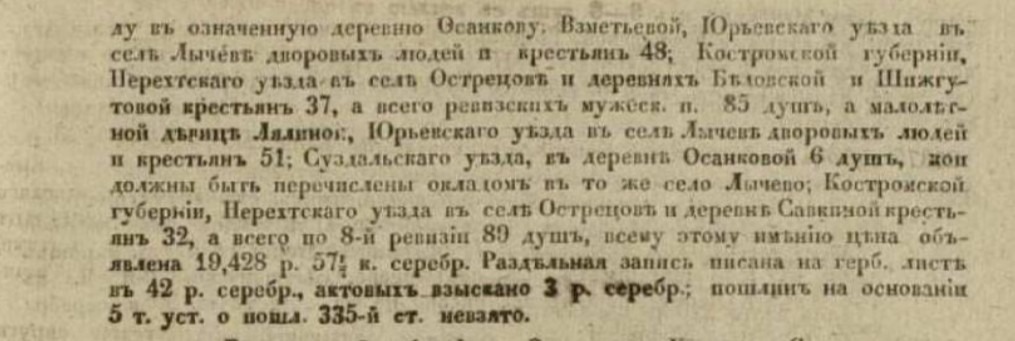
September 15, 1841. A deed of partition is approved, based on the decree of the Vladimir Chamber of the Civil Court issued to the said Guardianship on July 11 of this year 1841 under No. 4915, and with the consent of the Moscow Guardianship Council, for the partitioned estate left after Second Lieutenant Pyotr Ivanov Lyalin, among the heirs: his wife, now Second Lieutenant’s wife by her 2nd husband, Praskovya Ivanova von Strahlborn, and his daughters, of the nobility, the Provincial Secretary’s wife Ekaterina Petrova Vzmetneva and the minor maiden Marya Petrova Lyalina. According to the deed, the shares fell as follows: To Strahlborn, immovable property located in the Vladimir Governorate, Suzdal district, in the village of Osankova, 24 peasants; in the Yuriev district, by the village of Lychevo, 3 house serfs and peasants; in the Kostroma Governorate, Nerekhta district, 1 house serf, totaling 28 souls, the latter 4 of which she is obliged to transfer to the said village of Osankova for the payment of taxes and other duties according to the assessment. To Vzmetneva, in the Yuriev district, in the village of Lychevo, 48 house serfs and peasants; in the Kostroma Governorate, Nerekhta district, in the village of Ostretsovo and the hamlets of Belovskaya and Shizhgutova, 37 peasants, totaling 85 male revision souls. And to the minor maiden Lyalina, in the Yuriev district in the village of Lychevo, 51 house serfs and peasants; in the Suzdal district, in the village of Osankova, 6 souls, who must be transferred by assessment to the same village of Lychevo; in the Kostroma Governorate, Nerekhta district, in the village of Ostretsovo and the hamlet of Savkina, 32 peasants, making a total of 89 souls according to the 8th revision. The declared value of this entire estate is 19,428 silver rubles and 57 1/4 kopecks. The deed of partition is written on stamped paper for 42 silver rubles; act fees of 3 silver rubles were collected; no duties were exacted based on Vol. 5, Statute on Duties, Art. 335.
The dry inventory of souls and villages below is the true anatomy of the impending conflict.
First, we see an absolute financial disproportion: the widow Praskovya received a share of the inheritance three times smaller than that of her daughters from her first marriage. It becomes abundantly clear why Praskovya and her desperate hussar fought so fiercely to retain guardianship over the girls, and why Ludwig subsequently began selling off parcels of land.
The Appetites of the Italian Countess
The younger sister Maria by no means limited herself to local skirmishes with her own sibling. Having spread her wings and taken cover behind her Venetian title, she decided to throw down the gauntlet to the chief authority of their family terrarium, her formidable aunt, Tatyana Zakharyina.
Young Maria’s appetites had escalated to an entirely different level. The illustrious lady decided to settle scores with the heavy hitter of their family circle, the very same uncompromising dame who had once provoked her sister’s escape and attempted to snatch 75,000 rubles right from under the orphans’ noses.
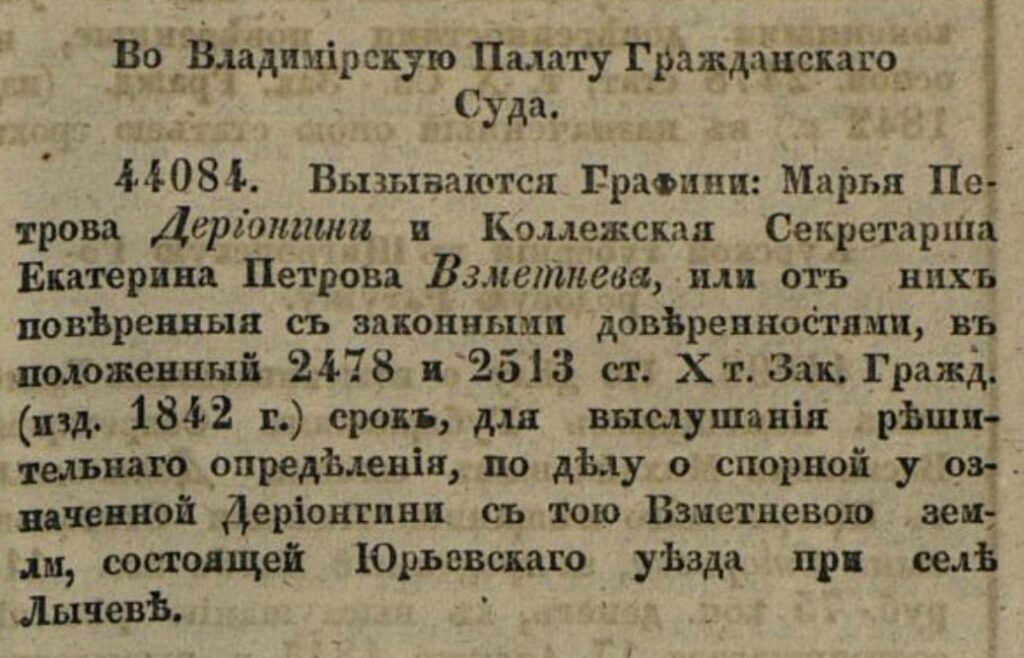
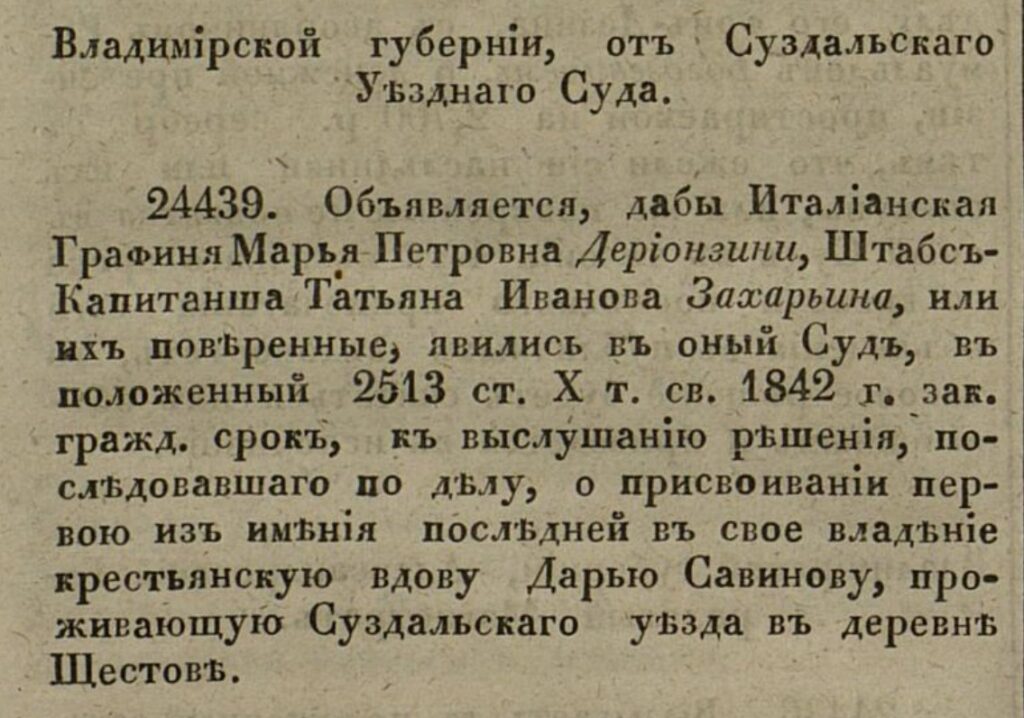
However, Maria did not bother with elaborate intrigues involving forged promissory notes or midnight flights. The dry lines of the Suzdal District Court announcement invite the “Italian Countess” and the Staff Captain’s wife, Zakharyina to the barrier, that is, to appear and hear the ruling on a rather spicy case. It turned out that Countess Derionzini had arbitrarily seized the peasant widow Darya Savinova from her aunt’s estate in the village of Shchestovo and transferred the woman “into her own possession.”
The family school of survival, mastered in her youth under the tutelage of Mother Praskovya and her permanent agent Yunits, had clearly not been lost on the newly minted countess.
The Return of the Cherry Tree
But the true apotheosis of this familial absurdity was a case that takes us right back to the very first pages of our saga: “The case concerning the demarcation of the manor land in the village of Lychevo, Yuriev district, and the ownership of a cherry tree…”
That very same tree, which the widow Praskovya had scrupulously entered into the property inventory after her first husband had a taste of rat poison, took center stage once again. Now, the manor was being divided by her grown daughters.
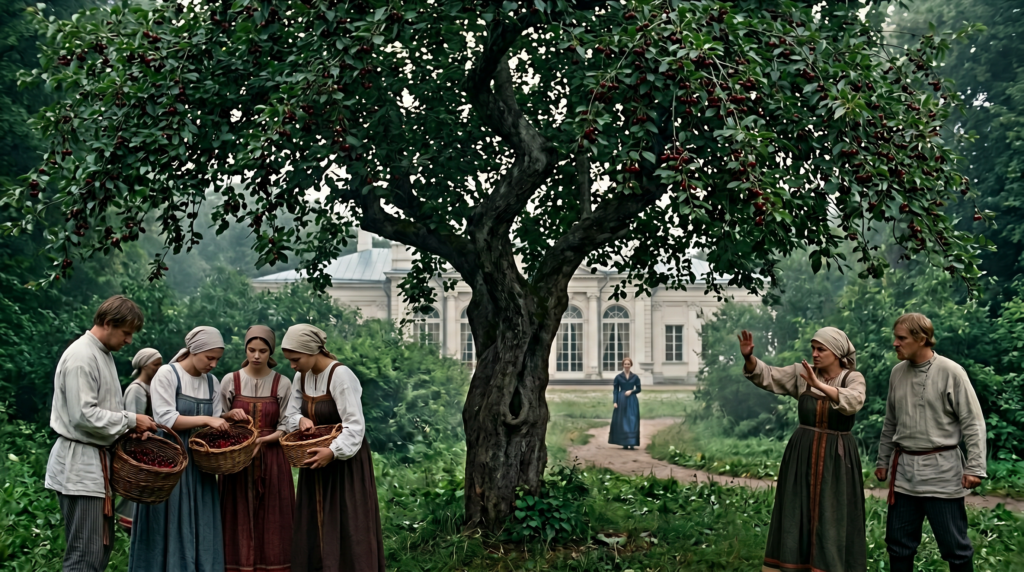
After the official land survey, the ill-fated tree ended up smack on the boundary line. In a bountiful year, the house serfs of the Secretary’s wife, Vzmetneva marched out to harvest the berries, arguing that the branches hung over onto their side. Countess Derionzini’s serfs bodily stood their ground to defend the crop. A petty neighborly squabble instantly snowballed into the scale of official litigation, complete with formal complaints, accusations of taking the law into one’s own hands, and the mandatory summoning of the district land surveyor. The titled countess and the provincial secretary’s wife litigated over berries with the exact same procedural zeal that their mother had brought to fighting for estate rights across several districts.
The story of Ekaterina Lyalina, which began with a dramatic midnight escape in flimsy slippers, concluded in a manner quite befitting the novels of her era. The courtroom battles over hay meadows and cherry trees ultimately gave way to a quiet fading away.
Epilogue for the Fugitive
She only flickered occasionally through the parish registers in the role of a godmother. The documents have preserved no information regarding any heirs of her own.
On September 10, 1866, the story of the 41-year-old Collegiate Assessor’s wife ended with her death from consumption. Following a modest funeral service conducted by the parish clergy, Ekaterina Petrovna was laid to rest in the Kalitinsky cemetery.
September 10, 1866. Wife of Collegiate Assessor, Ekaterina Petrova Vzmetneva. – of consumption – The Parish Archpriest Stefan Protopopov with Deacon Evgeny Vinogradov, Sexton Sivil Sokolov, and Ponomar Ivan Ozeretskovsky. In the Kalitinsky cemetery.
September 10, 1866. Wife of Collegiate Assessor, Ekaterina Petrova Vzmetneva. – of consumption – The Parish Archpriest Stefan Protopopov with Deacon Evgeny Vinogradov, Sexton Sivil Sokolov, and Ponomar Ivan Ozeretskovsky. In the Kalitinsky cemetery.
But her sister, Marya Petrovna, the Italian Count Alexander Gavrilovich Derionzini, and his hopelessly tangled pedigree are destined to play a far longer and much more astonishing role in our history.
