Financial Ruin, a Runaway Hussar, and a Retired Clerical Worker.

For the widow of Second Lieutenant Lyalin, who had now become the wife of Lieutenant von Strahlborn, the family idyll with the dashing hussar came to a rather predictable end. It transpired that Ludwig Karlovich was not merely utterly devoid of practicality, but also possessed a highly peculiar understanding of his marital duties. First, he took the prudent step of transferring his wife’s inheritance entirely into his own name. Then, in May of 1840, he simply departed for Moscow, leaving Praskovya behind with their four young children (Fyodor, Ludwig/Lev, Konstantin, and Elizaveta) and virtually no means of survival.

Guardianship Due to Cruelty.
The archival file (GKU YaO GAYaO F. 151. Op. 2-6. D. 11836) unveils a rather unsightly truth. Lieutenant Strahlborn was listed as the owner of fifty-one male souls in the very villages – Yershniki, Ustavskoye, and Sumarokovo – where my direct ancestors from the Bogdanov family had lived for centuries. However, he treated his people with such remarkable severity that, prompted by a chorus of complaints, the Governing Senate found it necessary to intervene.
By decree of the Senate, the estate was taken from Ludwig and placed under noble guardianship. The reason was stated with dry and absolute finality: “For this lieutenant’s cruel treatment of the peasants.” Staff Captain Alexander Ogalevtsev was appointed as the guardian, and it fell upon him to shovel his way through the financial chaos left behind by the runaway hussar.

Education Above All Else.

Praskovya Ivanovna, playing the part of a mother deeply concerned for her children’s welfare, tried in vain to squeeze at least some money out of the revenues of the ward-controlled estate. In her petitions to the local courts, she bemoaned her “husband’s coldness toward her and the children” and outlined some rather ambitious educational plans.
She had already placed her eldest son, Fyodor, in a private boarding school in Yaroslavl run by a Monsieur Belli (the lyceum superintendent), an arrangement that cost her 600 rubles a year. She planned to send her second son to follow in his brother’s footsteps. It is worth recalling a rather crucial detail here: during the investigation into the escape of her eldest daughter, Ekaterina, the gendarmes reported that Praskovya’s children were living in an inn near the local gymnasium without any supervision or care whatsoever. It was only when the family’s finances had completely run dry that Praskovya suddenly developed a burning passion for expensive private education.

The officials’ response to Praskovya’s needs was a firm negative. The court calculated that during the first half of 1841, 1,320 rubles in quitrent had been collected from the peasant households. One might think this would be quite enough to cover both the boarding school and their daily bread. But every last penny of this collected money was ordered to be sent immediately to Moscow. It turned out that Lieutenant Strahlborn had managed to mortgage several souls to the Moscow Guardianship Council, and the interest on this unpaid loan entirely swallowed the collected sum. As for Praskovya herself, she was allotted a pitiful 195 rubles.
Ludwig’s Final Flourish
The court did not merely refuse Praskovya the money; they also strictly instructed her “not to trouble the higher authorities with such representations” in the future. But the true blow was yet to come. While she was busy exchanging letters with the noble guardianship, it came to light that her husband had found a permanent solution to their property management problems. Lieutenant von Strahlborn had sold the estate in the Yaroslavl province entirely without leaving a single scrap, debts and obligations included, to a neighboring landowner named Podpalov.
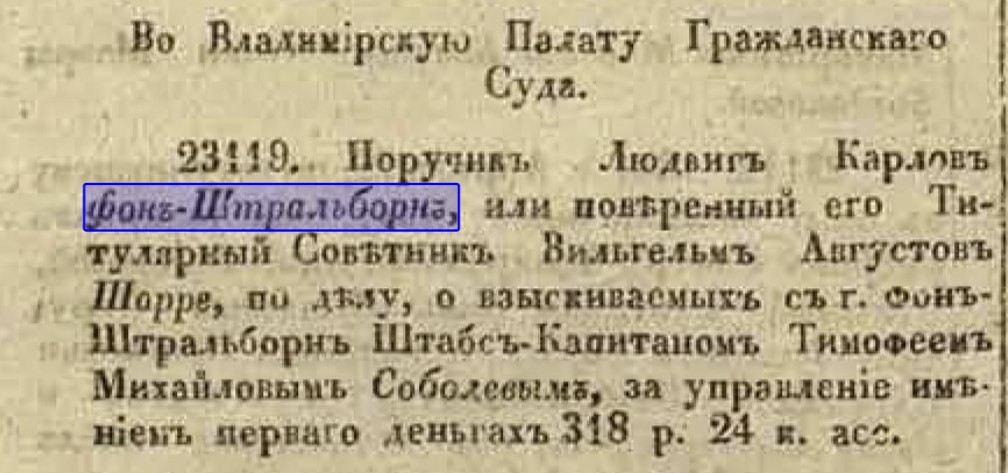


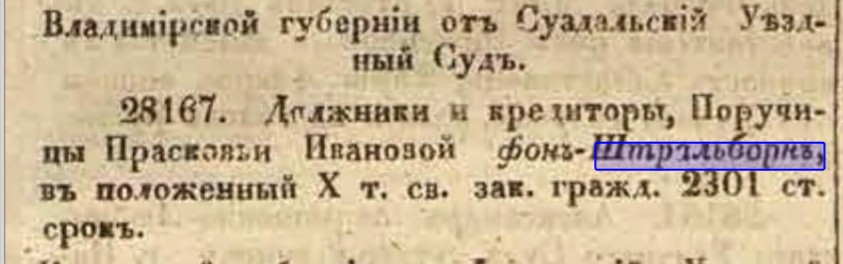


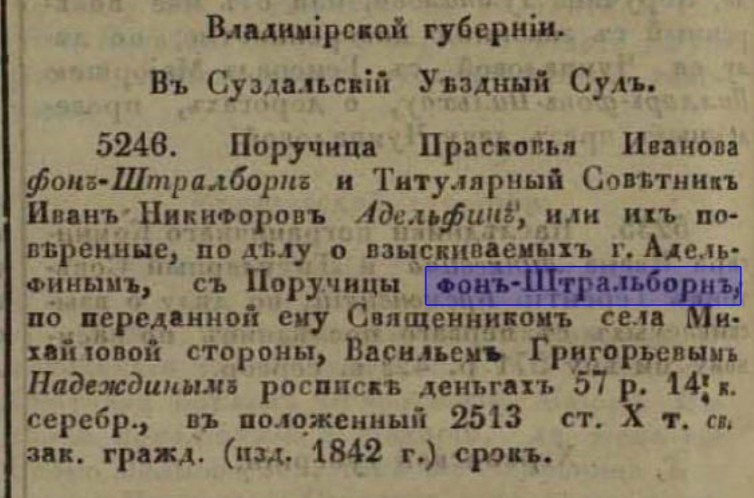
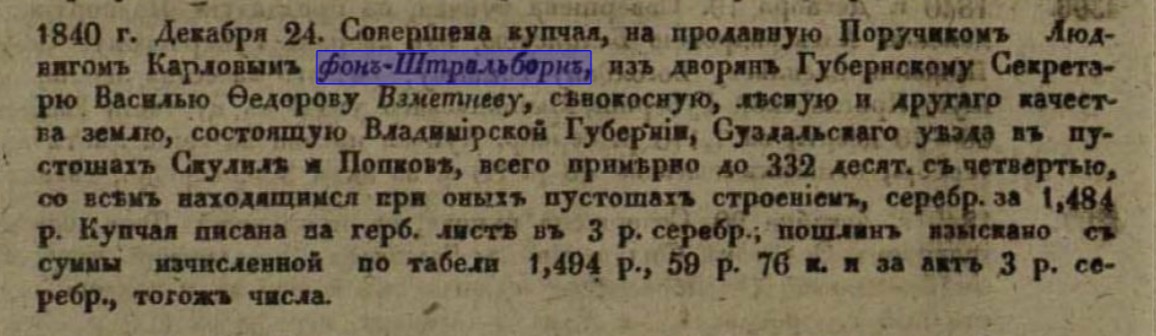
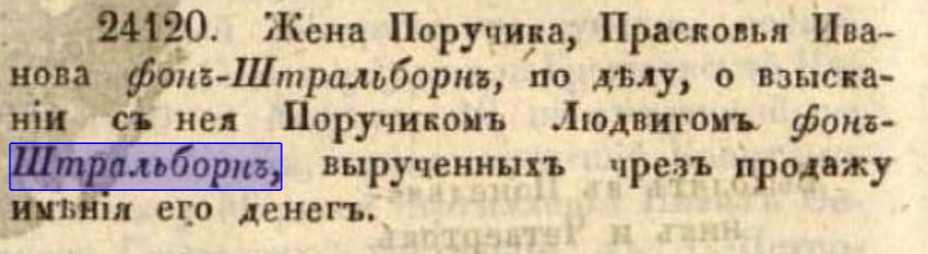

Senate announcements found on archive.org and yandex.ru ↑ . There are quite a few announcements regarding the debts of Ludwig and Praskovya; if one were to list them all, they would take up half the chapter.
And so it was that one of the Tregubov sisters lost her ancestral estate, or rather, the particular slice of it she had inherited from her father. My own ancestors, the Bogdanovs, remained securely tethered to her sister Irina (and do not worry, they shall make another appearance in this unfolding drama).
Troubles began rolling toward Praskovya like a rather large and menacing snowball. Ludwig was being hunted through the courts for debts owed to a wide assortment of people. Praskovya herself was summoned as well, partly for her own debts, and partly to answer a rather touching little claim: she had failed to pay for her servant girl’s lessons in hoop embroidery, taught by another peasant woman. Things, it seemed, had grown so delightfully grim that even paying for such a simple service had become quite impossible.
This delicate predicament of managing a vast estate while fending off endless legal inquiries clearly required a specially trained manager. And, as luck would have it, one appeared.

The Great Schemer, Mr. Yunich
Enter an ex-clerk and part-time charismatic adventurer named Alexander Nikolayevich Yunich. Now, if a clerical worker makes an entrance in this archival soap opera, you can be certain it is the sort of clerk who makes not just a small provincial town, but the entire district, tremble in its boots.
Judging by the accounts of those who had the pleasure of knowing him, Yunich possessed traits remarkably similar to Ludwig’s. Only, instead of shooting at bottles in a tavern, he fired off endless petitions and complaints to the courts. He made a rather comfortable living this way, masterfully pouring oil on the fires of local landowner disputes to ensure a steady income. Near Gavrilov Posad, he found not only a lucrative workplace but also a cozy spot in Praskovya’s heart. It was Yunich who drafted the legal complaints on her behalf, sniffing out Ludwig’s hidden revenues. Later, he would also champion the cause of securing noble titles for Praskovya’s sons from her second marriage. And it is highly likely that, thanks to his helpful meddling, our story will soon welcome a mysterious new character: Praskovya’s son-in-law, a count of Venetian descent named Derionzini (but we shall save him for the next chapter).
In the newspaper clippings of the mid-nineteenth century, Yunich’s name pops up constantly in wanted notices and court summonses for the most varied of reasons, sometimes as a helpful mediator in disputes, and quite often as the defendant answering to a colorful array of charges.
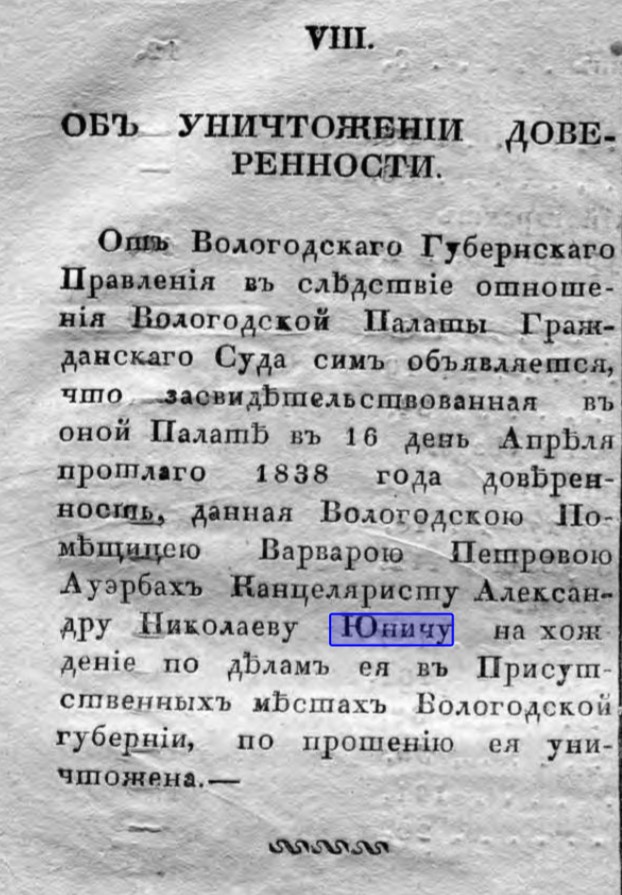
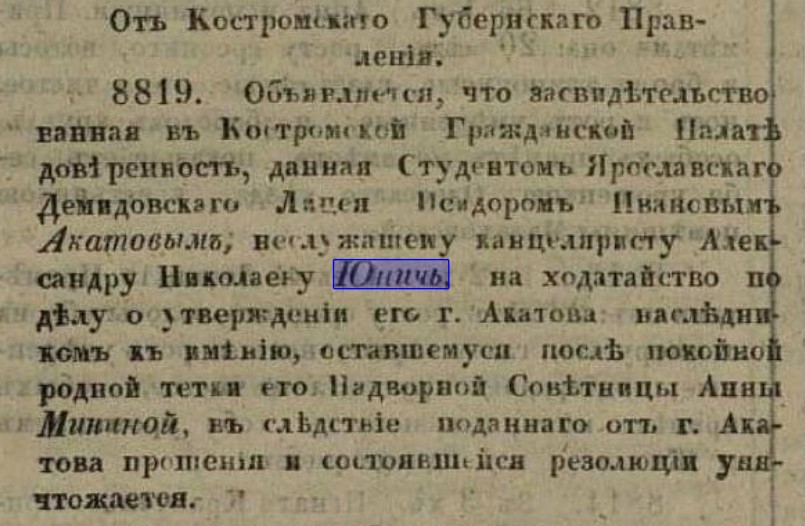
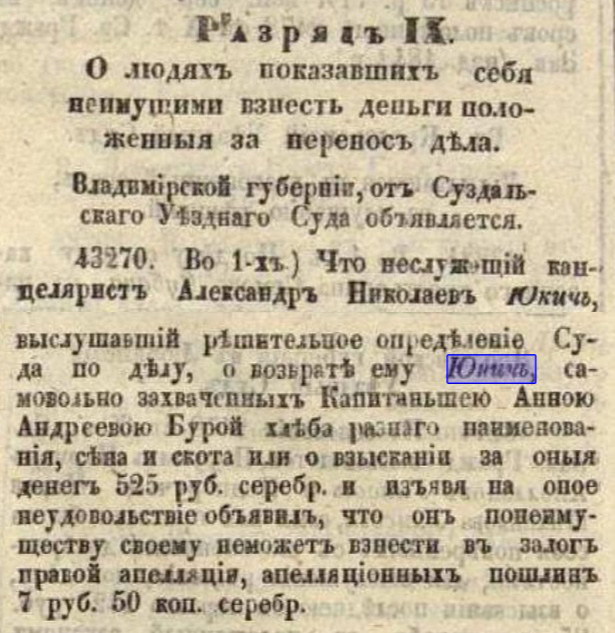
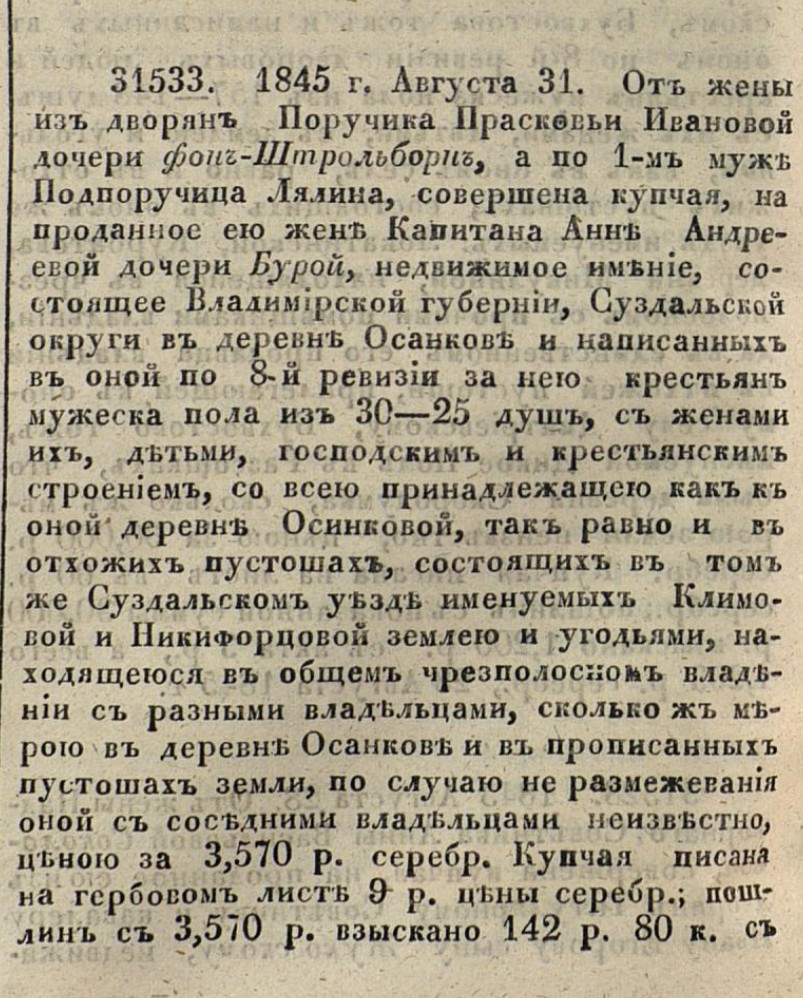

Files 801-900
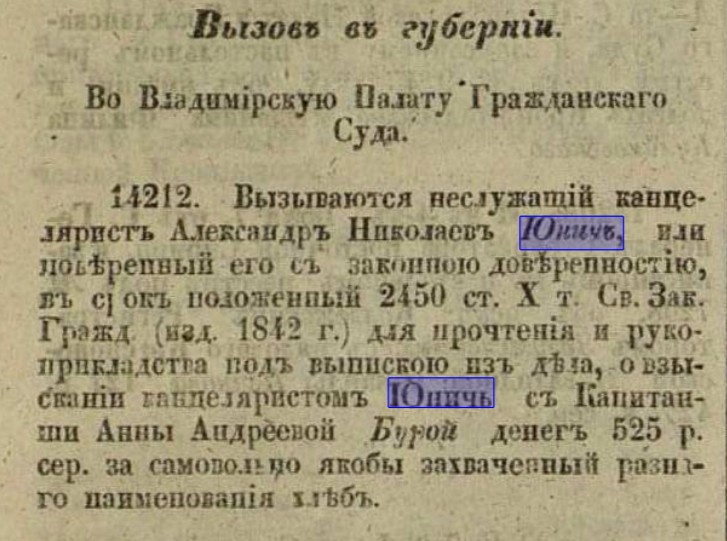
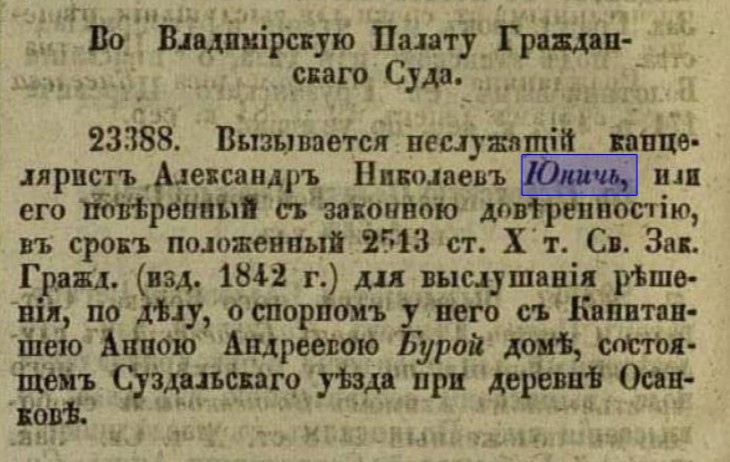
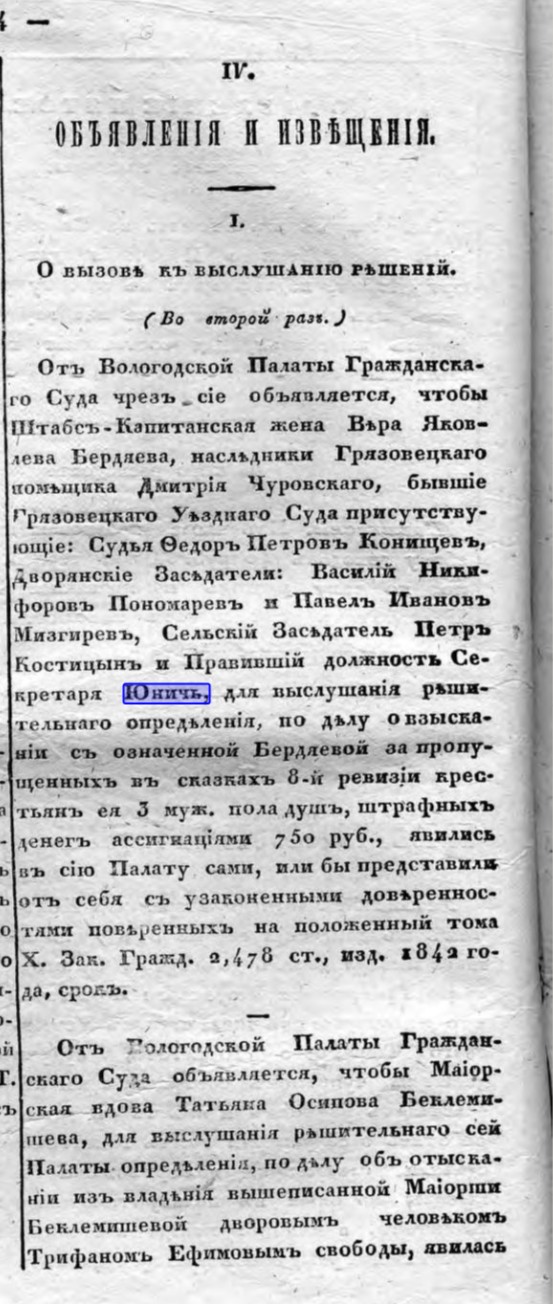
Senate announcements found on archive.org and yandex.ru ↑
A Melodrama Becomes a Detective Story
In 1844, Praskovya’s peasants supposedly approached the authorities with a rather unexpected request: to lift the guardianship and return them to the tender care of their mistress, Madame Strahlborn. During the inquiry, however, it came to light that the peasants had never laid eyes on such a petition, and not a single soul knew who had written it or “lent a hand” to sign it.
It turned out that in August of 1843, Mr. Yunich, who was conveniently residing with Praskovya, had simply asked the estate headman to drop a certain envelope at the post office. Enjoying an exceedingly close relationship with the lady of the house, Yunich had taken to managing the estate as he pleased, entirely ignoring the official guardian. This guardian, incidentally, was the husband of Praskovya’s younger daughter (Maria), the very same Italian Count Derionzini. The Count, under whose mild supervision the peasants had suffered no oppression, had been ousted from control precisely because of Yunich’s “ill-intentioned and meddlesome character.”
With this grand schemer at the helm, the peasants faced genuine ruin. Under the guise of property sales, their canvases, cotton, horses, and livestock were simply confiscated. The peasants firmly believed that the forged petition in their name had been penned by none other than Yunich himself, purely so he could officially seize control of the estate.
The district marshal, Bogdanov, soon learned that Praskovya had handed Yunich a promissory note for 2,314 rubles and a receipt for 4,217 rubles, both drawn against her own brother. Madame Strahlborn’s close ties to the clerk, coupled with his rather drunken lifestyle, gave the marshal every reason to suspect that Yunich would simply squander what little remained of the estate and leave the young children to beg in the streets. The elder daughters from the first marriage were already safely married off by this time; Praskovya herself had lost both her father’s inheritance and part of her first husband’s estate, while her “current husband, out of dissatisfaction, left her and vanished to parts unknown.”
If one were to write a detective novel based on this little history, the most splendidly wild theories immediately spring to mind: perhaps Yunich had a hand in Ludwig’s disappearance; perhaps the runaway hussar and the clerk were secretly in cahoots to siphon off Praskovya’s income; or perhaps Praskovya herself had a flair for finding rather permanent ways to dispose of inconvenient husbands.
As for Ludwig von Strahlborn, his final appearance in the archives dates back to 1844: “Lieutenant’s wife Praskovya von Strahlborn, concerning the collection of money from her by Lieutenant Ludwig von Strahlbert.” Just once did a brief note flutter into the metric books of Moscow regarding the marriage of one of Ludwig’s household serfs. After that, the trail of the dashing hussar vanishes completely into thin air. It is quite possible that Ludwig met with a sudden mishap owing to his adventurous lifestyle, or perhaps he was simply living incognito, dodging his creditors.

1844:
“Lieutenant’s wife Praskovya von Strahlborn, concerning the collection of money from her by Lieutenant Ludwig von Strahlbert”
A Prison Tour
In 1845, Praskovya made another brave attempt to lift the guardianship from her estate. As one might expect, she was promptly blocked by the marshal of nobility, Bogdanov, who politely reminded everyone of her association with Mr. Yunich and the small matter of her children being abandoned at an inn.
In retaliation, Yunich fired off a furious complaint to the Active Privy Councillor, Count Lev Perovsky. The sprawling text of his message, written in unbelievably flowery prose and terribly tiny handwriting, essentially boiled down to this: he, Yunich, was merely residing with Madame Strahlborn under the terms of a loan in a house he had built in the village of Osankovo in the Suzdal district, and he had simply forwarded the peasants’ heartfelt plea to lift the guardianship to the Senate. As for the local authorities in Suzdal, they were persecuting him purely out of “the personal disfavor of the superiors in the town of Suzdal, who are all tangled up together by family ties and mutual back-scratching.”
To get to the bottom of this mysterious peasant petition, the prosecutor sent a polite inquiry to the Moscow magistrate regarding the whereabouts of Mr. Yunich himself. The reply from Moscow stated that Mr. Yunich had, in fact, spent the last month sitting comfortably in the Moscow prison castle on charges of attempting to murder a merchant named Kasatkin (!). By this point in our story, however, such delightful little twists are hardly surprising.
Madame Strahlborn hurried to bail her lover out. The Suzdal court demanded Yunich’s physical presence for a face-to-face confrontation with the peasants and a household serf belonging to Count Derionzini, who, as it turned out, had also lent his hand to the forged petition. But Praskovya failed to produce her protégé. Yunich sent a written refusal to appear, and soon it was discovered that yet another case had been opened against him. A neighboring landowner (to whom Praskovya had sold a piece of her estate to cover debts) was now accusing the clerk of inciting her peasants to riot.
While the courts were busy churning out summonses, the elusive Mr. Yunich found himself under arrest once again, this time in Yaroslavl. The inquiry involving the peasants and Yunich could not be completed, and a firm refusal was issued regarding the phantom request to lift the estate’s guardianship. The authorities planned to forward this decision to the Yaroslavl court so that Yunich might be officially notified.
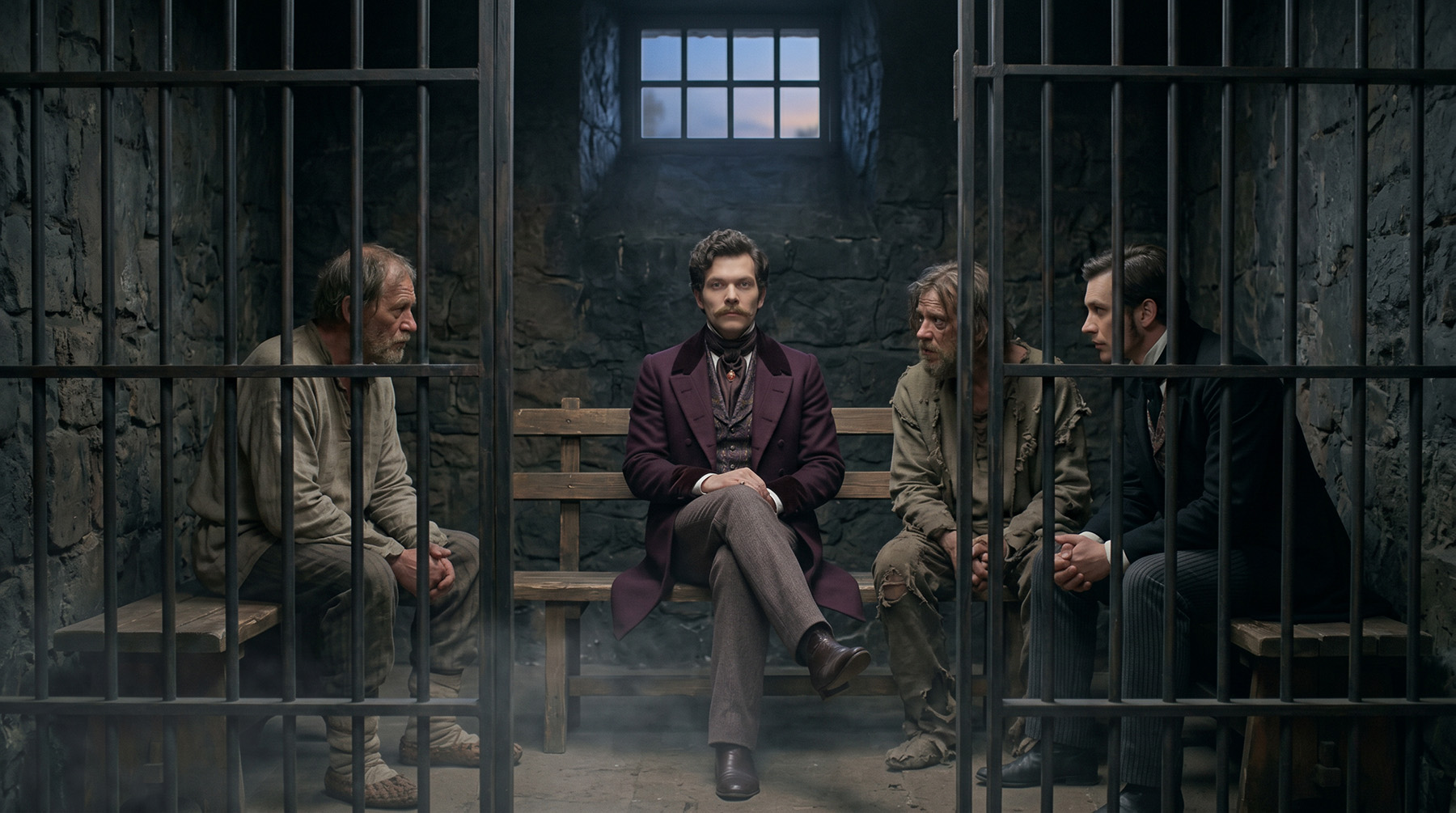
In the Yandex archives, one can find the entire case involving the merchant Kasatkin, which dragged on wonderfully from 1844 to 1853:
“Concerning the Moscow burgher Nikolai Vasilyev Kasatkin, the retired clerk Alexander Nikolayev Yunich, the collegiate secretary Sergei Andreyev Dobrov, and others,” which examined: 1) Calling oneself a merchant; 2) Living under an assumed name; 3) Passing on a second certificate of residence; and the participation of the others in knowing the facts.”
← Read Chapter II | ← Read Interlude | Read the continuation →
