A Multi-Part Archival Detective Drama

Author and Creator of the Website: Alexandra Fomicheva
The characters in this saga are not only representatives of the Tregubov noble families from the Vladimir province, the von Strahlborns originally from Estonia, and the European counts of Venetian descent, but also the Derionzinis. Alongside them, other surnames appear: the Lyalins, Zakharyins, Yunichs, and Molchanovs. Even those figures who appear in this epic in passing inevitably become part of a complex and rich plot. And at the center of the story is the marriage of the von Strahlborn brothers, who were hussars, to the Tregubov sisters.
I feel an affinity for the atmosphere of a confined space within a single conventional estate, much like in classic detective stories where all the characters are gathered under one roof, and the wrought-iron gates of an old garden restrict their movements. I tried to recreate this atmosphere on the main page and in the panoramic interior scene, where you can take a closer look at each participant and catch their gestures and facial expressions.
A video sequence of artistic imagery covering the first chapters of the story
You can also listen to a summary describing the events presented in the video.
The music used in both the video and audio formats is Goehr Walter – Bruckner Symph 3 (MMS-2018) 1952; source: archive.org.
A few years ago, while working with the confession records of the Novoselki-Penkovo parish in the Rostov district, I was looking for information about my ancestors and the estate where they had lived for several centuries. It was then, in the mid-19th-century papers, that I discovered owners with an unusual surname. Over the years, clerks recorded it by ear, generously displaying their imagination: Shtramberg, Shtramborg, Shtrambern, Shtralbort…
It is worth clarifying right away: these people are, so to speak, “my landowners”, those to whom my ancestors belonged. Those who owned serfs bought them, sold them, mortgaged them to boards of guardians, and casually lost them at the card table. A detailed study of these gentlemen’s biographies was completely out of my plans. However, other archival files brought me back to these new acquaintances time and time again. Their private lives turned out to be filled with such an endless series of plot twists that it was impossible to stop.
Judging by the announcements in the Senate Gazettes and archival records, the nobility of some of these gentlemen often ended where financial interest and immediate gain began. Their names are found in lawsuits involving oppression, excessive extortion, and even physical cruelty.
However, I am merely an impartial spectator, watching this archival performance. The provincial noble estate as a setting gradually drew me in not only to a detailed account of the events, but also to their visual embodiment; this story began to exist not only in text, but in imagery.
Every new case was more surprising than the last. In this epic, new faces emerged in passing, only to immediately become part of a complex puzzle. Around the fifteen-year-old daughter of one of the heroines, a real thriller unfolds with poisoning, escape, and document forgery. Nearby looms an influential guardian – the godmother of Leo Tolstoy’s sister-in-law. And just when it seems the plot has peaked and is moving towards a logical conclusion, a new twist unexpectedly occurs. A seemingly inconspicuous character appears, someone I had only encountered a couple of times in the files I studied, but his title and surname intrigued me. Following the entirely natural script of this archival saga, there are no random people in it, and the new hero turns out to be none other than the Venetian Count Derionzini, complete with his own collection of skeletons in the closet.
The density of intrigues here is such that reality confidently surpasses any fictional TV series. Even abstracting completely from speculation, the plain, dry archival facts paint quite caricatured personas, as if borrowed from a school literature curriculum: ranging from the classic old-world landownress, Tatiana Zakharyina, to a count with an unconfirmed title and not a penny to his name.
Two Sisters and Two Hussars
If this starting point were an invention, the author would be reproached for a lack of imagination. In the 1830s, two biological sisters, Irina and Praskovya Tregubov, married two biological brothers – Captain (Rotmistr) Alexander and Cornet (later Lieutenant) Ludwig von Strahlborn.
Such a concentration of romantic clichés is rare in real life, making this detail a true gift for the plot. When reality begins to so blatantly imitate a romance novel, all one can do is quietly observe the unfolding events.
Both the brothers and the sisters came from large but not wealthy noble families, and this mattered: in such circles and in that era, prosperity was most often determined by inheritance. The Strahlborns were born in Estonia and ended up in the Vladimir province as part of the hussar troops. Some of the Tregubovs were also military men and owned lands in the Vladimir and Yaroslavl provinces.
When I tried to find out the correct spelling of the surname on the Yaroslavl archives forum, I was given a link to an article by B.A. Volchenkov, a member of the Russian Geographical Society, is dedicated to the history of Gavrilov Posad. In this fascinating work with the memorable title “The hussars came to us… 200 years ago,” it was mentioned that in the first third of the 19th century, several military regiments were simultaneously stationed in the town. Among them was the hussar regiment in which the Strahlborn brothers served.
Unfortunately, the article is currently unavailable, but I have kept its text. Here is a short excerpt:
Other hussars also found their fate here. For instance, Captain Strahlborn married the daughter of landowner Tregubov, Lieutenant Dick married the daughter of a merchant’s widow, Kovylayeva, and Josaphat Nevyadomsky found a bride in the village of Teykovo. Hussar officers were welcomed into wealthy merchant homes. They attended balls. The original verses of an unknown hussar poet who described a ball at the house of merchant I.I. Barashkov on the occasion of his name day have been preserved. Here are the first stanzas:
Upon the banks of Bolotnaya River
There stands a posad, with two churches fair,
Some fifty houses, decent and proper
And here, for our sins, we too must dwell.
There live the merchants and the townsfolk,
The town head, the bustling arcade,
Here are nobles of various standing,
Secretaries – and sundry absurdities.
There are young beauties to be admired,
And jealous husbands standing near,
Dashing dandies clad in tailcoats –
Yet all of it I cannot fully recount.
For who could capture all that thrives
Within this worthy, lively place:
The gossip, the tales of who lives how,
The diversions of local society,
The curious lives unfolding here?
But let us cease these idle amusements
And empty chatter. Long have I dreamed
Yes, long have I wished, I must confess
To describe a posad ball…
Inheritance Above All
However, the frivolous waltzes and the double wedding were preceded by much darker events. In 1829, the sisters’ father, Cornet Ivan Mikhailovich, passed away. Soon after, Praskovya was widowed; her first husband, Second Lieutenant Lyalin, died under circumstances so murky that they deserve a separate story.
Given the fleeting nature and the timing of Praskovya’s new marriage, the Estonian hussars’ introduction to the Tregubov sisters could well have taken place at one of the posad balls long before the tragic events.
One way or another, by the time she entered official mourning, Praskovya had become not just a free woman, but the manager of a double inheritance (her father’s and her husband’s), as well as the guardian over the shares of her young daughters – Ekaterina and Marya.
Thus, balls gave way to mourning, and mourning to suspiciously quick weddings. The consequences of these events would later snowball, enveloping everyone involved in the story. Some representatives of other Strahlborns became prominent military men and officials. But the two brothers who “fell” to me did not achieve high careers. Instead, they provided me with the material for an excellent archival drama.
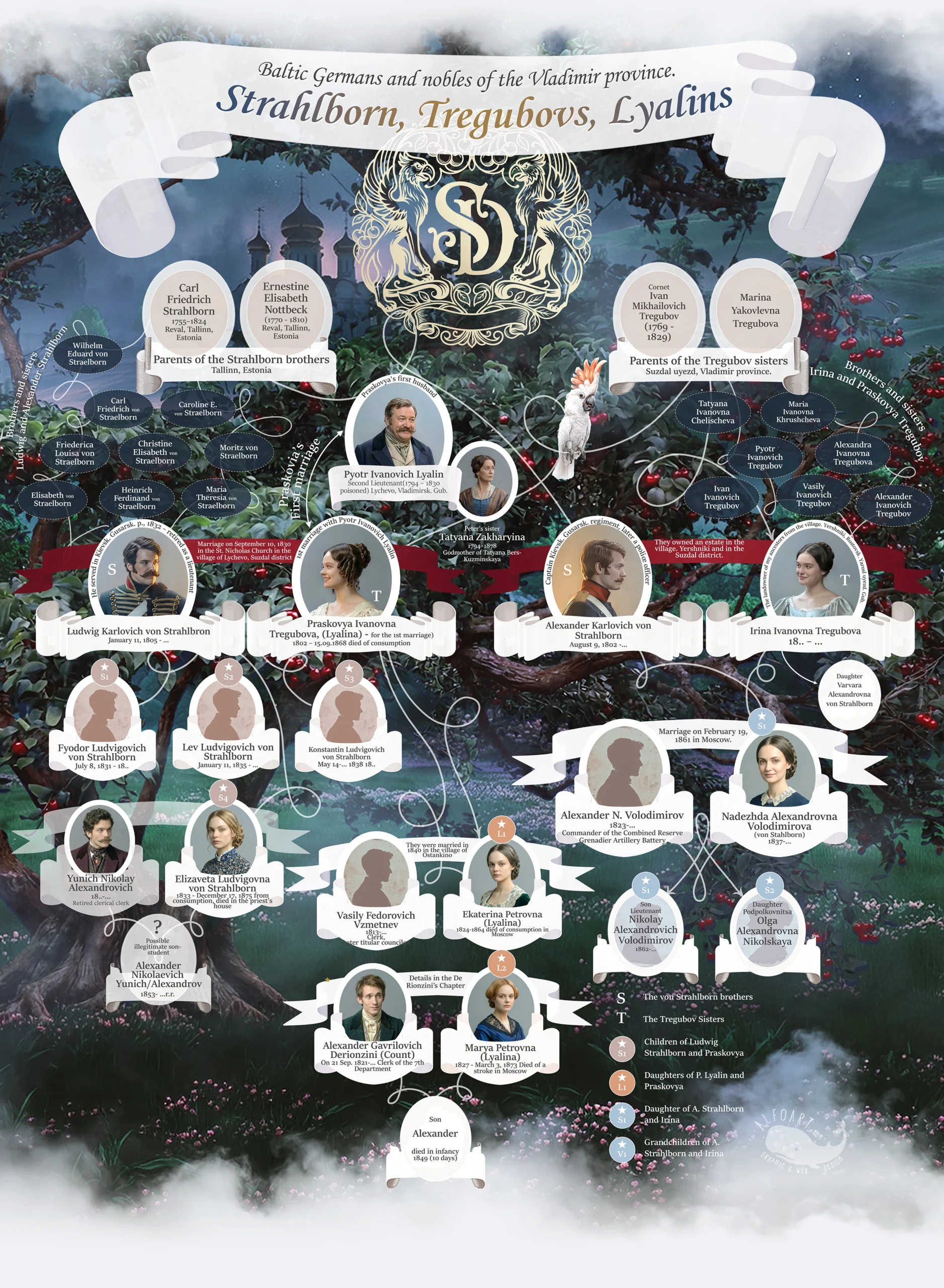
The von Straelborn/Strahlborn — Tregubov — Lyalin Families.
Since we are talking about real people, I have tried to compile a summary of the family ties of the main characters. Perhaps someone will find familiar surnames and useful information here.
I. The von Strahlborn Family
Parents of Alexander and Ludwig von Strahlborn:
- Karl Friedrich von Strahlborn: February 8, 1755 – May 27, 1824, Tallinn (69 years old)
- Elisabeth Ernestine von Strahlborn: June 20, 1770 – October 11, 1810 (40 years old)
11 children were born in the marriage, among whom are the brothers of interest to me:
- Alexander Karlovich von Strahlborn (Alexander von Strahlborn). Born September 1, 1802. Staff-Rittmeister of the Kyiv Hussar Regiment. After retiring, he served as a district police officer of the first district of the Bronnitsky uyezd of the Moscow okrug. Often found in metric books, conducting affairs in the section of the deceased.
- Ludwig Karlovich von Strahlborn (Ludwig von Strahlborn). Born January 29, 1805. Lieutenant of the Kyiv Hussar Regiment, in 1829 received the rank of Portupey-Junker, in 1831 promoted to Cornet, in 1832 discharged from service with the rank of Lieutenant.
Brothers and sisters of Alexander and Ludwig: Wilhelm Eduard von Strahlborn, Friederike Luise von Hueck, Karl Friedrich von Strahlborn, Heinrich Ferdinand von Strahlborn, Karoline Elisabeth Koch, Elisabeth (Betty) Dieckhoff, Elisabeth Dieckhoff, Maria Theresia von Hueck
II. The Tregubov Family
Parents of the sisters Irina and Praskovya:
- Ivan Mikhailovich Tregubov, Cornet 1769 – 1829
- Marina Yakovlevna Tregubova
Daughters:
- Irina Ivanovna Tregubova – wife of Alexander Karlovich von Strahlborn
- Praskovya Ivanovna Tregubova (1802 – 1868) – wife of Pyotr Lyalin, from 1830 the spouse of Ludwig Karlovich von Strahlborn. Died in the almshouse of Colonel Volotsky
Other children of Ivan Mikhailovich Tregubov: Tatyana Ivanovna Chelishcheva, Ivan Ivanovich Tregubov, Alexandra Ivanovna Tregubova, Pyotr Ivanovich Tregubov, Maria Ivanovna Khrushcheva, Vasily Ivanovich Tregubov, Alexander Ivanovich Tregubov
III. Marriages of the Tregubov Sisters
Marriage of Irina Ivanovna Tregubova to Alexander Karlovich von Strahlborn
Daughter:
- Nadezhda Alexandrovna von Strahlborn – born in 1837. On February 19, 1861, she married:
Alexander Nikolayevich Vladimirov (born 1823), Lieutenant Colonel, commander of the consolidated reserve grenadier artillery battery
Children of the Vladimirovs:
- Olga Alexandrovna Nikolskaya (Lieutenant Colonel’s wife)
- Nikolai Alexandrovich Vladimirov (born 1862), Lieutenant
Marriage of Praskovya Ivanovna Tregubova to Ludwig Karlovich von Strahlborn
Wedding: September 10, 1830 – St. Nicholas Church in the village of Lychevo, Suzdal uyezd
First husband of Praskovya Ivanovna: Pyotr Ivanovich Lyalin, Second Lieutenant. Resided in the village of Lychevo, Yuryevsky (Yuryetsky) uyezd, Vladimir province.
Pyotr Lyalin died in 1830 from rat poison. Left a suicide note. In 1809, Sub-Ensign of the Life Guards Preobrazhensky Regiment. Participant in the Foreign Campaign of the Russian Army. For unauthorized absences, theft of clothes from stores, and underpayment in taverns, he was demoted to the ranks by Barclay de Tolly and deprived of nobility by the court. A private of the Yaroslavl Infantry Regiment, later pardoned and rose to the rank of Second Lieutenant.
Parents of Pyotr Lyalin:
- father – Ivan Trofimovich Lyalin, Ensign (died before 1807)
- mother – Ekaterina Fedoseevna Lyalina, Ensign’s wife
Sister of Pyotr Lyalin:
- Tatyana Ivanovna Zakharyina, Staff Captain’s wife – godmother of the memoirist Tatyana Bers-Kuzminskaya. Had no children of her own. Her goddaughter was named in her honor. Zakharyina was a patient of Andrei Yevstafyevich Bers, father of Tatyana and Sofya Bers. The latter, in turn, was the wife of Leo Tolstoy, and he was personally acquainted with Tatyana Zakharyina. Zakharyina was a wealthy landowner and owned an estate in the village of Goncharovo, which is mentioned in archival files connected with the Strahlborn and in the memoirs of Tatyana Bers.
- Tatyana’s husband: Vasily Borisovich Zakharyin, Staff Captain
Children of Praskovya Ivanovna and Pyotr Lyalin:
- Ekaterina Petrovna Lyalina. 1824 – 1864 (died of consumption). On November 3, 1840, she married Vasily Fyodorovich Vzmetnev (born 1813), a clerk (later – Titular Councilor. Resided in Gagarinsky Lane, in the Ukhanova house). Wedding – Trinity Church in the village of Osankovo (Ostankino?).
- Marya Petrovna Lyalina. 1827 – March 3, 1873 (died in Moscow, cause of death – “from a stroke”). Husband – Count Alexander Gavrilovich Derionzini, clerk of the noble deputy assembly.
IV. Children of Praskovya Ivanovna and Ludwig Karlovich von Strahlborn
- Elizaveta Ludwigovna von Strahlborn. 1833 – December 17, 1875 – died unmarried in the house of priest Sokolov from consumption. Presumably gave birth to an illegitimate child in 1854. The file of the retired clerk Alexander Nikolayevich Yunich indicates that they lived together in Gavrilov Posad with an infant brought from Moscow.
- Fyodor Ludwigovich von Strahlborn. Born July 8, 1831 – information from the metric book of the village of Rykovo, Yuryevsky okrug
- Lev Ludwigovich von Strahlborn. Born January 11, 1835, in the village of Lychevo. Godfather – uncle, Alexander Karlovich von Strahlborn.
- Konstantin Ludwigovich von Strahlborn. Born May 14, 1838 – information from the metric books of the village of Nelshi, Suzdal okrug
Literature and Internet Resources Used.
Genealogical chart of the sisters Irina and Praskovya Tregubova
The Straelborns on www.familysearch.org
File on the report of the Acting Military Governor of the city of Vladimir and the Vladimir Civil Governor concerning the retired clerical worker Alexander Yunich, RGIA [Russian State Historical Archive]. 1286 / 13 / 947
GKU YaO GAYaO [State Archive of the Yaroslavl Region] F. 151 Op. 2-5 D. 8563 File on the issuance of a certificate for the Rostov estate to the noblewoman Irina Ivanovna Tregubova
https://fgurgia.ru/object/5506217 F. 1286 Op. 7 1839 D. 222 File on the report of the Vladimir Civil Governor regarding the harsh treatment by Lieutenant’s wife Straelborn of her daughters from her first marriage to Lyalin, and the poor management of the estate belonging to these children, 1839.
GKU YaO GAYaO F. 934 Op. 1 D. 913 File on the escheated estate of the missing Sext-Clair, Martynov, Roslavlev, von Straelberg, and Pribylsky (if the file is divided by surnames, the part concerning Straelberg/Straelborn is of interest)
GKU YaO GAYaO F. 121 Op. 3-1 D. 4250 Rostov Uyezd. Statutory charter of the village of Ustavskoye, owned by the landowner Irina Ivanovna von Straelborn
GKU YaO GAYaO F. 151 Op. 2-6 D. 12209 File on the issuance of a certificate to Lieutenant’s wife Praskovya Ivanovna von Straelborn
GKU YaO GAYaO F. 193 Op. 3 D. 53 File on the guardianship over the property of the missing Second Lieutenant von Straelbern
GKU YaO GAYaO F. 121 Op. 3-1 D. 4249 Rostov Uyezd. Statutory charter of the village of Yershniki, owned by the landowner Irina Ivanovna von Straelborn
https://fgurgia.ru/object/2520626264 F. 1347 Op. 85 D. 1130 – Third (Appellate) Department of the Senate. File from the Poltava province regarding Rittmeister von Straelborn and his debt to Colonel Gorlenko on a promissory note for 2 thousand rubles.
GKU YaO GAYaO F. 121 Op. 2-3 D. 6214 – File on the redemption of land in the village of Yershnikovo, Novoselko-Penkovskaya volost, Rostov uyezd by peasants temporarily obligated to the heirs of the landowner Irina Ivanovna von Straelborn
Main GKU YaO GAYaO F. 121 Op. 2-1 D. 1091 File regarding the relation of the Rostov peace mediator on reducing the obrok (quitrent) duty for the peasants of the village of Yershnikovo, Novoselko-Penkovskaya volost, Rostov uyezd, temporarily obligated to the heirs of the landowner Irina Ivanovna von Straelborn
GKU YaO GAYaO F. 455 Op. 2RS t. 1 D. 987-995 Special geometric plan of the dacha in the village of Yershnikov owned by the landowners von Straelborn. 989, 991, 993, 995
GKU YaO GAYaO F. 151 Op. 2-6 D. 11836 File on the petition of the landowner von Straelborn for the issuance of money to her from the collected revenues
https://fgurgia.ru/object/2416937048 – F. 1341 Op. 75 D. 144
https://www.lialine.narod.ru/history/lyalins.htm
Article about the Marshal of Nobility S. N. Bogdanov, mentioned in the note by P. I. Lyalin
https://fgurgia.ru/object/82003 von Straelborn L.K. F:1343; Op:51; D:57; Province: Vladimir
Memoirs of Tatyana Bers about Tatyana Zakharyina
TsGA of Moscow [Central State Archive of Moscow], bundle – 493 file No. 106481 On the serf of Mr. Fonvizin, Isay Terentyev, the clerk’s son and the soldier’s wife of Titular Councilor Pavel Stepanov Molchanov – Gavrila Klementyev Dereonzini and Agripinna Mikhailova, the 1st for strangling Second Lieutenant Molchanov with the intent to deprive him of his life, the 2nd allegedly in a conspiracy…
File on the complaint of the landowner Marya Derionzini regarding the wrongful accusation of her and her husband of mistreating serfs, RGIA. 1286 / 22 / 1314
Of the Italian’s wife Afimya (Yefimya) Derionzini with the foreigner Elizabeth Defort concerning the non-return of accounted items and money – TsGA of Moscow, fund No. 81, inventory 2 vol. 2, p. 63 file No. – 94800/6825/5606

