How My Landowners’ Lawsuit Led to the Family of Leo Tolstoy
Following the account of fifteen-year-old Ekaterina’s escape, it becomes rather clear that in this archival drama, there are no straightforward victims and absolutely no pure villains. Every single character is a fully-fledged story with a false bottom. And it is perhaps best to begin with the very person to whose house the young girl initially fled, her own aunt, the staff-captain’s wife, Tatyana Ivanovna Zakharyina.
A Genealogical Discovery: The Woman Without a Past
For a very long time, to literary historians and biographers of Leo Tolstoy, this woman remained a figure entirely without a past. She was known exclusively as the “Moscow godmother” of Tatyana Bers, but her maiden name and origins were nowhere to be found. Piecing together her family tree and tying these scattered facts into a neat little bundle proved to be quite a genuine genealogical discovery for me.
It turned out that the venerable metropolitan philanthropist Zakharyina was, in fact, born a Lyalina. She was the blood sister of that very same Second Lieutenant Pyotr Lyalin, who had so dramatically poisoned himself with rat powder. It was this precise fact that firmly linked literary Moscow to the remote estates of the Vladimir province and their rather ruthless judicial skirmishes over guardianship.
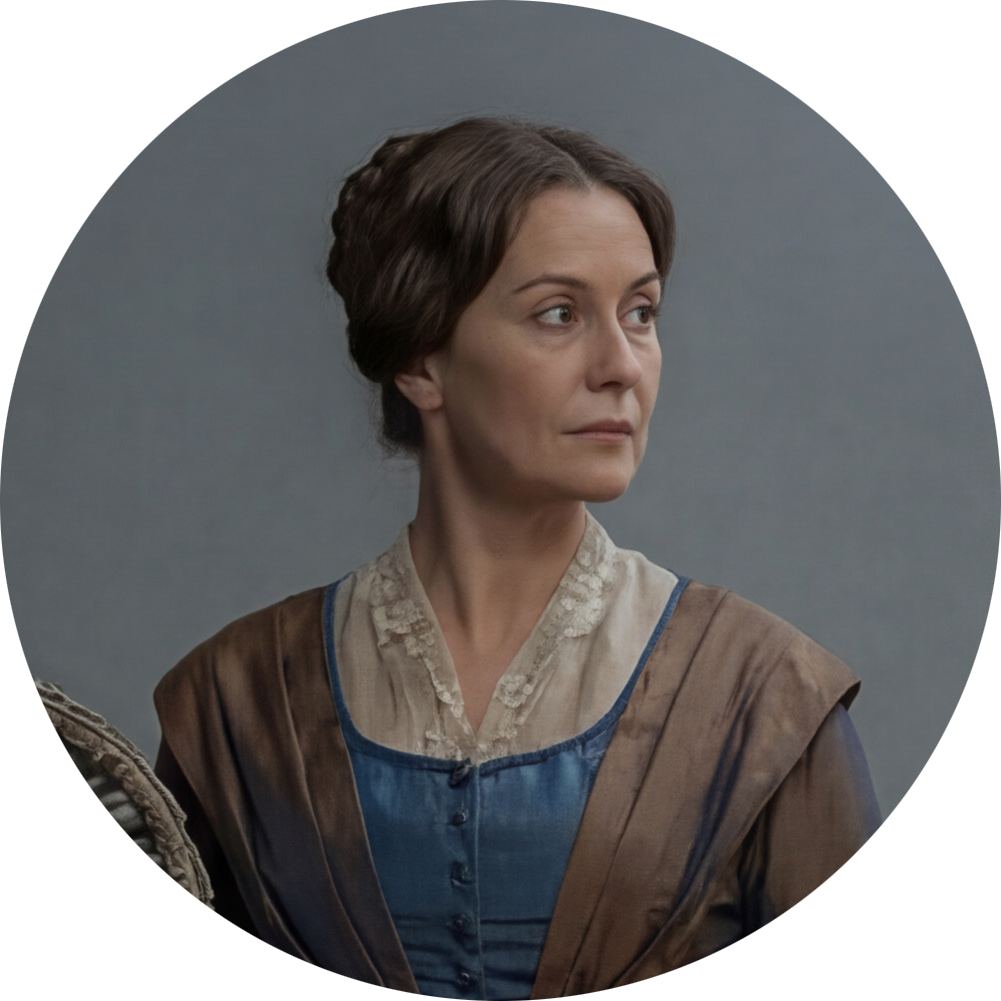
Tatyana Ivanovna and her husband, Vasily Borisovich Zakharyin, had no children of their own. Being the proud owners of vast estates across several districts, the couple settled in Moscow during their mature years. And it is precisely this Moscow chapter of her life that reveals the domineering Vladimir landlady from a thoroughly unexpected angle.
A Promise on the Brink of Doom
In the burial registers of the Donskoy Monastery necropolis, where the Zakharyins are laid to rest, a rather curious detail is noted: Tatyana Ivanovna was the godmother of Tatyana Andreyevna Bers-Kuzminskaya—the blood sister of Sofya Andreyevna, who was the wife of Leo Tolstoy himself.
The story of how this connection came to be reads like a ready-made plot for a novel. The little girl’s father, a Moscow physician named Andrei Yevstafyevich Bers, was treating Zakharyina during a severe illness. Hovering on the very brink between life and death, she said to the good doctor:
Andrei Yevstafyevich, I have made a little bargain with fate: if your wife gives birth to a daughter, I shall recover; name her Tatyana. I shall be her godmother and care for her my entire life; but if a son is born, then it is the end of me. Save me.
A baby girl was indeed born, and Zakharyina, true to her word, miraculously recovered. She baptized the little one, loved her as her very own daughter, and remained by her side for the rest of her life.
The goddaughter grew up to become a writer and memoirist, spent a great deal of time conversing with Tolstoy, and is generally believed to have served as the prototype for Natasha Rostova. In her memoirs, Zakharyina appears as a woman of about fifty, lean, upright, and wonderfully good-natured. The Zakharyin household breathed with hospitable antiquity: young wards fluttered about, the hostess’s beloved lapdogs scurried hither and thither, and an air of absolute order and patriarchal coziness reigned supreme.

Occasionally, however, this patriarchal coziness took on rather peculiar forms. For instance, on the day of her goddaughter’s tenth birthday, Zakharina fell ill; unable to attend in person, she sent a gift. The little girl, naturally, expected to receive a doll—or perhaps a puppy, but instead of a gift for the birthday girl, a maid named Fedora, sent by Zakharina, arrived with a basket of nuts and homemade fruit paste. Young Tatiana Bers was so stunned that, for quite some time, she could not utter a single word. Fedora, for her part, remained with the family for many years, becoming the goddaughter’s assistant and deeply involved in the daily life of her household.
Leo Tolstoy himself was also acquainted with Zakharyina. In his diaries, there is a passing mention of her arrival (on the very day when, under the direction of Dr. Bers, the writer was undergoing surgery on an improperly healed arm bone). And in 1866, in correspondence with his wife, Tolstoy notes that Zakharyina had decided to provide funds for her goddaughter to be treated abroad, as she was showing signs of consumption.
The Decembrist Trail in the Village of Goncharovo
From 1841 onward, the village of Goncharovo became the permanent residence of a retired staff-captain of the horse artillery, Pavel Alexandrovich Bestuzhev—the younger brother of the rather famous Decembrists. Unlike his brothers, he took no part in the uprising on Senate Square, though he did endure his fair share of Caucasian exiles and wars. Upon retiring, he sensibly married Ekaterina Yevgrafovna Tregubova (a relative of our dear Praskovya) and settled quite comfortably on her estate.
The dry little announcements in the Senate gazettes reveal just how wonderfully entangled the fates of these people became out in the provinces. Grand historical ambitions gave way entirely to the soothing routine of bureaucracy. A man whose very surname once made the capital shudder found himself firmly woven into the mundane agricultural and financial affairs of the Zakharyin-Tregubov clan.
According to the Senate gazettes of 1845, Staff-Captain Bestuzhev acted by proxy on behalf of Tatyana Zakharyina’s husband, Vasily Borisovich. And so, while Praskovya was furiously waging war over her guardianship, the youngest Bestuzhev occupied himself with restoring lost leave certificates for Zakharyin’s household maids and quietly managing other Tregubov estates.
Pavel Bestuzhev passed away in 1845 from the lingering effects of an old wound, leaving behind nothing more than a few newspaper lines summoning his heirs and creditors. The grand sweep of history merely brushed past this little provincial world, only to dissolve instantly into yet another round of lawsuits over promissory notes and mortgaged souls.
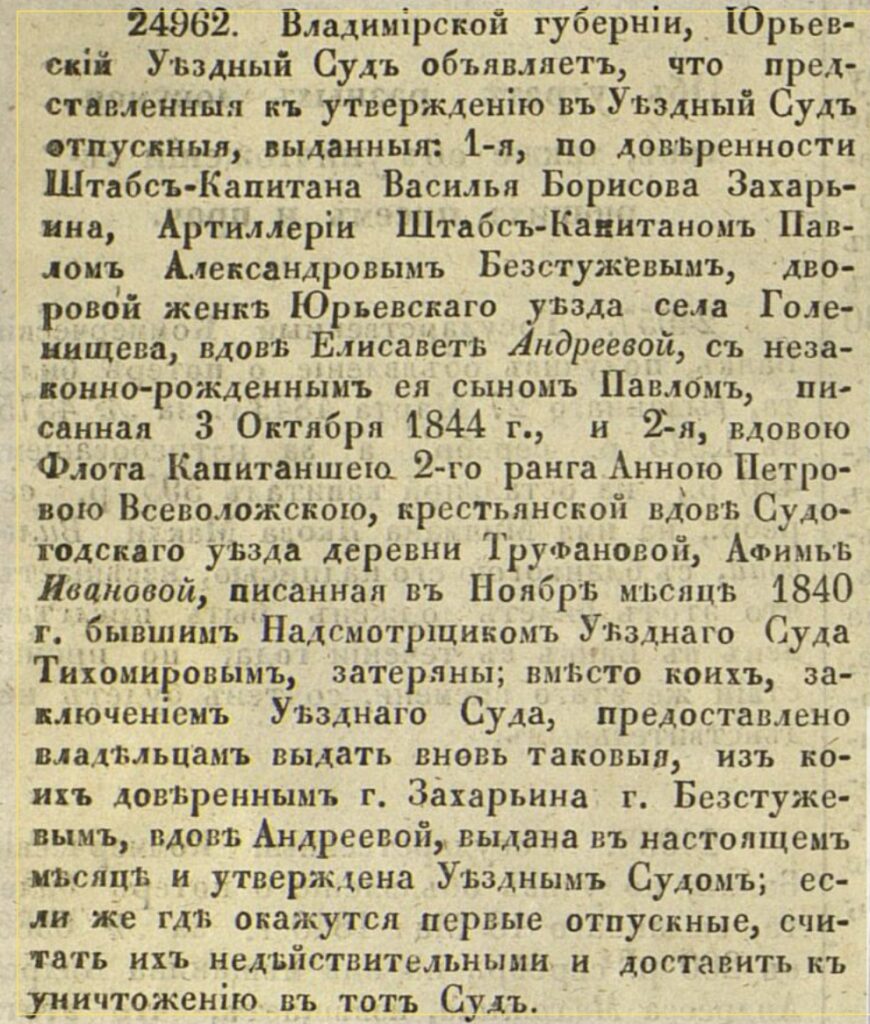
September 27, 1845 yandex.ru
- The Yuryev District Court of the Vladimir Province hereby gives notice that the certificates of manumission, previously presented to the District Court for ratification, have regrettably been lost. These certificates were issued as follows: firstly, by proxy of Staff-Captain Vasily Borisov Zakharyin through Artillery Staff-Captain Pavel Alexandrov Bestuzhev, to a household woman of the village of Golenishchevo in the Yuryev District – the widow Elisaveta Andreyeva, along with her illegitimate son Pavel, drawn up on the 3rd of October, 1844; and secondly, by the widow of a Fleet Captain of the 2nd Rank, Anna Petrova Vsevolozhskaya, to a peasant widow of the village of Trufanova in the Sudogda District, one Afimya Ivanova, drawn up in November, 1840, by the former Overseer of the District Court, Tikhomirov.
In their stead, by the resolution of the District Court, the owners have been granted permission to issue new certificates. Of these, the certificate from Mr. Zakharyin’s proxy, Mr. Bestuzhev, to the widow Andreyeva has indeed been issued this very month and duly ratified by the District Court. Should the original certificates ever surface, they are to be deemed entirely invalid and must be delivered straight to the aforementioned Court for destruction.
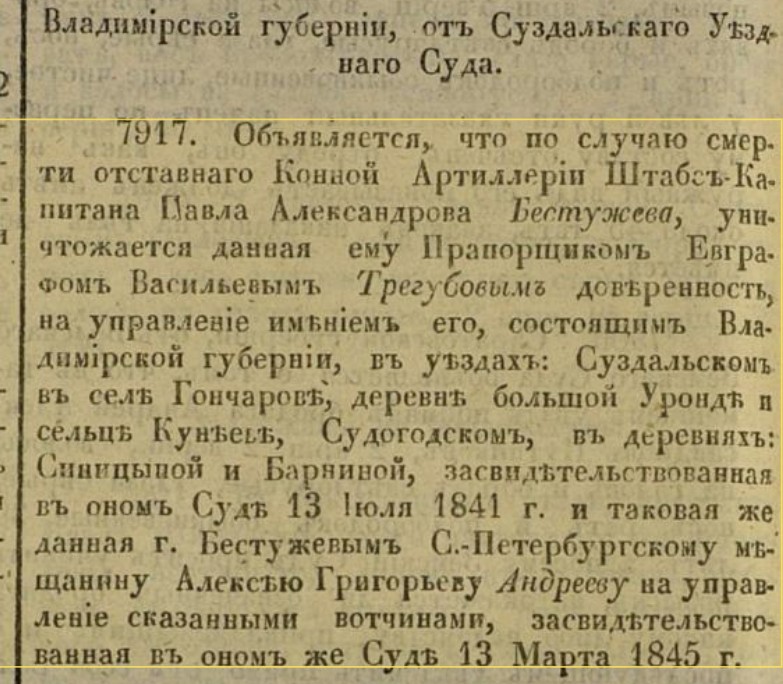
March 13, 1847 yandex.ru
- It is hereby announced that, occasioned by the rather permanent demise of the retired Horse Artillery Staff-Captain Pavel Alexandrov Bestuzhev, the power of attorney entrusted to him by Ensign Yevgraf Vasilyev Tregubov is now entirely annulled. This document, which granted him the management of the Tregubov estates in the Vladimir province—specifically the village of Goncharovo, the village of Bolshaya Uronda, and the hamlet of Kuneyevo in the Suzdal district, alongside the villages of Sinitsyna and Barnina in the Sudogda district—was originally certified in this Court on the 13th of July, 1841.
Consequently, a secondary power of attorney—handily passed along by the late Mr. Bestuzhev to a St. Petersburg burgher by the name of Alexei Grigoryev Andreyev for the management of these very same properties, and certified in the selfsame Court on the 13th of March, 1845—is likewise rendered completely void.
Archival Reality Versus Literary Memoirs
In the affair of Ekaterina Lyalina’s escape, Zakharyina proved herself to be a rather brilliant tactician. It was she who quietly persuaded the servant to orchestrate her niece’s flight by dangling the promise of freedom. It was also she who attempted to snatch 75,000 rubles from the orphans’ inheritance using highly suspicious promissory notes from her late mother. And finally, it was she who kept her runaway niece under lock and key, wringing the necessary testimony out of her for the court.
Was there nothing but base greed behind her actions? That remains an open question. It is entirely possible that Zakharyina genuinely believed she was saving the ancestral property from total ruin. And there was certainly a grain of truth in this: while Praskovya, her rowdy hussar husband Ludwig, and the schemer Yunich were happily squandering the funds, the elder girls were receiving no proper education, and the younger children had been dumped at an inn.
As befitted a woman of her era and social circle, Tatyana Ivanovna was wonderfully domineering and unyielding. She was certain that she knew precisely “how things ought to be,” and she sought to keep absolutely everything under her firm control—from the daily routines of her beloved lapdogs to the inherited fortunes of her nieces.
The Zakharyins lived long and rather full lives. The metric records of the Moscow Central State Archive indicate that Vasily Borisovich passed away from an “exhausting fever,” while Tatyana Ivanovna outlived him by eight years, eventually dying in 1878 of “senile exhaustion of strength.”
And thus, perfectly coexisting within one single person, we find the prototype for classical memoirs and the ruthless architect of family ruin in the documentary saga of the Strahlborns.