Diary of Sophie Knorring. Part 1 – May 1841.
Begun around May 1, 1841, at her parents’ estate of Paslep, completed around March 1, 1842, in St. Petersburg *. The discoverer of this document and the author of the detailed commentary on the text is the historian Sergei Gavrilov.
A brief introduction to the diary of a Baltic noblewoman and a two-part article on the context of the era.
The further I delved into the diary, the more I marveled that professional historians had not yet dissected it to the very atom. On the other hand, I was delighted that such obscure archival treasures can still be found. Thanks to the discovery by Sergei Gavrilov, a researcher of the Pushkin era and the Estonian nobility who provided the material, this diary is being published on this site for the very first time. The historical document is accompanied by his commentary, which helps navigate the events, names, and everyday details mentioned, placing them firmly within the historical context of the 1840s.
The winter of 1841–42. A young, sharp-tongued, and brilliantly educated maiden from a powerful Baltic lineage arrives in the very heart of glittering St. Petersburg to distract herself from family upheavals and the personal drama of a broken engagement, to savor the capital’s cultural life, and perhaps to secure a suitable match. For nearly a year, she remains at the epicenter of high society, and her private entries become an ironic and remarkably candid mirror of the Pushkin era. On these pages, true history springs to life:
- Chance encounters with Nicholas I on a snow-swept Liteiny Prospect, conversations with the Heir to the throne, and the secrets of private masquerades at the Mikhailovsky Palace.
- You will find yourself in theater boxes and society drawing rooms where the legendary Italian baritone Antonio Tamburini performs. He grants the diary’s author private vocal lessons, with the cost of a single session equaling the annual salary of a minor civil servant. You will read of a performance by the famous Romani choir of Ilya Sokolov and the high-society gossip surrounding the scandalous romance between Prince Trubetskoy and the goddess of ballet, Marie Taglioni.
- The underbelly of etiquette—the diary details the very anatomy of social intrigue: how webs were spun around lucrative matches, how alliances were forged, and the true cost a young woman paid in that era to break off an engagement.
Can the heroine, in her search for profound affection, withstand the cold pragmatism of her milieu? The finale of this deeply personal drama maintains its suspense up to the very last page, which cuts off mid-sentence. The personality of the author is an equally vital aspect of the diary. Sophie is by no means a frivolous society belle reveling in her status. She possesses a profoundly thoughtful nature, given to reflection and the continuous re-evaluation of her feelings and actions. She does not fawn over the more prominent ladies of high society, nor does she seek to capture the crowd’s attention at any cost. Rather, Sophie feels weighed down by the frenetic pace of society life, yet she truly appreciates the significant cultural phenomena to which her family’s high standing grants her access. Before you is the living embodiment of Tatyana Larina—no more, no less.
The Beginning of the Diary
* Hover over the bold text to view the commentary.

Before I finish keeping my diary in this notebook, I wish to briefly record a certain event that, shortly after the death of my dear, beloved sister, thoroughly occupied and agitated me. Mr. von Kursell, who had been acquainted with us since our stay in Hapsal and visited us frequently there, continued this acquaintance in Paslep; he called on us a couple of times in the summer and once in the autumn—he showed me marks of attention, and it became clear to me that these visits were intended for me; Papa, who also noticed this, found it disagreeable and thus received him somewhat coldly; after Mama returned from St. Petersburg with my sisters in the autumn, Kursell visited us once more; immediately following that visit, we had to endure such an exceedingly difficult time that his next call was one of condolence (condoléances visite), then he was here for the funeral—and on Sunday, January 5th, on the very day we were to

travel to Lückholm (it being the day of Natalie’s betrothal), Mr. von Kursell arrived for dinner; after the meal, as we went to freshen up [change our clothes], he suddenly stood and went into Papa’s room; by the time he returned, we were already dressed—our horses were all brought round, he took his leave and departed.
When we returned from Lückholm in the evening, Mama informed me that Mr. von Kursell had asked Papa for my hand; although I might have suspected something of the sort, it was in the highest degree unexpected and sudden to me. — I could do nothing but refuse, as my affection was far too weak to allow me to venture upon such a momentous step, moreover, my dear parents were categorically opposed,—Papa promised to give him an answer the following day in Hapsal.

Papa rode out there [to Hapsal] early the next morning, ah, and my heart was so heavy the entire day; with the greatest impatience I awaited his return, and he brought us the reply that Mr. von K. had asked him whether he might hope for something in the future, and… So few days had passed since this decision that there was no peace in my soul whatsoever when, on January 16th, a letter from K. arrived from Hapsal for Mama, in which he repeated his suit. — Mama asked me, and I remained firm in my first answer; though the first time I doubted that affection alone had guided his steps, this time his letter moved me, and I now felt that love had prompted this new approach; nevertheless, I asked dear Mama to write a second refusal; with this, I supposed, the matter would come to an end. And after a few days, my soul felt much lighter, for I had entrusted this whole affair to the faithful Lord; I acted and proceeded in the awareness that the Lord was working within me, I did nothing without prayer, and thus peace and tranquility returned to my soul once more. — But on the following Wednesday, the 22nd (Papa having left for Kedik immediately after dinner), Fräulein Betty K… [Kursell] arrived; this visit was so unexpected that I stood as if turned to stone, almost breathless; Mama went up to her, and she spoke on behalf of and in the name of her brother; she said, namely, that she could no longer bear to watch her brother’s condition, and had therefore resolved to come here, laying the matter before Mama; this conversation lasted over an hour, then she asked Mama whether she would permit him to visit us; Mama, naturally, could have nothing against this; shortly before tea I came out to them, very silent and unwelcoming, whereas she, on the contrary, was exceedingly amiable, and soon after tea she departed. On the following Saturday, the 23rd [of January?], Mr. von Kursell arrived here; I was unwell and thus did not appear, and besides, it would have been quite impossible for me to see him so soon after all that had transpired; then I saw him for the first time on Thursday, February 26th, he arrived in the afternoon; what was in my soul is difficult to describe, after that I did not see him at all until May 1st in Neuenhof. How long this will continue rests in the hands of the Lord, as does the outcome of this affair; I have placed everything in His hands, He will care for me in my weakness, and come what may.
May, 1841
1st, Thursday 4.
Beautiful weather; after coffee, we worked on the coat [mantle]. In the morning, Pauline Ungern arrived; she left only in the afternoon. — We received from St. Petersb[urg] [a letter] from Grandmamma and from Margaret; she sent fabric for dresses for all three of us; after tea, I walked in the Great Garden. When Mama wanted to go to the chapel, the roads were muddy, [so] I walked in the garden after supper.
2nd Friday.
It rained the entire day; after coffee, we finished the coat, then cut the dresses—Mama was especially occupied with helping with this; the rain did not cease all day. Today brought the much-desired rain.
3rd Saturday.

After coffee, Mama led the domestic service [prayers], then we worked until noon; the day was very stormy [windy]; in the afternoon I walked in the small garden with Fräulein M. V., Elena, and Louisa; after tea we rode to the chapel, where we remained for quite a long time—sorrow once again grips our hearts, and tears pour upon the grave of our beloved sister; Mama in particular wept very bitterly, wept profusely and knelt before the coffin. On the way back, it became very cold and bleak.
4th, Sunday

Rose early, as I traveled with Papa to Kedik; it rained until we arrived there; Grandmamma felt quite unwell and was especially kind to me. After the meal, the weather cleared completely—she then gave me to read several letters from Aunt Louisa, in which she describes all the festivities from the wedding of the Heir to the throne; immediately after tea we departed; the weather was beautiful, the sun set magnificently. Just approaching Hapsal, we met dear Mama with all my sisters; they had gone for a walk to the chapel and rested for a moment at the pastorate. Pauline Ungern accompanied them right to our very steps; after supper, we talked a great deal in the hall.
5th, Monday
The weather is very bleak; it rained and the wind raged the entire day; after coffee, Mama tested my knowledge of geography using the atlas I had brought with me from Kedik; all day I felt quite unwell; after tea, we read the newspapers aloud—immediately after supper I went to bed; the evening prayer, regrettably, I had to skip
6th, Tuesday
In the morning I reviewed my geography and embroidered; in the afternoon Carlblom 6 came for tea. After supper, Fräulein V. played [music], and I paced back and forth; I was occupied with various thoughts that distressed me and brought on sadness.
7th, Wednesday

The weather is rather fine; after coffee I ironed all my collars. After tea everyone went for a walk; I remained at home with Fräulein V., she accompanied me at the beginning [of the walk?] — After supper Fräulein V. played the clavier, while I paced back and forth; we went to bed late.
8th, Thursday
In Nuckö we had a German sermon; in the morning, after I arose, Papa rode to church in Hapsal; we drank coffee late, then dressed, and at 12 o’clock rode to church; first we stopped at the chapel, from there to the pastorate, and about half an hour later to the church; many partook of Holy Communion, and I too felt a heartfelt desire to do so; shortly after the sermon, Mama departed; Mademoiselle V. and I remained there for dinner. Marie developed a slight rash in the morning, so we saw each other only from a distance. After the meal, the company broke into groups; Pauline U[ngern] and Nelly [went] for a walk. Immediately after tea we left; we sat for a long time on the porch, etc. — Finally, Papa arrived, who, however, could tell us nothing of interest; I went for a walk in the small garden, the day was wondrous, for the first time 20 degrees [Réaumur, approx. 25°C].
9th, Friday

After coffee I read the book of Proverbs [verses] and yesterday’s Gospel in the bedroom; in the morning, dear Mama read aloud to us a beautiful sermon by Krummacher; we sewed sleeves onto Mama’s grey-and-black dress; the morning passed incredibly quickly; when I entered the front room, I saw the table laid. During dinner, it rained heavily, but afterward the weather became even more beautiful; after the meal, Mama, who had risen very early, lay down to rest; after tea, we went for a walk in the little wood, after which I went to the Great Garden. I froze in admiration: after the blessed rain, everything around had turned so beautifully green. And I know not why, but the thought would not leave me that this is the last spring I shall spend in Paslep. And at this time of year, Paslep is simply enchanting and wondrous; even the lindens before the porch have already put forth their little leaves. Everything around is unfurling and blooming; truly, wonderfully great and mighty does the Lord reveal Himself in nature.
10th, Saturday
The weather was magnificent. Mama had long planned to travel to Hapsal on this day to visit the Knoblochs, and on the following day to Neuenhof. The entire morning I was busy putting my things in order and packing everything that needed to be taken along. We dined early; after dinner, we stowed our belongings and departed on peasant carts. Papa remained at home alone.
The road to the coast was indescribably wretched. Upon arriving, we had to wait a short while, and we stopped at the home of the dear Madame Ivanova [?]. But how utterly astonished we were when we entered to find the house in the most dreadful disarray: Madame in papillotes, all the windowpanes and mirrors smeared with chalk, all the furniture standing in a jumble. At first she was embarrassed by the visit, but in the end she allowed herself to be persuaded to shelter us. — For tea we went to the Knoblochs, where we were received very amiably. At 9 o’clock we went home without supper; the Knoblochs and Eugenie U[ngern] accompanied us; we met the Stackelbergs. — Our obliging hostess had in the meantime prepared a lovely room for us and tidied up. At first we talked a great deal; after our prayers we went to sleep, although my poor arms and legs still ached from that dreadful road.

11th, Sunday
The weather was no longer as beautiful; it was cloudy and raining. Louisa, who slept in the same bed with my sister, made us laugh terribly in the morning; we had to wait a long time for coffee. After coffee, Mama and my sister went to Hunnius, while we went to the Russian church; Eugenie Ungern was partaking of Communion, it rained heavily, and we arrived there soaked. Before we were dressed, the carriage was already brought round; Mama, N[elly], and L[ouisa] walked on ahead; we followed in the carriage and took our leave of the Knoblochs. I had advised waiting before they all traveled to Echmes; the rain had intensified. Upon arriving in Neuenhof, we were received very amiably; I made the acquaintance of General Stackelberg’s wife and her daughter Minnie—both exceedingly sweet and obliging. — It was very lively here, with much laughter and jesting. — After the meal, several gentlemen arrived: August Kursell, Mohrenschildt, cavalry captain Georg Stackelberg. — Soon after them came Kursell [my suitor] with his sisters Betty and Charlotte; it was very distressing for me to enter this company, as I was just then with Hedwig, who was very kind to me. K… [Kursell] at first did not greet me at all . I sat, without uttering a word, at the other end of the hall, which was quite torturous for me; fortunately, a small partition projecting behind the sofa concealed us from the rest of the hall. We moved into the adjacent room, where Hedwig was preparing tea; somehow everyone joined us, and I, after we had finished drinking and had been “married off” here [in jest?], K. [Kursell] entered the room, very serious and coughing; he greeted me without dropping a single syllable; this weighed upon me and embarrassed me greatly (décontenancirte), and I longed to [escape] from this lower section [of the room?] into the carriage that was to take us to Hapsal; on the other hand, I regretted that I could not remain there longer; for me, this will remain an unforgettable day. After taking our leave, it occurred to me that I had done a foolish thing in not inviting Fräulein K… [Kursell] to visit us, which vexed me greatly. — The weather was stormy and unsightly, and at half-past nine we crossed over on the Hapsal boat; on the way I recounted much to Fräulein V. about the day I had lived through. We found Papa already in bed; we supped (soupirten) with an appetite. After prayer I reverently read something very beautiful for the 13th of May in my prayer book. With a heavy heart, I went to sleep.
Fascinating everyday details of the era emerge in the diary: boat trips, being received by a flustered hostess in papillotes, three people sleeping in a single bed, and, of course, the awkward encounter with the rejected suitor, Mr. von Kursell.
12th, Monday
The weather was quite fine. The entire morning I was laying out all the things we had brought from Hapsal; all day I was very much out of sorts, occupied with various thoughts and feelings; after tea we went for a walk in the little wood; in the evening I paced back and forth across the hall, while Mademoiselle V… played the clavier.
13th, Tuesday
The weather is magnificent. — Rose late, worked during the day, walked in the little wood after tea, after having watered the flowers in the garden with Mama and my sisters — went to bed late; on this day my soul felt lighter.
14th, Wednesday
In the morning, Mama read aloud to us a beautiful sermon on faith by Hahn, but prior to this I had quite a long conversation with dear Mama in the bedroom, after which I worked on our dresses, which must be finished by Pentecost. — But I had no desire for anything; languor and despondency accompanied me everywhere; I paced to and fro, seeking occupation here and there, but everything was a burden to me. — After tea, Mama, my sisters, and Fanny went to the chapel, though it was very windy; I could not accompany them, as I had a sore throat and generally felt unwell. — When my [family] returned, they brought Pauline Ungern with them, who wished to see me and left only after supper.
15th, Thursday

Rose rather early and read, then immediately sat down to work. Fanny was exceedingly pleasant to me; she helped to hem the edges (sew). She remarked that since Sunday I seemed to have found myself again. Louisa said something to me in the morning in a rather amiable manner, and I burst into tears, no longer able to hold them back, so exhausted did I feel. — We sat down to dinner late; soon after the meal we received letters from Aunt Minna and Pyotr And[reyevich]: Yes, there was an abundance of news! Madame MacDonald writes in a lovely letter that, thanks to Mama’s invitation, they have received permission to come to S[t. Petersburg]. — The postman, Karl, told us that the Knorrings from Weissenfeld and several others would be coming for tea. In the greatest haste, everything was put in order, we dressed, and soon the Baron arrived, driving the carriage himself, followed by Dücker and Kursell with his sister Betty. Kursell was very amiable, approached me at once and congratulated me on my name day. A long general conversation ensued. The gentlemen went off to inspect the stables. We lingered at the tea table until late, then they went to the stables again. Kursell went into the garden. I remained with all the ladies and returned with Fräulein V. When everyone returned, we went into the hall. Fräulein V. sat at the piano, then she played four-hands (à quatre mains) with Louisa; after that I sang several romances, of which K[ursell] seemed highly to approve. Afterward, oranges were handed round, and soon after that, everyone departed. — For me, it was a very pleasant day. After supper, I spoke with Mademoiselle V., and she reminded me of her prophecy that K[ursell] would be announced as a betrothed [his engagement to another would be declared] this very week.
These pages reveal the resolution of that awkward scene with Mr. von Kursell (who has now begun greeting her!), along with numerous details about daily life, needlework for Pentecost, and the celebration of Sophie’s own name day.
16th, Friday
Magnificent weather — after coffee we worked, washed, and ironed the dresses. Mama was very busy with household chores the entire day; in the evening, after tea, I wrote a letter to Aunt Minna, and after supper I walked a little in the garden.
17th, Saturday
The weather was magnificent; we had many tasks all day, washing the floors; after the meal, Mama and Mademoiselle V. rode to Hapsal; before their departure we received an invitation from Madame Knorring of Weissenfeld for the following day; we were very glad of this, I especially so; I answered the letter; after Mama left, we had much to do to prepare for the next day. With the post from Revel came a letter and the ordered items from Margaret; in the evening Mama returned. After supper I walked a little more in the garden, although I was very tired; the moon shone so romantically, and the nightingales sang, and there was a certain sadness in my heart; we went to bed late.
18th, Sunday

We rose early, dressed in haste, and departed at half-past 10; the weather was wondrous. Upon our arrival in Hapsal, the horses from Weissenfeld had already come for us. In great haste we changed our clothes and drove on. For dinner, besides ourselves, there were also von Bock and his wife; we sat for a time on the beautiful balcony, which was shaded by a magnificent chestnut tree standing in full bloom; after the meal we went to walk in the garden; it was superb in the [garden] itself, the shade refreshed me, as it was a warm and stifling May day. Finally, after an hour, we went inside and sat in the sofa room — When the tea table was laid, Madame Knorring asked me to pour the tea, which I undertook most willingly; scarcely had I prepared the tea when the guests arrived: K[ursell] with his sister and his brother, the Stackelbergs, and the Dückers. The Stackelbergs were very friendly, but how could one ever forget what I felt in my soul at the tea table, when S… [Stackelberg] tried literally to nail me to the floor with her gaze; I truly had to arm myself with all my courage so as not to yield [not to lose my nerve]. I was glad when the tea was finished. Soon a walk was proposed, which everyone eagerly supported — first through the garden, and then along the road to Linden, which is indeed very beautiful. Kursell accompanied us and was very amiable. When we returned, the sun was already setting, and preparations for departure began. The cousins and sisters left a little before us, after which Fanny and I… Mr. von Kursell escorted us to the droshky. Just outside Hapsal, Mademoiselle V. joined us and escorted us to the shore. The evening was divinely beautiful: on one side the sun was setting majestically, sinking into the murmuring sea, while on the other, the lovely moon shone and reflected in the water. The crossing was very pleasant, the nightingales sang magnificently; we had supper and, after our prayers, went to sleep very late.
On these pages, we witness the true drama of 19th-century high society: awkward tea parties, the withering glares of judgmental matrons, gossip about the impending betrothal of a rejected suitor, and magnificent romantic landscapes.
19th, Monday
Rose very late; after coffee Mama conducted the domestic service and read aloud to us a sermon by Huber. — After the meal Mama lay down to rest, but only for a short while. Then there was a long walk; after tea we went to the chapel and laid flowers on the grave of our dear sister; the Carlbloms came out, and we conversed with them for about half an hour. — I played with their little girl, what an amusing and sweet child she is. — By the time we returned home, the sun had already set.
20th, Tuesday
The weather was wondrous. In the morning we were busy finishing the ruches [on our dresses]; in the morning I undertook nothing in particular, as our servants were not at home, and we had to see to everything ourselves; in the afternoon Mama lay down for a quarter of an hour; we sat in the hall and chatted; then I sang a little. — Immediately after tea we went for a walk to the pastorate and stepped inside for a short while; Amelia [?] was also there; they escorted us all as far as the tavern. — We arrived home quite late. — After supper we walked a little more in the garden
21st, Wednesday
Magnificent weather; in the morning I occupied myself with various tasks; immediately after the meal Mama rode with me to Hapsal for tea at the Stackelbergs’; they were all surprisingly friendly; the Dückers also arrived there. — When we crossed back in the evening with Fräulein V., whom we had collected, it was very windy and the boat rocked violently — We arrived swiftly and safely, went home; I was very tired. — On the way I spoke with Mama of many things the Stackelbergs had said regarding Kursell.
22nd, Thursday
I rose late. After coffee Mama conducted the service and read aloud to us Huber’s first sermon on prayer, which was exceptionally beautiful, and I clearly realized how terribly we sin daily in every prayer. On this day I sewed very diligently. — After the meal Mama lay down to rest. — The post brought us a letter from Grandmamma, in which she expresses deep concern for the health of Pyotr And[reyevich]. After tea [I went] to the little wood and swung on the swings; on the way I recounted in great detail how we had spent the previous day and the rest of Sunday. — Afterward I went for a walk with Mademoiselle V. in the small garden, where she began to tell me what Mama had said to her about me during their trip to Hapsal the previous evening. This touched me deeply, for I realized anew how great Mama’s love for me is. — And I can say that scarcely a day passes, especially now, at this time, that I do not thank the Lord with all my heart for having given me such a rare, dear, and sweet mother. — Our conversation was interrupted by Mama and Louisa, who came into the garden to water the flowers; I joined them at once. After supper we went out into the garden again for a moment, as the night was lovely.
23rd, Friday
We rose rather early. Even before coffee I was reading in the front room; when Louisa arrived, we sprang up and… to the piano, and sang for over an hour, Mama came over to us and accompanied me, for the first time since this tragic winter, and learned a new romance with me, which was sung right there; after the meal we went into the garden; soon after that I sat down to work, as we wished to travel to Neuenhof the following day; we were so diligent [in our sewing] that we had to miss our walking hour. Before supper Mama was still busy in the garden, and I too went out there for a moment; after eating I went there again with Fanny, but it grew very windy, and I abandoned the thought of traveling to Neu[enhof] the next day.
24th, Saturday

The weather in the morning was very pleasant and windy. Then it began to rain… After the meal I went for a walk with Mademoiselle V., where we continued our conversation begun on Thursday; we spoke of it for a very long time, and I gave her my opinion; it was a great relief for me to pour my heart out about this, after which we worked. — After tea we read the newspapers aloud; later Papa and Mama rode to the chapel; they returned shortly, it was raining very heavily. Our plan to travel to N[euenhof] was thwarted by the weather, which was far too wretched for it; however, this did not grieve me in the least. — In the evening Mademoiselle V. played the clavier; I was hemming my little waistcoat, and I could not hold back my tears: I thought of the past, of the future, and melancholy constricted my chest; gloomy thoughts took hold of me, but I resolved to resist [them] — the storm and rain continued the entire evening.
On these pages, we see how the high-society intrigues and gossip regarding Mr. von Kursell continue (Sophie discusses with her mother exactly what the Stackelbergs had said about him). But there are also deeply touching, intensely personal moments here: Sophie’s reflections on the power of a mother’s love and the timid return of joy to the house (for the first time since the “tragic winter” and the loss of her daughter, Mama sits at the piano to accompany Sophie).
25th, Sunday
We rose rather late; after coffee Mama conducted the domestic service as usual and read to us a sermon by Gerhard, which touched me especially. In the afternoon — that well-known little misunderstanding. It rained heavily the entire morning, but in the afternoon the sky cleared. Mama was quite unwell; she had a cough. — After tea I went with Fräulein V. to walk in the garden, and then I went for a walk alone in the Great Garden; it was beautiful; after the rain the greenery looked so refreshed; various thoughts engulfed me; no one walked alone here; I went indoors late, saw to all my tasks, and fell asleep.
26th, Monday
The weather was very fine. In the morning I finished the falbala [flounce] on my lilac dress and wrote a letter to Clementine, which a visiting captain who was here took with him to Hapsal. In the afternoon I suffered a severe toothache; I lay down, but the pain did not let up all day. In the evening Mama worked in the garden.
27th, Tuesday
My toothache subsided; the entire morning I helped Fanny iron collars. — In the afternoon Mama gave orders regarding the sowings [seeds]. — After tea I read a beautiful sermon by Hahn
[Right page] on the Fourth Commandment; it touched me deeply. The intention to travel to Revel soon, in order to partake of Holy Communion quickened greatly within me; I felt a heartfelt yearning for it, yet I had no desire whatsoever to be there on St. John’s Day and find myself amidst the bustle [of the festive crowd]. — My soul feels wretched; at times society and its vanity hold a charm for me — I begin to strive greatly for worldly things — then my heart becomes so empty, dead, and unreceptive to the divine; bound up with this state is usually a certain idleness, a dissatisfaction with myself and my surroundings. Such times I experience frequently; everything in my life then feels dead; I desire this and that, I make plans, but the future always seems dark and gloomy to me. — And when, at such moments, the Spirit awakens me and places before my soul that which is true and necessary — ah, then I recognize the nothingness of earthly life, and I can do nought but implore the Lord to take pity on me: let me not perish, and grant me greater earnestness. — After supper I walked for a long time with Fräulein Wiedemann. Mama conducted the evening prayer. It rained almost the entire afternoon.
28th, Wednesday
The air was exceedingly beautiful, and by noon it had cleared completely; my toothache subsided a little, and immediately after coffee I sat down to embroider names [monograms] on the chemises. — In the afternoon I walked for a long time in the Great Garden; Mama lay down to rest. — In the garden I thought much of how well I would converse with Hahn [the author of the sermons], in which may the Lord help me. — Then I reviewed geography. — After tea we went to the chapel; it was a pleasant walk. — There Mama prayed on her knees. Mama went to the pastorate, leaving us in tears; we returned with the Carlbloms, who had come out to meet us.
Mama went out for another moment into the small garden and sewed a little more on the dress — soon after supper we went to sleep.
Here, we finally learn the full name of the mysterious “Mademoiselle V.”, and we also immerse ourselves in Sophie’s deeply personal, spiritual experiences. The text becomes profoundly introspective: she reflects on the vanity of society life, struggles with “worldly desires,” and prepares for Holy Communion.
29th, Thursday
The weather was quite fine, and Mama and Papa went to Hapsal to see Hunnius to settle various matters; after I had tidied everything up, I gathered my courage and sang for over an hour. — After the meal they all arrived, and we went for a walk in the garden, then I sat down to work; the dear sisters arrived, speaking of the preparations for the anticipated visit that the Rehbinders intend to pay us. — After tea we went for a walk, Papa escorted us a little way. — Pauline U[ngern] came out to meet us, we walked her to the pastorate. Spoke much of things of little interest. — Mama and Fräulein V. came out to meet us at the gates, we walked a little in the small garden. — In the evening Mama and Louisa spoke of Pyotr And[reyevich]’s health, about which they are very anxious. This frightens me greatly as well, especially that he is traveling abroad alone. —
30th, Friday
The weather changed very frequently. — After coffee, once everyone had set about their household chores, I sat in the bedroom and read on the sofa, then I prayed fervently and sat down to work with Fanny. — After the meal, Helene, Fräulein V., and I went for a walk, the weather became quite fine, I returned. I sat by the window, as it was a bit stormy; I like this wind very much. After tea we went for a walk to the pastorate and lingered there for half an hour and then meant to return. The Carlb[loms] escorted us, the sky clouded over, and we turned back; after the clouds dispersed, we set off again, and in the meantime, it had grown quite late. —
31st, Saturday
In the morning, I embroidered names [monograms]. — It rained all day. — After the meal my sisters rode to the chapel. — We did not go, as it was very cloudy. In the evening we planted [plants] in the garden. — Mama took a bath. — We went to bed late. —

We transition from May into June. On these pages, Sophie describes her daily chores, the embroidery of monograms (“names”), mild ailments, the reading of sermons on the Rich Man and Lazarus, and also her music-making—in particular, the performance of the “Comet Waltz,” which was highly popular at the time.
All article commentary
1. Hapsal (Haapsalu) is now the town of Haapsalu (Estonia), a highly popular resort in the 19th century.
2. Paschlep — the Paslepa manor in the Governorate of Estonia (near Haapsalu), an estate of the Knorring family from 1786 to 1882, including the personal possession of Sophie Kursell, the author of the diary, from 1867 to 1882. The manor house has survived in a rebuilt form and is currently used as a hotel.
3. Papa – Jakob von Knorring (1789- 1862, Paslep), a veteran of the Napoleonic Wars, in civil service in Estonia from 1821 (Actual State Councilor). The Knorrings are a noble family of Baltic Germans, known since the 16th century. Portraits of two generals from the Knorring dynasty hang in the 1812 War Gallery of the Winter Palace in St. Petersburg.
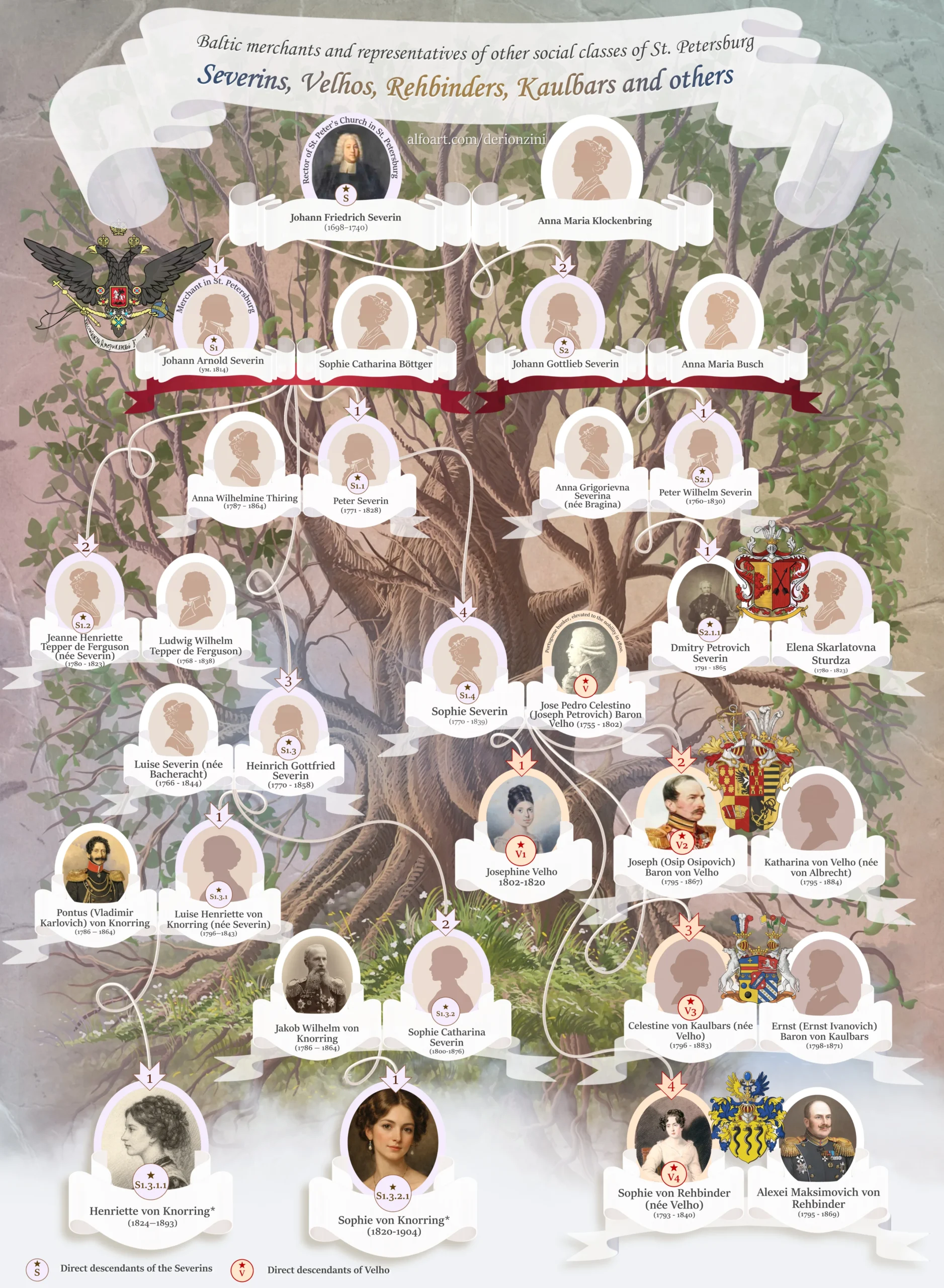
4. Mama – Sofia, née Severin (1800 St. Petersburg – 1876 Paslep), daughter of Heinrich Severin, a St. Petersburg entrepreneur, banker, and director of the Russian-American Company, and Louisa, née Bacheracht, a representative of another dynasty of St. Petersburg merchants and bankers.
5. Sisters – Helene (1822 Revel – 1900 Revel) and Louisa (1825 Revel – 1906 Hapsal). In 1841, they were 18 and 15 years old.
6. Condoléances visite — the author uses the French expression (a visit of condolence), which was highly typical of the nobility’s language at the time.
7. Funeral – this refers to the death of the fourth, youngest sister, Katharina (1837 Revel – 1840 Paslep), who died in December 1840.
8. Lückholm — currently Saare, an estate near Hapsal and Paslep. At the time described, it belonged to the von Rosen dynasty.
9. Natalie – likely Natalie von Rosen, the youngest daughter of the estate owner, sister of the writer Yegor Rosen, who authored the libretto for the Russian national opera A Life for the Tsar.
10. Otto von Kursell ( – 1885), owner of the Sinalep estate (now within the territory of Haapsalu). Son of Colonel Otto Kursell of the Starodubovsky Cuirassier Regiment. Retired major. Kursell (von Kursell) is an ancient noble family of Baltic Germans. Notably, the suitor’s cousin, Alexander Kursell, later commander of the Life Guards Uhlan Regiment, belonged to it and played a significant role in the life of the poet A. Fet.
11. “Mr. von Kursell asked Papa for my hand”: This describes the typical method of matchmaking in 19th-century noble families: the decisive step is taken not before the girl, but before her father. The suitor goes to “ask for her hand” personally and officially.
12. Absence of a direct conversation with the girl — the young woman learns of the proposal only after it has been made to her parents. This was the norm of the era. However, the liberal currents of the time allowed the girl to have an opinion on whether to accept the proposal or not.
13. entrusted this whole affair to the faithful Lord — this fragment vividly illustrates Sophie’s Protestant (Lutheran) worldview: she comprehends all difficult life decisions through the prism of Divine Providence and prayer.
14. Kedik — an estate near Hapsal (Haapsalu). It belonged to her father’s brother, Pontus von Knorring. Their mother, Sophie’s paternal grandmother, lived there at the time.
15. Betty K. — Elisabeth (Betty) von Kursell, the rejected suitor’s sister. A sister’s visit to act as a “matchmaker” or negotiator, when the suitor’s direct approach was spurned, is a highly characteristic detail of the noble etiquette of the time.
16. Neuenhof — an estate at the entrance to Haapsalu, modern Estonian name: Uuemõisa (now a suburb of Haapsalu). At the time described, it belonged to the von Gernet dynasty.
1. The Ungerns, more accurately Ungern-Sternbergs — a widespread family known in the Baltics since the 13th century. Sophie repeatedly mentions representatives of this dynasty as her neighbors and friends. The local Ungern-Sternbergs were descendants of Reinhold Ungern-Sternberg from the Linden estate (Est. Ungru), who earned the favor of Tsar Peter I by signing the capitulation of Estonia in 1710 on behalf of the knighthood. His grandson Ludwig U.-S. is infamous for setting up false lighthouses on the island of Dago to lure passing ships aground and seize their cargo. The affair caused an international scandal and tarnished the reputation of Tsar Alexander I, who was forced to exile the plunderer to Siberia and establish a lighthouse department under the Naval Ministry, whose head was stationed in Revel rather than St. Petersburg. The descendants of Christian Renatus U.-S., the enterprising sea robber’s brother, owned the Linden estate (Ungru is still named in their honor) until the land reform of 1919, along with a dozen other manors, including the Birkas (Pürksi) estate near Hapsal. Among them were many worthy individuals—officers, diplomats, and even entrepreneurs—but popular history remembers only one: Roman Fyodorovich U.-S., leader of the anti-Bolshevik movement in Mongolia.
1. Pauline Ungern (1816 Pürksi – 1895 Pürksi) — the youngest daughter of Carl Ungern-Sternberg, owner of the neighboring Birkas estate (modern Est. Pürksi) and former owner of the Paslep manor. A casual mention by first name indicates close ties between the neighboring landowners. Her mother was the daughter of von Rosen, owner of the Lückholm manor. The manor house of the Birkas (Pürksi) estate. It is now used for the needs of the local gymnasium.
Chapel (Kapelle) — the family vault where her sister had recently been laid to rest.
2. Fräulein M. V. – the governess to the Knorring sisters. More on her below.
3. Grandmamma – Helene Knorring, née Lantinghausen, in her first marriage Kaulbars (1761 Revel – 1843 Kedik).
4. Wedding of the Heir to the throne: This refers to the wedding of Tsesarevich Alexander Nikolaevich (the future Emperor Alexander II) and Princess Marie of Hesse (Maria Alexandrovna), which took place in April 1841.
5. Pastorate – the estate of the parish pastor, located in the village of Hosby, halfway between the Knorrings’ Paslep and Kedik manors. It is also the site of St. Catherine’s Church (the Nuckö parish) and the cemetery.
6. Carlbloms – a dynasty of Estonian pastors. This refers to Agnes Carlblom, née Ungern-Sternberg, wife of Pastor Johannes Carlblom, who served as pastor of St. Catherine’s parish in Noarootsi from 1816 to 1861. Pauline Ungern was her sister. Judging by the text further on, Sophie frequently visited them at the pastorate. The Carlbloms and Knorrings were close family friends.
7. Nuckö: Once an island, now the Noarootsi peninsula north of Haapsalu. At that time, it was populated predominantly by Baltic Swedes and Germans, which is why Sophie notes that the sermon was explicitly German (deutsche Predigt) and not Swedish or Estonian.
8. Krummacher: Friedrich Wilhelm Krummacher — a highly popular Reformed preacher in the 19th century. His published sermons were frequently read in pious Protestant households in the mornings or on Sundays instead of attending church.
9. 20 degrees: The Russian Empire and the Baltics utilized the Réaumur scale at the time. 20°R equates to 25°C — an exceptionally warm, truly summery day for May in Estonia.
10. Knoblochs – a dynasty of Revel physicians. In 1841, Gottlieb Knobloch (1789 – 1862) owned the Echmes estate. But this likely refers to visiting the Knoblochs in Hapsal. The town was a popular summer retreat, drawing nobility from all over Estonia. The Kurhaus, where people gathered to pass the time, still stands on the bay’s shore to this day. Cf. the poem Hapsal’s Casino (1824).
11. Papillotes and chalk on the mirrors: The author caught the hostess during a deep clean or renovation. Mirrors and windows were frequently rubbed with a mixture of chalk and water, then wiped to a shine with a dry cloth—this was the classic method for cleaning glass in the 19th century. Papillotes (paper or fabric tubes used for curling hair) indicate that Madame was caught in her domestic deshabille.
12. Eugenie U[ngern] – the eldest daughter of Adolf Ungern-Sternberg, an officer of the Grodno Hussars. Through her mother, Ekaterina Pishchevich, she was related to General Shevich and the Chief of Gendarmes Benckendorff, as well as being a distant relative of Natalya Nikolaevna Pushkina. Married to Baron Ottokar Loudon from 1844, she was the mother of the artist Elli von Loudon, whose works are held in collections including the State Hermitage. The familial and marital ties of Eugenie Ungern serve as a vivid illustration of Alexander Blok’s line: “The nobles are all kin to one another.”
13. Upon arriving in Neuenhof, we were received very amiably – the siege continues. The daughter of the owner of the Neuenhof estate, Julia Gernet, had been married since 1837 to August von Kursell, the suitor’s brother.
14. General’s wife Stackelberg – likely the widow of General Strandmann, née Charlotte Stackelberg (1767-1842), mother of Cavalry General Carl Strandmann, whom Sophie would later encounter in St. Petersburg.
Stackelbergs – a sprawling noble and countly family known in the Baltics since the 16th century. By the 19th century, they had branched into at least 23 lines. Here, the Stackelbergs are descendants of the Swedish General Carl Adam von Stackelberg (1669-1749), who entered the service of Peter I in 1723. According to S. Gavrilov’s hypothesis, it was A. Stackelberg who, as the head of the “Holstein party” at the Russian court, orchestrated the coup in favor of Empress Elizabeth Petrovna (see “Baltic Germans in St. Petersburg. Russia between Schleswig and Holstein”). His great-grandson Peter Stackelberg (1762-1826), the strict General’s wife’s brother, founded the branch of the dynasty that owned the Riesenberg (Riisipere) estate, as well as Putkas on the island of Dagö (Hiiumaa), Sutlema, and others. According to the memoirs of Prince P. Vyazemsky, who visited Riesenberg in 1826: “a castle of quite beautiful appearance presented itself on the road… the master of the castle, a 70-year-old man, Baron Stackelberg, caught sight of us and, after having us asked for our names some three times, invited us in and treated us to excellent coffee. His manor is Riesenberg: the house is vast and well-built, furnished entirely by his own people, and costs 28 thousand, though by our estimation—closer to a hundred thousand. He has a wife and many children, but they are all scattered,” meaning they had moved away. The sons Konstantin and Eduard joined the Life Guards Grodno Hussar Regiment: “The 2nd squadron, to which I was assigned, was commanded… by Eduard Stackelberg, under whom I was already a staff-captain and soon received a squadron myself…. The 6th squadron was commanded first by Aderkas, then by Konstantin Stackelberg (he soon married the daughter of the merchant Kramer, and I was his groomsman).” (Lermontov in the Life Guards Grodno Hussar Regiment: Arnoldi). Sophie is likely referring to one of them, who would have still held the rank of lieutenant at the time.
16. Hunnius: This refers to Carl Abraham Hunnius (1797–1851), the renowned physician who opened the first mud baths in Hapsal in 1825. It was precisely thanks to him that Hapsal (Haapsalu) became an imperial resort. Carl Hunnius was married to Alexandra Ungern-Sternberg, sister of the aforementioned Agnes Carlblom and Pauline, as well as Adolf Ungern-Sternberg.
17. Russian church: It is unclear exactly which Orthodox church in Haapsalu was meant (likely a temporary or house church, as the stone Church of Mary Magdalene would be built slightly later). The fact that the Baltic German Eugenie von Ungern is taking Communion there is a fascinating interfaith nuance. Her mother, Ekaterina Pishchevich, was Orthodox. Under Imperial law, a child born into a marriage where at least one parent was Orthodox had to be baptized Orthodox as well.
18. Reception in Neuenhof: although Sophie had refused, the rejected suitor’s family continues their efforts to arrange a meeting. On this page, they happen to cross paths at a social gathering at the Neuenhof estate. The daughter of the estate owner, Johann von Gernet, Julia (1819-1886), had been married since 1837 to August Kursell, the suitor’s brother. Her sister, Hedwig von Gernet (1821-1884) attempts to smooth over the awkwardness of the situation.
19. Meeting with K…: A dramatic scene! The rejected suitor (Otto von Kursell) pointedly ignores Sophie when they meet at Neuenhof, failing to greet her, which causes her to feel terribly uncomfortable (fatal in the German of that era meant not “deadly,” but rather “torturous/exceedingly unpleasant”).
20. Crossed over on the Hapsal boat – the shortest route to the estate was directly from Hapsal across the bay by boat.
21. French loanwords: The text is peppered with Gallicisms, typical of the nobility. Sophie writes “soupirten” (from Fr. souper — to sup), “décontenancirte” (from Fr. décontenancer — to disconcert, to embarrass), “conversation” instead of their German equivalents.
22. Pentecost (Pfingsten): An important ecclesiastical and secular holiday. The girls are hurriedly sewing new dresses (hemming the skirts — die Säume) so as to be ready to dress up for Pentecost.
23. Aunt Minna and Pyotr And[reyevich] Severin – Sophie’s St. Petersburg relatives, her mother’s sister and brother.
24. Madame MacDonald – likely one of the daughters of the Marshal of France, Étienne-Jacques-Joseph-Alexandre MacDonald. A rather telling detail indicates the vast scope of the social connections maintained by Sophie’s parents.
25. Knorrings from Weissenfeld – representatives of another branch of the Knorrings, who owned the neighboring Weissenfeld (Kiltsi) estate: Gustav von Knorring, his wife Ekaterina, née Rüdinger, and his sisters. A poem, evidently penned by Ekaterina Rüdinger, satirically exposing the mores of the Hapsal resort-goers, can be found below.
26. Kursell’s change of mood: While on the previous page the rejected suitor Kursell ignored Sophie, here, on her name day, he is “very amiable” and approaches her himself to strike up a “long conversation.” May 15th — Name Day (Namenstag): This is a crucial detail! May 15th was the feast day of Saint Sophia. The guests are arriving to congratulate her on her name day. The relationships within high society continue to evolve!
27. “Proklamirt wird” (Announcement of betrothal): Mademoiselle V. gossips with Sophie, predicting that following Sophie’s refusal, the spurned Kursell will announce his engagement to another girl that very week (in the Lutheran tradition — Proklamation, the public reading of the bride and groom’s names in church several weeks prior to the wedding).
28. The moon shone so romantically, and the nightingales sang, and there was a certain sadness in my heart… – It seems Sophie has succumbed to Kursell’s charm and the song of the nightingales.
29. Dückers – neighboring landowners from the Hardo estate, they lived in Hapsal: Adolf Dücker (1804-1842) and his wife Pauline, née Vietinghoff. Alternatively, it could be his brother Robert, the father of Admiral Richard Dücker.
30. Withering gaze: Sophie writes that a certain Madame Stackelberg, “mich durch ihren blicken zu boden drücken wollte” (“wished to nail/crush me to the ground with her gaze”). Sophie had to muster all her courage simply to continue pouring tea calmly. This was likely that very same General’s wife who disapproved of Sophie rejecting such an advantageous match.
31. Romance and social pressure: This page reveals the drama of the diary’s author: the rejected Kursell once again seeks a meeting. At the tea table, the young woman endures intense emotional pressure, but during the walk, Kursell behaves politely and escorts her to the boat crossing.
32. Weissenfeld and Linden: Weissenfeld and Linden are located near one another along the road from Hapsal to the sea. A stroll along the road to Linden was the classic high-society promenade of the time.
33. Droshky (Dorschka): In the original, Sophie uses the Germanized Russian word “Dorschka” instead of referring to German carriages, which was a frequent occurrence in the speech of Baltic Germans who had absorbed elements of Russian culture.
34. Hostess of the house (Die Knorring) or one of her husband’s sisters, who, being unmarried, lived with their brother’s family, asked Sophie to act as hostess at the tea table (pouring tea was an honorable duty for young, unmarried ladies). It was a blatant attempt to force Sophie to interact with Kursell.
35. The crossing was very pleasant; the nightingales sang magnificently – Sophie is clearly in elevated spirits following her walk with Kursell.
36. Huber’s sermon: Sophie mentions reading the sermons of Victor Aimé Huber — a well-known 19th-century German publicist and literary scholar whose works, including those of a Christian nature, were actively read in conservative noble circles.
37. Servants were not at home: The entry for Tuesday vividly illustrates the realities of manor life. If the house serfs/servants were absent (likely for a church holiday or labor duties), the noble ladies had to “see to everything themselves” — which, judging by Sophie’s tone, was perceived not as a tragedy, but merely as a disruption of their usual routine.
38. To the Stackelbergs for tea, they were all surprisingly friendly: this time the Stackelbergs (the very same ones where the General’s wife had tried to incinerate Sophie with a look) turned out to be “surprisingly friendly.” Otto von Kursell’s relatives are doing everything in their power to win Sophie over to Kursell. Why Sophie’s mother chose to take her daughter to see them, however, remains unclear.
39. Pyotr And[reyevich]’s health – Sophie mentions her uncle several times; he was living in Hamburg at the time, evidently seeking medical treatment. Certain phrases suggest she felt a stronger affection for him than for her other relatives.
40. The return of music: The mention that Mama sat at the piano and accompanied her “for the first time since this tragic winter” brings us back once more to the very beginning of the diary — to the recent death of Sophie’s beloved sister. Singing and learning romances become a symbol of the family’s gradual return to life following their period of mourning.
41. Falbala: A fashionable term of the era. This refers to a wide ruffle or flounce used to trim the hems of women’s dresses.
42. Fourth Commandment of the Lutheran catechism (the fifth in Orthodoxy): “Honor thy father and thy mother.” Reading this sermon, judging by the entry, evidently triggered an internal conflict within Sophie.
43. St. John’s Day in Revel: Sophie writes that she wishes to travel to Revel (Tallinn) to take Communion, but fears being there on Johannis (St. John’s Day, June 24th on the Gregorian calendar). St. John’s Day was one of the loudest and most massive celebrations in Estonia, complete with fairs, festivities, and bonfires, which was completely at odds with her pious mood.
44. Spiritual crisis: The entry from May 27th-28th is a classic example of Protestant (Pietist) reflection. Sophie feels guilty for enjoying “worldly things” (balls, beautiful dresses, social chatter) and describes a state of spiritual emptiness and apathy. This is a remarkably sincere and profound passage that illustrates her internal struggle.
45. Revealing the mystery of “Fräulein V.”: On this page, Sophie writes out her companion’s surname in full for the first time: Fräulein Wiedemann. This is likely Amalie Christine Charlotte Wiedemann (1800 – ?), sister of the famous linguist Ferdinand Wiedemann (1805, Hapsal — 1887, St. Petersburg) — an academician of the St. Petersburg Academy of Sciences and a founder of Finno-Ugric studies in Russia. Sophie occasionally refers to her by the name Amalie in the diary. It is possible Amalie Wiedemann was the Knorring sisters’ governess.
46. Embroidering names on chemises: The phrase “die Namen zu Hemden” means embroidering initials or monograms onto undergarments. In the 19th century, linen was sent out to be washed in large batches (often to laundresses outside the home), so marking every shirt with the owner’s initials was a mandatory, routine chore for ladies and servants alike.
47. Sang for over an hour – Sophie pursues her singing on an almost professional level. See further details on this in the following chapters.
48. Rehbinders: A famous Baltic country and noble family. In this instance, it likely refers to Sophie’s relatives on her mother’s side. Her cousin, Sofia Velho, known from the early poems of A. Pushkin (see the blog), was married to General Alexei Rehbinder. By this time, however, Sofia Rehbinder-Velho had passed away. Exactly which of the Rehbinders intended to visit the Knorrings is not entirely clear.
National Archives of Estonia (EAA). F. 1334. Inv. 1. F. 78. EAA.1334.1.78 Tagebuch der Sophie von Knorring. [Diary of Sophie von Knorring. Volume II] (1841–1842).
To be continued…
Discover more from Strahlborn and De Rionzini
Subscribe to get the latest posts sent to your email.

The diary becomes increasingly detailed, describing the daily life, travels, weather, and domestic pursuits of the Baltic nobility. The calendar on this page aligns perfectly: if May 3rd was a Saturday (as on the previous page), the entries here flow seamlessly from Sunday, May 4th, through Friday, May 9th.