The AI “Kiss”
From Illustration to Reconstruction. The AI “Kiss”
Article Author: Historian Sergei Gavrilov
One sometimes gets the distinct impression that modern neural networks can do absolutely everything.
They write texts, compose music, and paint pictures gracefully stylized to any given era. The next logical step, naturally, was to hand them a task researchers had puzzled over for years: visualizing the world of Pushkin.
But it is precisely here that the unexpected occurs.
🎨 The Illusion: Neural Networks as a Pushkinist’s Tool
The initial idea was quite delightfully simple.
If a neural network is perfectly capable of:
- Reproducing artistic styles
- Combining compositions
- Building scenes
…then why on earth not use it to reconstruct a sketch by Pushkin? In our correspondence, we discussed various experiments with Midjourney and other such tools. In Alexandra’s publications, nineteenth-century scenes had materialized with the greatest of ease:
- Correct costumes
- Atmospheric lighting
- Plausible interiors
Take, for instance, the image of a running noblewoman: “one of the options pleased me on the very first try.”
At this stage, it seemed that just a little more effort would allow us to neatly “illustrate Pushkin.” But! When we actually attempted to have the AI “finish” Pushkin’s sketches, a rather curious fact emerged:
Pushkin is one of those authors who stubbornly resist algorithms.
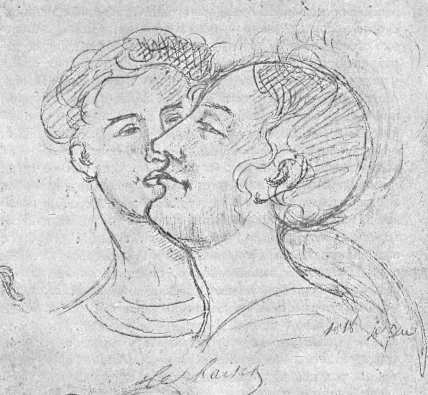
And this became most glaringly obvious in the case of one rather small drawing—”The Kiss.”
💋 A Drawing That Gives Researchers No Peace
Pushkin left behind a splendid multitude of graphic sketches in his manuscripts—from simple profiles to amusing caricatures.
Yet “The Kiss” occupies a rather special place among them.
Firstly, it happens to be one of Pushkin’s earliest genre drawings—
not merely a portrait or a passing stroke, but a fully-fledged scene involving actual action.
Secondly, this drawing has long attracted the keen eye of researchers.
Abram Efros, a pioneer in the study of Pushkin’s graphics, believed that “the drawing imitates academic schemes” and that “The Kiss of 1818 could well be a copy, or at the very least, a variation.”
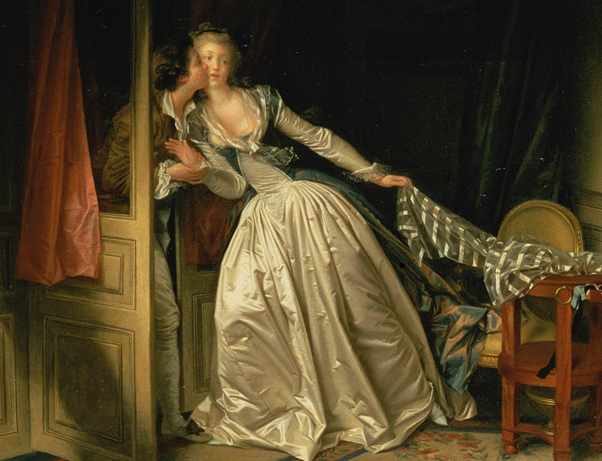
Alexandra instantly made a rather sharp observation: the composition of Pushkin’s “The Kiss” bears a striking resemblance to Fragonard’s painting, “The Stolen Kiss.”
Here, a third and quite unexpected dimension presents itself:
— Could Pushkin, consciously or subconsciously, have taken his cue from Fragonard?
The history of the painting’s time in Russia offers no straightforward answer to this little puzzle. It might possibly be a copy of a copy. It is known that the Velho sisters copied paintings by European artists during their travels abroad. However, Alexandra finds it highly unlikely that Pushkin would have copied from ladies’ albums: the painting’s subject matter was far too provocative for the moral standards of the early nineteenth century.
This very similarity became one of the main reasons we decided to examine the drawing as a possible:
- Reworking
- Quotation
- Or even an attempt to reimagine a Western European model
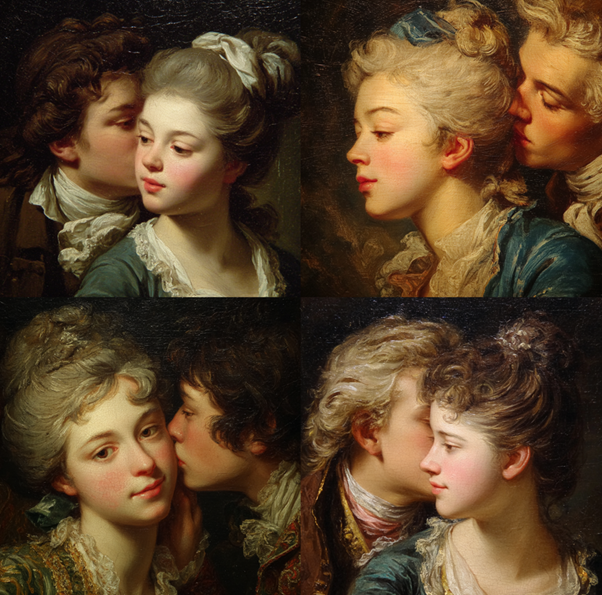
To test this, we politely asked the neural networks to develop Pushkin’s sketch into a full, painted picture.
⚙️ Where the Impossible Begins
Pushkin’s “The Kiss” is not merely a scene.
It is a rather tangled knot:
- Biographical
- Cultural
- Visual
And all of this must somehow be tied together.
But the neural network begins to quite literally fall to pieces when attempting to hold onto:
- Specific characters
- Their interrelationships
- And the required composition
“Absolutely everything appeared, except the scene we actually wanted.”
The AI is perfectly capable of producing a beautiful image,
but it is entirely incapable of grasping the historical meaning of the scene.
🧩 From Generation to Assembly
Gradually, it became delightfully clear:
pure AI simply does not work here.
Instead of generation, one must resort to assembly:
- The character is created separately
- The background separately
- The details separately
- Then everything is stitched together by hand
Sometimes the final image consisted of several elements (up to five or ten). In truth, this was no longer generation at all, but rather visual montage.
🎭 The “Kiss” Test
It was precisely the scene of “The Kiss” that became our primary test.
Because it demands, all at once:
- Precise composition
- Recognizable faces
- Historical authenticity
- And emotional tension
Add to this the hypothesis of a possible connection to Fragonard—
and the task becomes something approaching a proper art history problem. But the result was rather telling. Despite all our attempts to:
- Input exact prompts
- Use references
- Combine elements
—the scene simply refused to come together.
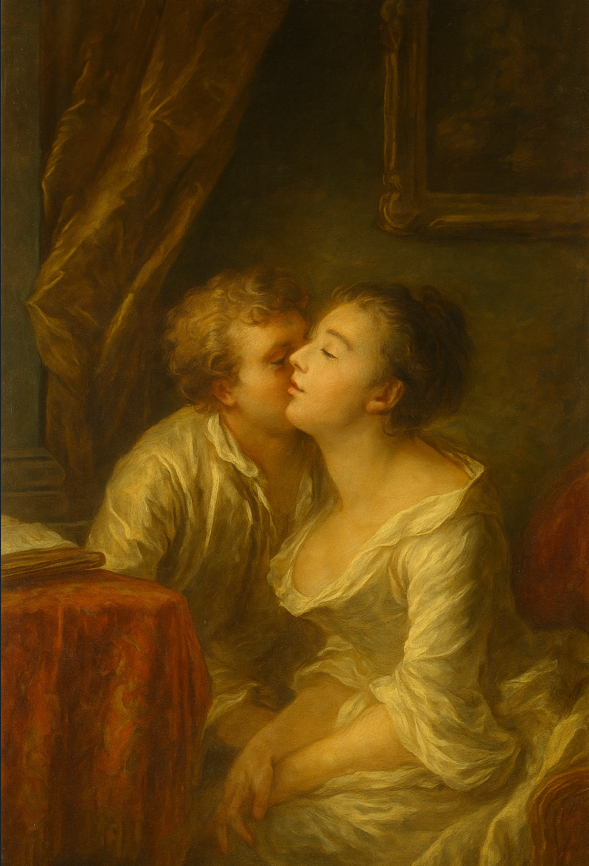
And in the end, the conclusion proved to be remarkably honest: “There is no need to Photoshop the kiss—it was merely an experiment.”
🧠 Why This Matters
This experience proved valuable not for what actually worked,
but for what completely failed.
It vividly demonstrated the absolute limits of AI.
AI performs splendidly when presented with:
- Typical imagery
- Repeatable patterns
- An averaged aesthetic
But it becomes hopelessly lost when faced with:
- Cultural memory
- Complex intertextuality
- Authorial intonation
And a drawing by Pushkin is precisely such a case.
🧾 In Lieu of a Conclusion: “And you shall be left wondering“
At some point, we had rather fondly expected that artificial intelligence might help us better understand Pushkin.
It turned out to be quite the opposite. Pushkin helped us better understand artificial intelligence.
And it became quite clear that even the most advanced modern technologies
cannot possibly replace what has existed for two hundred years:
— reading,
— interpretation,
— and the careful handling of imagery.
Because “The Kiss” is not merely a drawing.
It is a question. And, much like Pushkin once did, we find ourselves left wondering—does AI really help at all?
💋 A Hooligan’s Experiment with “The Kiss.” But What If?
But what if we were to reconstruct the kissing scene based on a rather well-known incident: Pushkin the lyceum student, the dark corridor of the maids of honor’s quarters, and a fatal error—embracing a princess instead of a maid.
“Pushkin, to his misfortune, was alone, heard the rustle of a dress in the dark, imagined it simply must be Natasha, and threw himself to kiss her in the most innocent manner. As luck would have it, at that precise moment the door from the room opened, illuminating the scene: standing before him was Princess Volkonskaya herself.” (I. Pushchin. Notes on Pushkin)
It is an almost theatrical story. Absolutely ideal material for visualization.
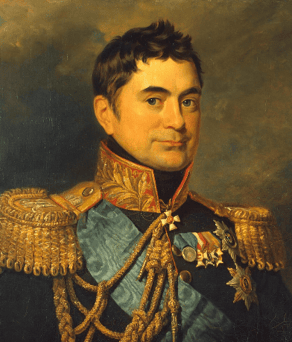
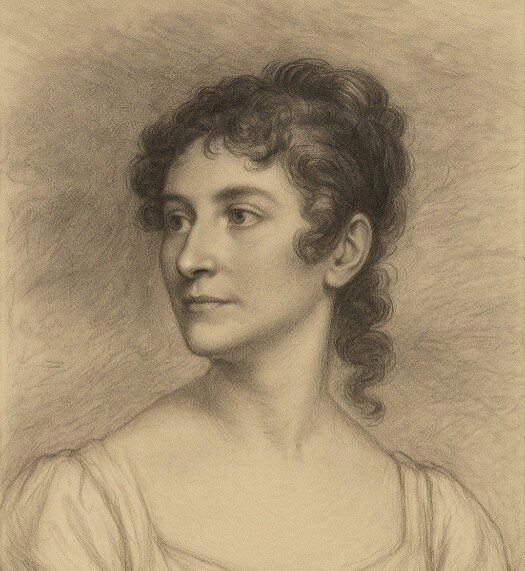
The difficulties began with trying to locate an accessible image of Princess Volkonskaya. As it turns out, there is not a single surviving portrait of Varvara Mikhailovna. Whatever to do? Eureka! There are mountains of portraits of her brother, the Most Serene Prince Pyotr Volkonsky. So, we fed the following task into the prompt: transform the bust portrait of the brother into a pencil portrait of the sister, age 45, in appropriate attire:
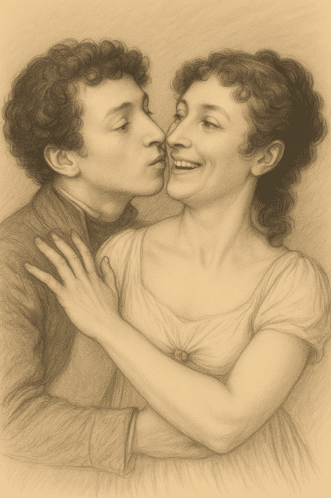
We take Pushkin the lyceum student—perhaps from the famous painting by Repin.
We ask the AI to imagine the kissing scene from the exact same angle as in Fragonard’s painting. Into the prompt we also slip Tsar Alexander’s rather famous remark, “La vieille est peut-être enchantée de la méprise du jeune homme, entre nous soit dit” (The old maid is perhaps delighted by the young man’s mistake, strictly between us)—just to give the drawing the lively feeling of a kiss stolen not entirely against the victim’s will.
Hooliganism? Assuredly. But entirely in the style of Pushkin the rake. It seems things aren’t quite so hopeless between Pushkin and neural networks after all…
To be continued:
📚 The Second Thread: Not Illustration, but Identification
In parallel, another piece of work was underway—not so much artistic as purely investigative. An attempt was made using AI to:
- Compare Pushkin’s sketches with real historical figures
But here, too, the result proved rather double-edged:
- A likeness was achieved
- Definitive proof was not
The AI helped us visualize the hypothesis, but it simply could not confirm it.
Discover more from Strahlborn and De Rionzini
Subscribe to get the latest posts sent to your email.
